


In the alchemical tradition, “stress response herbs” refers to spagyric tinctures, Ormus mineral preparations, and botanical aromatic elixirs used as ritual supports for energetic and emotional recalibration — not as pharmacological treatments. Practitioners use them daily in small, intentional doses to anchor the nervous system, create space within contemplative practice, and restore a sense of inner order when depletion sets in. Think of them as tools for the biofield rather than the bloodstream.
- Spagyric tinctures: Drop-based plant extracts prepared through alchemical separation, purification, and recombination of a plant’s Sulfur, Mercury, and Salt principles
- Ormus minerals: Monoatomic mineral preparations linked to the Orbitally Rearranged Monoatomic Elements (ORMEs) concept, first researched by David Hudson in the late 1970s
- Botanical aromatics: Ritual mists and elixirs (like Kejiwa Alchemy’s Jasmine Passion Alche-Mist) used for emotional grounding and energetic clearing
These three forms are the heart of what Kejiwastore offers — and what this guide will help you understand, use safely, and choose wisely.
Table of Contents
- What are stress response herbs in an alchemical sense?
- How do these preparations work energetically?
- How to use these preparations in daily practice
- How to choose a quality alchemical product and maker
- Safety and legal guidance for U.S. readers
- Simple ritual recipes you can try today
- What should you realistically expect?
- Key Takeaways
- Why alchemical ritual matters more than the herb itself
- Kejiwastore’s handcrafted ritual preparations
What are stress response herbs in an alchemical sense?
The term “stress response herbs” means something specific in this context. These are not standardized capsules from a supplement aisle. They are handcrafted preparations designed to work on the energetic and spiritual dimensions of your experience, alongside the physical.
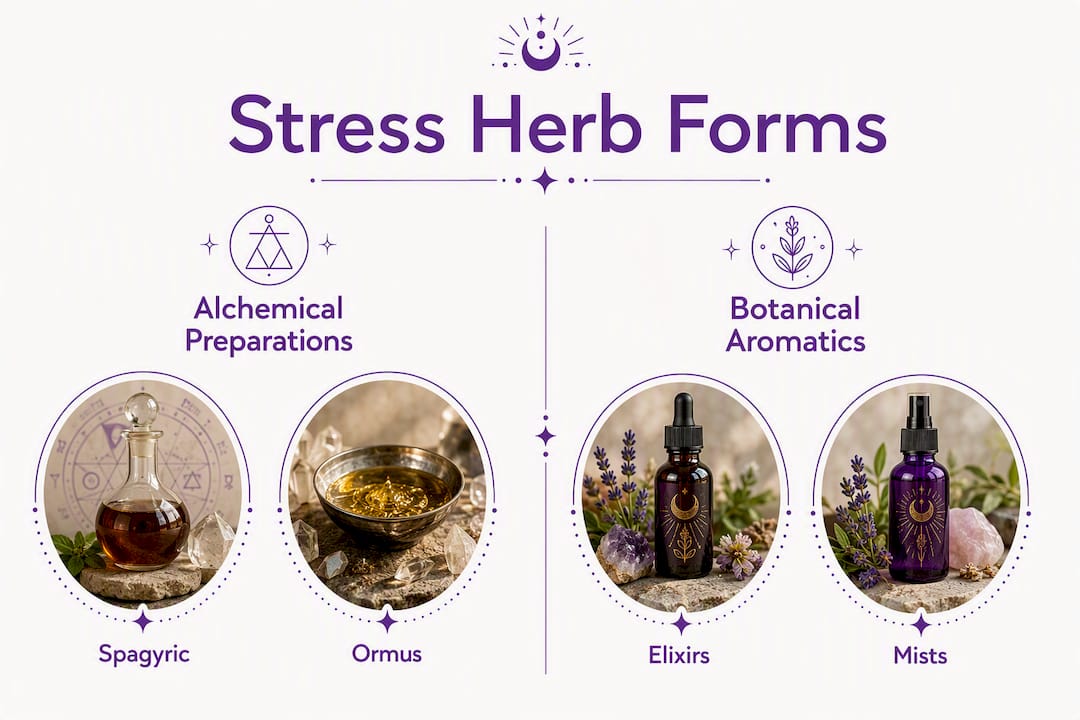
Spagyric tinctures
Spagyric preparations separate, purify, and recombine a plant’s three alchemical principles — Sulfur (the plant’s essential oils and volatile constituents), Mercury (the plant’s alcohol-soluble compounds), and Salt (the mineral body). The result is a highly concentrated remedy that carries the plant’s full spectrum: physiological, energetic, and symbolic. Because the mineral salts are reintegrated, effective doses are small — typically a few drops rather than a full dropper. You can read more about spagyric herbal medicine benefits to understand why this method produces something qualitatively different from a standard tincture.

Ormus minerals
Ormus refers to mineral-rich preparations associated with ORMEs — Orbitally Rearranged Monoatomic Elements. David Hudson’s research in the late 1970s brought this concept into modern alchemical circles. Practitioners describe Ormus not as a supplement that acts on the body biochemically, but as a preparation that interacts with consciousness and life-force energy. It is often made through alkaline precipitation of sea salt or seawater.
Botanical aromatics
Aromatic elixirs and mists occupy a different register entirely. They work through scent, intention, and the ritual act of application. A product like Kejiwa Alchemy’s Jasmine Passion Alche-Mist is designed to shift your energetic state in a moment — a midday reset, a pre-meditation clearing, or an evening settling. The role of aromatherapy in ritual is well-documented in contemplative traditions, and these mists bring that practice into an accessible daily format.
| Form | Primary Action | Typical Use |
|---|---|---|
| Spagyric tincture | Energetic and physical integration | Morning or evening, drop-based |
| Ormus mineral | Consciousness amplification | Paired with meditation or breathwork |
| Botanical aromatic | Emotional and sensory grounding | Midday reset, ritual opening |
Pro Tip: Keep each form in a dedicated spot — tincture by your morning water, Ormus near your meditation cushion, mist on your desk. Consistent placement is itself a sensory anchor that primes your nervous system before you even take the dose.
How do these preparations work energetically?
These preparations act as ritual anchors and energetic amplifiers, not pharmaceutical agents. That distinction shapes everything about how you use them and what you can reasonably expect.
Spagyric practitioners describe the value of their work as operating on a plant’s “energetic order” — the symbolic and vibrational depth that biochemical analysis cannot fully capture. When you take a spagyric tincture with intention, you are not just ingesting plant compounds. You are entering a relationship with the plant’s full alchemical signature.
Ormus functions differently. Proponents describe it as an amplifier for inner work — most effective for those already engaged in meditation, breathwork, or self-inquiry. It does not create a state; it deepens access to one you are already cultivating.
Think of it like a tuning fork. The fork does not create music on its own. It reveals the resonance already present in the instrument. These preparations work the same way: they support your capacity to notice, settle, and recalibrate. Community reports suggest Ormus and spagyric approaches may facilitate alpha and theta brain-wave states during meditation, though these claims remain anecdotal and lack controlled clinical replication.
Pro Tip: Before taking any dose, take one slow breath in through the nose and out through the mouth. This single breath signals the body that something intentional is happening — and that pause is often where the real recalibration begins.
How to use these preparations in daily practice
Start simple: choose one preparation, one time of day, and commit to it for one week before adding anything else.
Ritual success depends on consistency and simple sensory anchors — a breath before a dose, a consistent location, a moment of stillness. These cues train the body to recognize the ritual as a reliable pause point. For guidance on weaving botanicals into a broader practice, ritual botanical use offers a practical framework.
- Choose your anchor. Pick one preparation: a spagyric tincture for morning grounding, Ormus for pre-meditation, or an aromatic mist for midday resets.
- Set your dose. Spagyric tinctures: a few drops in water. Ormus: begin with a small amount in water, observing changes over time. Aromatic mists: a few sprays at arm’s length.
- Take one breath first. Inhale slowly, exhale fully. This is your transition signal.
- Pair with practice. Follow your dose with 5 minutes of stillness, slow breathing, or journaling. The preparation supports the practice; the practice gives the preparation a container.
- Track subtle changes. Keep a brief daily note — one sentence on your energy, mood, or quality of attention. Patterns emerge over weeks, not hours.
Safety note: If you take prescription medications, are pregnant or nursing, or have known sensitivities to mineral concentrates, consult a qualified healthcare provider before using Ormus or any mineral-based preparation. These are ritual supports, not medical treatments.
How to choose a quality alchemical product and maker
The single most important trust criterion is maker transparency: can you trace the ingredients, the method, and the person behind the product?
| What to look for | What it signals |
|---|---|
| Named ingredient sourcing (organic, wild-harvested) | Maker accountability and quality commitment |
| Batch notes or small-batch labeling | Traceability and care in production |
| Extraction method stated (spagyric, wet method) | Honest representation of the preparation |
| Clear dosing instructions and ritual guidance | Maker experience with actual practice |
| Blog content on nervous-system regulation | Practitioner depth, not just marketing |
Kejiwastore publishes guidance on the alchemical approach to nervous-system regulation alongside its products — a meaningful trust signal that the maker understands the practice, not just the product.
Red flags to avoid: grandiose medical claims (“cures anxiety”), opaque sourcing (“proprietary blend” with no further detail), “instant results” language, and no dosing guidance whatsoever.
Three questions worth asking any maker before you buy:
- Where are your botanicals sourced, and are they certified organic or wild-harvested?
- Can you describe your extraction or preparation method?
- Do you provide batch notes or lot traceability?
Pro Tip: A maker who cannot answer those three questions clearly is not yet ready to support your practice. Transparency is not a bonus — it is the baseline.
Safety and legal guidance for U.S. readers
These preparations are ritual supports, not medical treatments. If you have a diagnosed health condition, please work with a qualified healthcare provider alongside any energetic or herbal practice.
- Medications: Mineral concentrates and plant preparations can interact with certain medications. Disclose all supplements to your prescribing physician.
- Pregnancy and nursing: Avoid Ormus and concentrated mineral preparations during pregnancy or while nursing without explicit medical clearance.
- Children: These preparations are formulated for adult use. Keep them out of reach of children.
- Metal sensitivities: If you have known sensitivities to minerals or heavy metals, approach Ormus preparations with particular caution and start with the smallest possible dose.
- Product purity: Source only from makers who disclose their preparation method and ingredient origins. Purity varies widely in the Ormus market.
If you are experiencing escalating anxiety, panic attacks, or thoughts of self-harm, please contact a licensed mental health professional. These preparations are companions for a stable practice, not substitutes for clinical care.
This article is general information, not medical or professional advice. Confirm current guidance with a qualified healthcare provider or primary source.
Simple ritual recipes you can try today
The fastest way to begin: mist your palms with an aromatic elixir, rub them together, and cup them over your face for three slow breaths before your morning practice. That is a complete micro-ritual.
Morning grounding drop ritual
- Fill a small glass with room-temperature water.
- Add 3–5 drops of your chosen spagyric tincture.
- Take one slow breath before drinking.
- Sit for 5 minutes in stillness or with a simple body scan.
Midday reset mist
- Step away from your screen or task.
- Spray your botanical aromatic elixir 2–3 times into the air or onto your chest.
- Close your eyes, breathe in the scent, and exhale any held tension.
- Return to your work with one conscious breath.
Evening Ormus and breathwork protocol
- Add a small teaspoon of Ormus to water 30–60 minutes before sleep.
- Sit comfortably and practice 4-count box breathing: inhale 4, hold 4, exhale 4, hold 4.
- Repeat for 5–10 minutes.
- Write one sentence in a journal: what you noticed, however subtle.
- Frequency: daily, at consistent times
- Duration: commit to one full week before evaluating
- Journaling prompt: “What did I notice in my body or attention today?”
- Pairing tip: slow, nasal breathing deepens the receptive state for all three forms
For additional ritual structures, spiritual wellness rituals offers a broader cultural map of practice forms.
What should you realistically expect?
Effects from these preparations are usually subtle, cumulative, and ritual-dependent. They are not fast pharmacological fixes, and expecting otherwise sets you up for disappointment.
Most practitioners report an immediate sense of calm cueing — the ritual itself signals the nervous system to downshift, regardless of the preparation. Over days and weeks of consistent use, many describe a gradual increase in resilience: a slightly longer pause before reactivity, a steadier quality of attention during meditation, a gentler relationship with depletion. Herbal ritual products work best as daily companions for emotional steadiness, paired with intentional practice and rhythm.
If you feel overstimulated after starting Ormus, reduce your dose significantly and slow your pace. If you notice no effect after two to three weeks of consistent daily practice, try pairing the preparation more deliberately with breathwork or meditation — the amplifier needs something to amplify. And if the practice feels flat, revisit your ritual design: is your anchor consistent? Is there genuine stillness around the dose?
Key Takeaways
Stress response herbs in the alchemical tradition are spagyric tinctures, Ormus minerals, and botanical aromatics used as daily ritual anchors for energetic recalibration — not pharmacological treatments.
| Point | Details |
|---|---|
| What they are | Spagyric tinctures, Ormus minerals, and botanical aromatics designed for energetic and emotional support in ritual practice. |
| How to start | Choose one preparation, one time of day, and commit to a consistent micro-ritual for one week before adding more. |
| What to expect | Effects are subtle and cumulative; most practitioners notice gradual resilience over weeks, not immediate dramatic shifts. |
| Safety first | Consult a healthcare provider if you take medications, are pregnant, or have mineral sensitivities before using Ormus or concentrated preparations. |
| Choosing a maker | Prioritize transparent sourcing, batch notes, stated extraction methods, and makers who publish practitioner-level guidance. |
| Kejiwastore | Kejiwastore offers small-batch Ormus minerals, spagyric tinctures, and botanical aromatic elixirs crafted for ritual nervous-system support. |
Why alchemical ritual matters more than the herb itself
The most common mistake practitioners make is treating these preparations like supplements — taking them inconsistently, without intention, and then wondering why nothing shifts. The herb or mineral is not the active ingredient. The ritual is.
What Kejiwa Alchemy has understood from the beginning is that the container shapes the medicine. A spagyric tincture taken in a rush between meetings is a different experience than the same tincture taken after one conscious breath, in a quiet moment, with genuine attention. The preparation supports the practice. The practice is where the recalibration actually happens.
There is also a deeper point worth sitting with: these traditions ask you to develop a relationship with the plant, the mineral, the mist — not just consume it. That relational quality is what distinguishes alchemical herbalism from supplement culture. It is slower, subtler, and ultimately more sustainable. You cannot pour from an empty vessel, and no tincture fills it for you. What these preparations do is help you notice when the vessel is low — and give you a ritual moment to tend to it.
Kejiwastore’s handcrafted ritual preparations
Kejiwastore brings together three distinct alchemical forms — each crafted in small batches with organic and wild-harvested ingredients — specifically for practitioners who need real support for their energetic and emotional practice.
The Ormus Minerals collection offers monoatomic mineral preparations designed to amplify your meditation and breathwork. The Spagyric Herbal Tinctures are drop-based, full-spectrum plant extracts prepared through true alchemical separation and recombination. And the Botanical Aromatics collection — including the Jasmine Passion Alche-Mist — gives you an immediate sensory anchor for any moment of the day.
Every product comes with batch notes, clear ritual guidance, and the transparency you need to trust what you are bringing into your practice. If you are ready to build a consistent ritual foundation, browse the collections and find the preparation that fits where you are right now.