


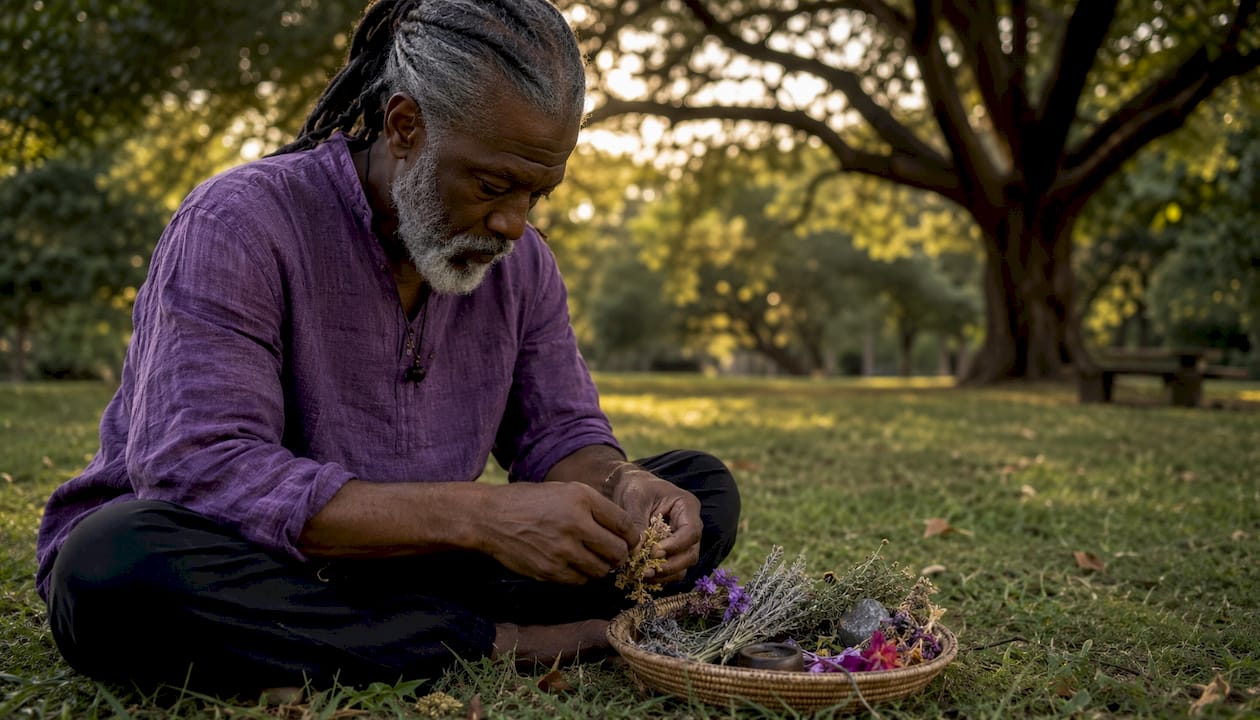
Ritual botanical use is the intentional, structured practice of working with plants within a ceremony or sacred context to create symbolic meaning, mark transition, or shift energetic states. It is not casual herb use. Think of placing fresh rosemary on a home altar to honor an ancestor, or weaving calendula into a garland at a seasonal threshold. Kejiwa Alchemy’s guides and small-batch botanical tools are built around exactly this kind of practice. Research published in MDPI’s Horticulturae journal documented 80 plant species used in structured monthly ceremonies, and Springer’s Naxi ethnobotany study confirmed that ritual plant use ties directly to cultural identity and biodiversity protection. The short version: plants become ritual tools the moment intention and structure enter the picture.
Table of Contents
- Where do botanical rituals actually show up?
- How plants function in rituals: core versus supporting species
- A simple 6-step botanical ritual you can do today
- Why ritual botanical use matters beyond the personal
- Four ritual formats you can adapt right now
- How Kejiwastore supports your botanical ritual practice
- Key Takeaways
- Why plant reciprocity is the practice most people skip
- Kejiwastore’s practice-ready botanical tools
- Useful sources and next-step reading
Where do botanical rituals actually show up?
Spiritual botanical practices appear across four primary domains, each with its own relationship to plants and purpose.
- Symbolic and religious offerings. Plants serve as devotional gifts to ancestors, deities, or the sacred. Marigolds on a Día de los Muertos altar, cedar boughs at a sweat lodge entrance, or a simple bowl of dried lavender on a home shrine all fit here. The plant carries the prayer.
- Life transition marking. Birth, coming-of-age, marriage, grief, and death all call for botanical witness. Rosemary at a memorial, white flowers at a naming ceremony, or smudging herbs at a new home blessing anchor the emotional weight of change in something living and fragrant.
- Seasonal and agricultural observances. Planting, harvest, solstice, and equinox practices tie human rhythms to the land’s cycles. Ethnobotanical research in Western Ukraine documented plant use across seven religious festivals, with 18 taxa persisting continuously across a century of practice.
- Apotropaic (warding) use. Plants placed at thresholds, carried on the body, or burned to clear a space serve a protective function. Neem leaves, black mustard seed, and dried chili are documented warding plants across multiple traditions. In the U.S., cedar, juniper, and black tourmaline-infused sprays serve similar purposes in contemporary practice.
Each domain reflects a different relationship between practitioner and plant. The MDPI Heet Sip Song study confirms that ritual plant use spans all four, often within a single community’s annual cycle.
How plants function in rituals: core versus supporting species
Not every plant in a ritual carries equal weight. Ethnobotanical research among the Nung people of Vietnam found a stratified structure in ritual plant use: a small number of core species play central, repeated roles, while many others serve supportive and context-dependent functions.
| Role | Why chosen | Example plant (U.S.-accessible) | Sourcing tip |
|---|---|---|---|
| Core species | Symbolically necessary, repeated across rituals | Rosemary (remembrance, clarity) | Grow at home; widely cultivated |
| Supporting species | Contextual, decorative, or seasonal | Calendula (offering color, solar energy) | Buy organic; easy to grow from seed |
| Incense/smoke species | Clearing, consecrating space | White sage, cedar, copal | Source ethically; avoid wild-harvested white sage |
| Wearable/garland species | Embodied protection or blessing | Lavender, chamomile | Local farms or home garden |
A few ethical sourcing principles worth holding:
- Wild-harvest with restraint. Take no more than 10% of any wild stand, and never harvest from protected lands without a permit.
- Know your endangered species. White sage (Salvia apiana) is under pressure from overharvesting. Cedar and rosemary are far more sustainable alternatives for smoke-clearing.
- Respect cultural reciprocity. Ethnobotanical fieldwork consistently shows that genuine exchange and long-term relationship are required to access deep traditional plant knowledge. Borrowing a plant’s ritual role without understanding its cultural context is extractive, not devotional.
For practical guidance on selecting smudging herbs, Kejiwastore’s smudging herb selection guide walks through the differences between species and their ceremonial uses.
A simple 6-step botanical ritual you can do today
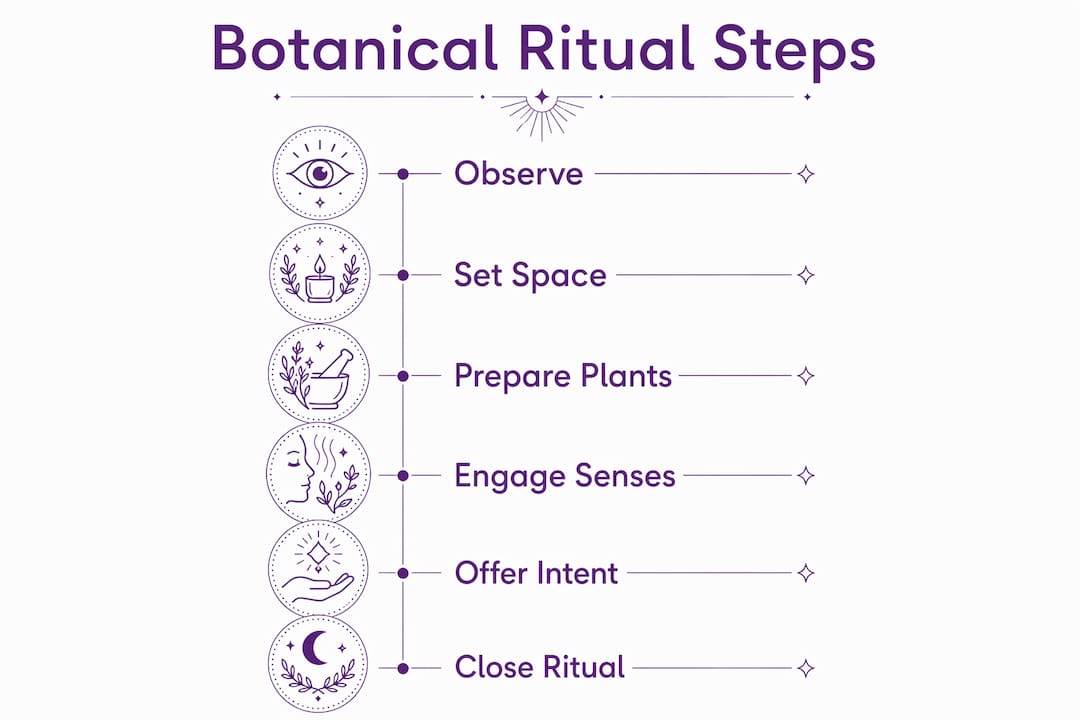
A safe botanical ritual can be a six-step offering and intent-setting practice using locally sourced herbs and conscious breathwork. No elaborate setup required.
Materials:
- One core herb (rosemary, lavender, or cedar)
- One supporting herb or flower (calendula, chamomile, or rose petals)
- A small bowl or plate
- A candle (optional)
- A smoke-free alternative: an aromatherapy mist or infused water if smoke is a concern
Steps:
- Set your materials. Gather your plants and place them on a clean surface. Pause before touching them.
- State your intention aloud. One sentence is enough: “I am here to mark this transition” or “I offer this in gratitude.”
- Attune to the plant. Hold the herb, breathe its scent, and notice its texture. This sensory engagement, what practitioners call plant attunement, is credited with deepening ritual effectiveness more than the materials alone.
- Make your offering or ritual action. Place herbs in the bowl, mist the space, weave a small garland, or simply hold the plant while breathing slowly.
- Close the ritual. Speak a closing word or gesture. Bow, extinguish the candle, or place your hands on the earth.
- Aftercare. Return plant material to the earth (compost or garden), wash your hands, and drink water.
Safety and ethics checklist:
- Check for allergies before handling unfamiliar plants
- Use smoke-free alternatives if anyone in the space has respiratory sensitivities
- Never harvest from roadsides, treated lawns, or protected natural areas
- Avoid any plant listed as threatened or endangered in your state
Pro Tip: Before you use a plant in ritual, spend a week simply observing it. Smell it in the morning, notice how it responds to light and water. Practitioners who build this sensory relationship first consistently report that the ritual feels more alive and less performative.
Why ritual botanical use matters beyond the personal
Botanical ritual shifts perception from consumption to connection. That shift has consequences at every scale, from your nervous system to the local ecosystem.
Personal benefits practitioners report include:
- Grounding during grief or major life transitions
- Embodied awareness of seasonal rhythms
- A felt sense of reciprocity with the living world
The ecological dimension is less obvious but well-documented. The Naxi study found that community rituals protecting sacred sites maintained species and habitat over generations, often more reliably than formal legislation. When a plant’s survival is woven into a community’s cultural identity, people protect it without being told to.
The MDPI Heet Sip Song research reinforces this: ritual plant diversity directly connects to local cultivation practices and managed wild harvest, keeping rare species in active community use rather than passive neglect. Sustainability-focused researchers frame botanical ritual as a route away from consumerism and toward ongoing ecological stewardship. That is not a small claim. It means your personal practice, done with care, participates in something much larger than the altar on your windowsill.
Four ritual formats you can adapt right now
1. Offering/altar ritual Place a small bowl of herbs (rosemary, dried flowers, cedar) on a surface you designate as sacred. Light a candle or mist the space with an aromatherapy elixir. Speak your offering aloud. Leave it for 24 hours, then return the herbs to the earth.
2. Life transition marking Gather one herb that holds personal meaning for the transition (lavender for peace, rosemary for remembrance, rose for love). Hold it during a spoken intention or letter-writing. Smoke-free option: steep the herb in warm water and use the infused water to anoint your wrists or threshold.
3. Seasonal/harvest ritual At each solstice or equinox, bring in plants that are actively growing in your bioregion. Arrange them on a surface, acknowledge what the season is asking of you, and plant one seed as a commitment. This practice directly mirrors the agricultural ritual structures documented across indigenous communities worldwide.
4. Apotropaic/warding ritual Hang dried cedar, juniper, or rosemary at your doorway. Mist the threshold with a botanical aromatic. For an indoor adaptation, place a small bundle of protective herbs in a bowl near the entrance and refresh it monthly.
For smoke-sensitive spaces, aromatherapy in ritual offers a full range of mist-based and infused-water alternatives that carry the same intentional structure without combustion.
How Kejiwastore supports your botanical ritual practice
Kejiwa Alchemy provides handcrafted botanical tools and instructional guides designed for ritual practice and ethical sourcing. Each product type maps directly to a ritual role:
- Spagyric tinctures carry the full-spectrum energetic signature of a plant through an alchemical extraction process. Learn more about what makes spagyric extracts distinct from standard herbal supplements.
- Botanical aromatics and mists serve as smoke-free ceremonial tools for space-clearing, offering, and attunement.
- Smudging herbs from Kejiwastore’s smudging herbs collection are sourced with wild-harvest transparency and small-batch care.
- Guides and blog resources include a full ancestral healing botanical ceremony guide and a sacred plant medicine traditions guide that provide ceremonial structure for practitioners at every level.
All ingredients are organic or ethically wild-harvested, and every batch is made with the kind of intentional craftsmanship that the practice itself calls for.
Key Takeaways
Ritual botanical use is most powerful when intention, ethical sourcing, and plant attunement work together as a single practice rather than separate steps.
| Point | Details |
|---|---|
| Core definition | Ritual botanical use is intentional, structured plant work within ceremony to create symbolic or energetic outcomes. |
| Plant attunement first | Sensory engagement with a plant before ritual use deepens effectiveness more than materials alone. |
| Ethical sourcing matters | Avoid endangered species, harvest minimally from wild stands, and honor cultural reciprocity. |
| Conservation link | Community rituals that tie plants to identity protect species more reliably than legislation in documented cases. |
| Kejiwastore resources | Kejiwa Alchemy’s spagyric tinctures, botanical aromatics, and ceremony guides support practice-ready ritual work. |
Why plant reciprocity is the practice most people skip
Most people who come to botanical ritual are drawn by the aesthetics first: the beautiful altar, the fragrant smoke, the sense of ceremony. That is a fine entry point. But the practitioners who report the deepest shifts are the ones who stopped treating plants as props and started treating them as partners.
The beginner error documented across practitioner resources is exactly this: reaching for plant materials without first building a relationship with them. A sprig of rosemary from a grocery store and a sprig of rosemary you have grown, tended, and spoken to for a season are not the same ritual tool. One is a symbol. The other is a relationship.
Kejiwa’s approach to botanical alchemy is grounded in this understanding. The role of prayer in herbal crafting is not decorative. It is the mechanism by which a practical act becomes a sacred one. And that shift, from consumption to connection, is available to you in any practice, at any scale, starting with whatever plant is growing nearest to you right now. One caution worth holding: always verify local harvesting laws and endangered-species protections in your state before collecting from wild spaces.
Kejiwastore’s practice-ready botanical tools
If you are ready to move from reading about botanical ritual to actually practicing it, Kejiwa Alchemy’s spagyric herbal tinctures are the most direct entry point. These small-batch extracts carry the full energetic and physical signature of the plant, making them ideal for medicine-making rituals, intention-setting, and daily ceremonial use.

For smoke-free practice, the botanical aromatics collection offers aromatherapy mists crafted for ritual space-clearing, offering, and attunement. Both collections come with free access to Kejiwa’s blog guides and ceremony templates. Browse the collections and find the tool that fits your practice.
Useful sources and next-step reading
For deeper study, these are the source types worth consulting:
- Peer-reviewed ethnobotany journals: Journal of Ethnobiology and Ethnomedicine (Springer), Horticulturae (MDPI), and PMC (PubMed Central) all publish accessible, well-documented ritual plant research.
- Community guides and local herbalists: Contact your regional native plant society or a local herbalist for bioregion-specific guidance. Offer reciprocity: time, labor, or financial support in exchange for knowledge.
- Kejiwa Alchemy blog: The elemental rituals guide and sacred smudging guide are practical starting points for practitioners building a personal ritual framework.
- CBD and plant-derived wellness resources: For readers exploring plant-based ceremonial supplements, CBD oils represent one category of modern plant-derived wellness tools used alongside botanical ritual practice.
When reaching out to traditional healers or community stewards, approach with long-term relationship-building in mind. Ethnobotanical research consistently shows that authentic traditional knowledge is shared through sustained reciprocity, not one-time inquiry.
This article is general educational information, not medical, legal, or professional advice. Verify current harvesting regulations and any health considerations with qualified professionals for your specific situation.