


M-state elements, in spiritual wellness circles, refers to Ormus (also called monoatomic gold or monatomic minerals): handcrafted mineral preparations believed to carry a subtle energetic charge for meditation and ceremony. Treat these preparations as ritual and contemplative tools rather than proven ingestible medicine, and only ingest them, if at all, after verifying sourcing and lab testing; for more on responsible preparation and expectations, see THCa Flower Effects: What to Expect and How to Prepare. Choose makers who share ingredient lists, batch records, and test results, as is common among responsible small-batch producers.
TL;DR:
- Ingesting Ormus products poses potential risks, including documented cases of heart issues from prolonged colloidal gold use, so start with small doses and consult a healthcare professional.
- Many products claim to be monoatomic or “m-state,” but scientific evidence does not confirm their atomic claims or safety, and patents only suggest preparation methods, not efficacy.
- Lab testing, ingredient transparency, batch identification, and clear intended use are crucial indicators of a trustworthy Ormus vendor, especially for ingestion products.
- FDA regulations allow vague health support claims but prohibit disease treatment statements; lack of testing info or vague labels signals minimal vendor due diligence.
- The safest use of Ormus involves ceremonial or topical application instead of ingestion, with strict adherence to sourcing, testing, and conservative dosing if ingestion is chosen.
Table of Contents
- What the Ormus Community Means by M-State Elements
- Safety Signals and Toxicology: What the Case Reports Show
- Reading FDA Labels and Claims on Ormus Products
- How to Evaluate and Buy M-State Products
- Ritual and Meditation Uses That Minimize Risk
- Kejiwa’s Perspective: Craft, Transparency, and Guidance From a Maker
- Where to Explore Kejiwa’s Ormus Collection
- Sources
- FAQ
What the Ormus Community Means by M-State Elements
Inside the Ormus world, “m-state” describes a proposed altered condition of certain minerals, gold chief among them, said to shift the material’s energetic signature without changing its outward appearance. You’ll find this language on drops, powders, and altar sprays sold for meditation, energy work, and ceremonial anointing.
The word “monoatomic” gets borrowed from chemistry, but the two usages part ways quickly. In physics, monatomic simply describes single, isolated atoms, like the noble gases. In Ormus circles, it points to a spiritual or energetic quality attributed to precious metals, not a verified atomic structure. That gap matters because mainstream chemistry has not confirmed that stable, isolated precious-metal atoms persist at room temperature in these preparations. A scholarly review of ORMUS claims found no peer-reviewed experimental confirmation for the community’s core material claims.
Some vendors point to patents as proof of legitimacy. One British patent, GB2219995A, describes proposed non-metallic monoatomic forms of transition elements and preparation methods. A patent registers an invention idea; it does not validate safety, confirm the material’s true identity, or grant clinical approval. Keep that distinction in mind whenever a product page cites a patent as its scientific backing:
- Community definition: an energetically altered mineral state, not a laboratory-confirmed atomic arrangement
- Common forms: liquid drops, dry powders, and infused altar or room sprays
- Patents: describe an inventor’s proposed process, never independent clinical proof
Safety Signals and Toxicology: What the Case Reports Show
Documented cases of harm from concentrated gold ingestion exist, and they deserve your attention even though they involve colloidal gold rather than Ormus specifically. One published case report described a 40-year-old woman who developed reversible cardiomyopathy and left bundle branch block after a prolonged period of daily colloidal gold ingestion at the supplier’s recommended dose. Her heart function improved after chelation therapy and supportive care, but the case shows that “natural” and “harmless” aren’t the same thing.
A single case, a real warning: one documented report tied months of daily colloidal gold use to a heart-conduction abnormality that reversed only with medical treatment. That’s not a reason to panic over every Ormus product, but it is a reason to never treat vendor serving sizes as a safety guarantee.
Form changes everything here. Toxicology reviews comparing exposure routes note that colloids, nanoparticles, ionic gold, and bulk elemental gold behave differently once inside the body, with absorption and biological activity varying by particle size and chemical state. A liquid marketed as “monoatomic” could contain any of these forms, and without lab characterization, neither you nor the seller can say which one you’re holding.
Build these habits before you consider ingesting anything sold as m-state:
- Start with a tiny amount and stop immediately if you notice unusual fatigue, heart palpitations, or digestive distress
- Talk to a physician first if you’re pregnant, nursing, managing a heart condition, or taking prescription medications
- Never assume a bottle’s suggested dose has been safety-tested, since most small-batch labels reflect tradition, not toxicology
- Treat any high-dose or long-term ingestion claim with real skepticism, given how the documented cardiomyopathy case unfolded
Reading FDA Labels and Claims on Ormus Products
Dietary supplements in the United States fall under the Dietary Supplement Health and Education Act (DSHEA), which puts the burden of safety and accurate labeling on the manufacturer, not on the FDA testing every product before it reaches shelves. The agency can act against a product after the fact if it’s adulterated or misbranded, but that’s a very different safety net than pre-market drug approval.
This is why the wording on a label matters so much. FDA’s structure/function claim guidance allows supplement makers to say a product “supports relaxation” or “supports meditation practice,” provided they carry the required disclaimer and notify the FDA. What they cannot legally say, without crossing into drug territory, is that a product treats, cures, or prevents a disease, whether that’s heart disease, cancer, or anxiety disorder.
When you’re reading a label or product page, watch for these warning signs:
- No clear statement of intended use, leaving you to guess whether it’s meant for ritual, topical, or ingestible use
- Language that edges toward disease claims (“heals,” “cures,” “treats”) without the required supplement disclaimer
- Zero mention of batch numbers, testing labs, or contaminant screening anywhere on the packaging or site
- Vague “monoatomic” claims with no analytical method named, since true monoatomic identity requires instrumental characterization most small vendors simply don’t run
A product that clears these checks isn’t automatically risk-free, but a product that fails all of them tells you the maker hasn’t done basic due diligence.
How to Evaluate and Buy M-State Products
Before you add any Ormus product to your cart or your altar, run it through a short checklist. This takes five minutes and can save you from a preparation with no real transparency behind it.
- Read the full ingredient list. A trustworthy label names its base minerals and any carrier liquid, not just “proprietary Ormus blend.”
- Confirm the declared form. Ask whether the product is a liquid concentrate, dry powder, or spray, and whether the maker has characterized it as colloidal, ionic, or otherwise.
- Look for a batch ID. Small-batch makers should be able to trace any bottle back to its production run.
- Request third-party heavy-metal and contaminant testing. Ask for the lab’s name and the method used, not just a “tested safe” claim.
- Check the intended-use statement. The label should say plainly whether the product is meant for ritual and topical use, or whether ingestion is intended, since the safety bar differs sharply between the two.
- Start with the smallest available size. Log your experience for a few weeks before committing to a larger order or a daily ingestion practice.
Pro Tip: Email the seller before you buy and ask them to send their most recent third-party lab report directly. A maker with nothing to hide will usually respond within a day or two; a vague or defensive reply is itself useful information.
If you’re new to sourcing and dosing decisions, our Ormus dosage guide and our breakdown of side effects and safety signs both walk through starting doses and warning signs in more depth.
Ritual and Meditation Uses That Minimize Risk
The lowest-risk way to work with Ormus is to keep it off your tongue entirely. Anointing an altar object, adding a micro-drop to a ritual spray bottle, or using it as a symbolic gesture during meditation gives you the ceremonial connection many seekers describe without any ingestion risk at all.
- Dab a small amount on pulse points or altar items rather than diluting it into drinking water
- Pair Ormus with grounding aromatics, like a botanical mist, for a fuller sensory ritual
- Store bottles away from direct light and heat, and note the batch ID somewhere you’ll remember it
- Check for separation, odor changes, or discoloration before each use, and discard anything that seems off
If you do choose to ingest a product, keep the dose small, keep a written log of how you feel, and stop immediately at any sign of heart palpitations, dizziness, or gastrointestinal upset. Loop in a physician beforehand if you take regular medication. Ceremony rewards patience far more than it rewards a bigger dose.
Kejiwa’s Perspective: Craft, Transparency, and Guidance From a Maker
We built Kejiwa Alchemy on the belief that a maker’s honesty matters as much as the ingredients themselves. Every batch we craft starts with organic and wild-harvested botanicals, prepared by hand in small runs rather than mass-produced at scale, because we’d rather make less and stand fully behind it.
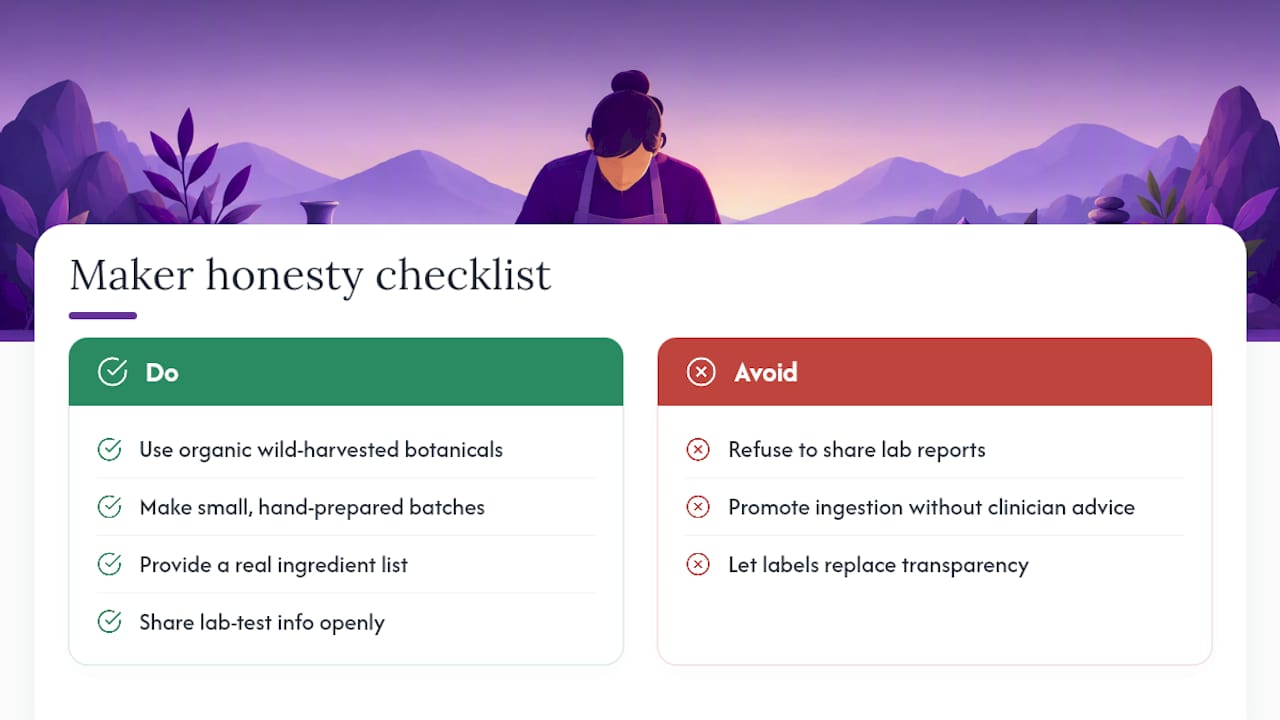
What we’d ask any responsible maker to offer, ourselves included, is simple: a real ingredient list, a clear statement of intended use, and a willingness to talk openly about testing. If a seller won’t answer a direct question about their lab reports, that tells you something.
Our stance on ingestion is conservative. Ritual, anointing, and meditation come first. If you’re considering ingestion, talk to a clinician, start small, and never let a pretty label substitute for real transparency.
— Kejiwa
Where to Explore Kejiwa’s Ormus Collection
Some makers produce Ormus minerals in small batches by hand, using organic and wild-harvested sourcing to support transparency, unlike mass-produced blends where sourcing is unclear. If the safety checklist above matters to you, that transparency is the whole point of buying direct from a small-batch maker instead of an anonymous online listing.
Before you order anything, or before you ingest anything you already own, run through the core buyer checks one more time.
| What to Check | Why It Matters |
|---|---|
| Full ingredient list | Confirms what’s actually in the bottle |
| Declared form (colloidal, ionic, etc.) | Determines absorption and risk profile |
| Batch ID | Lets you trace the product if questions arise |
| Third-party heavy-metal test | Screens for contaminants beyond marketing claims |
| Clear intended-use statement | Tells you whether it’s meant for ritual or ingestion |
Browse our Ormus minerals collection to see ingredient notes and product details for yourself, or pair a bottle with one of our botanical aromatic sprays for a fuller ceremony setup. If you’re building out a full altar practice, our smudging herbs make a natural companion piece.
Sources
This article draws on FDA’s dietary supplement guidance and structure/function claim rules, a documented cardiomyopathy case report, a toxicology review of gold exposure forms, and patent record GB2219995A. Each source grounds a specific safety, regulatory, or historical claim made above.
This article is general information, not a substitute for advice from a qualified doctor. Consult a qualified healthcare professional about your own circumstances before acting on anything here.
- Case report of gold- and silver-associated cardiomyopathy and LBBB
- Toxicological risk assessment of elemental gold following oral exposure to sheets and nanoparticles – A review
- Dietary Supplements | FDA
- GB2219995A — Non-metallic, monoatomic forms of transition elements (patent)
FAQ
What Does “M-State” Actually Mean?
In spiritual wellness, m-state describes Ormus, a mineral preparation believed to carry an altered energetic quality, most often associated with gold. It is not the same as a monatomic chemical element in physics, and mainstream chemistry has not confirmed the community’s material claims in a peer-reviewed review of ORMUS.
Is It Safe to Ingest M-State Ormus Products?
Ingestion carries documented risk, including one case report linking months of daily colloidal gold ingestion to reversible heart complications. Ritual and topical use carry far less physical risk, and any ingestion decision deserves a conversation with a physician first.
How Do I Know if a Vendor’s Product Is Trustworthy?
Look for a full ingredient list, a stated intended use, a batch ID, and a third-party heavy-metal test with the lab’s name attached. Responsible makers of small-batch Ormus lines often publish these details; any maker unwilling to share equivalent information may be worth questioning.
Does Kejiwa Alchemy Sell M-State Elements?
Yes. Kejiwa Alchemy’s Ormus minerals collection offers handcrafted monoatomic gold preparations made in small batches from organic and wild-harvested sources. Current pricing and product details are listed directly on the collection page.
Are FDA Claims Different From Spiritual Claims?
Yes, and the difference is legal, not just semantic. FDA’s structure/function guidance permits wording like “supports meditation,” but forbids disease-treatment language on a supplement label without crossing into drug regulation.