


Ormus side effects that people report most often are mild and short-lived: vivid dreams, headaches, digestive changes, and a heightened emotional sensitivity that can catch you off guard. The bigger safety concern isn’t some mysterious monatomic reaction. It’s production quality: contamination, incomplete neutralization, and inconsistent dosing across unregulated suppliers. If you’re going to try Ormus, start with half the suggested dose, buy only from a source that shares third-party lab testing, and stop immediately if you notice chest pain, severe swelling, or a reaction that doesn’t ease within a couple of weeks.
TL;DR:
- Most side effects, such as vivid dreams and mild headaches, typically resolve within one to two weeks as the body adjusts to mineral intake.
- Production risks like residual lye, heavy metal contamination, and inconsistent sourcing are the main safety concerns, emphasizing the importance of third-party testing.
- People with kidney disease, electrolyte disorders, pregnancy, or those taking specific medications should avoid Ormus or consult a healthcare professional before use.
- Starting with half the recommended dose and monitoring symptoms helps reduce risks and identify sensitivities early.
- Long-term safety data are lacking, making periodic lab tests and cautious cycling advisable for regular users.
Table of Contents
- What Is Ormus and What Does the Evidence Actually Show?
- What Are the Most Commonly Reported Ormus Side Effects?
- Why Do These Ormus Health Issues Happen? Mechanisms and Production Risks
- Who Should Avoid Ormus, and What Interacts With It?
- How Can You Reduce Ormus Risks If You Decide to Try It?
- When Should You Stop Taking Ormus and Seek Medical Care?
- What Does Long-Term Ormus Use Look Like, and Are There Cumulative Risks?
- Why Do Ormus Reactions Vary So Much From Person to Person?
- Weighing Anecdote Against Evidence: An Honest Take
- A Responsible Way to Try Ormus: What Kejiwa Alchemy Offers
- Sources
- FAQ
What Is Ormus and What Does the Evidence Actually Show?
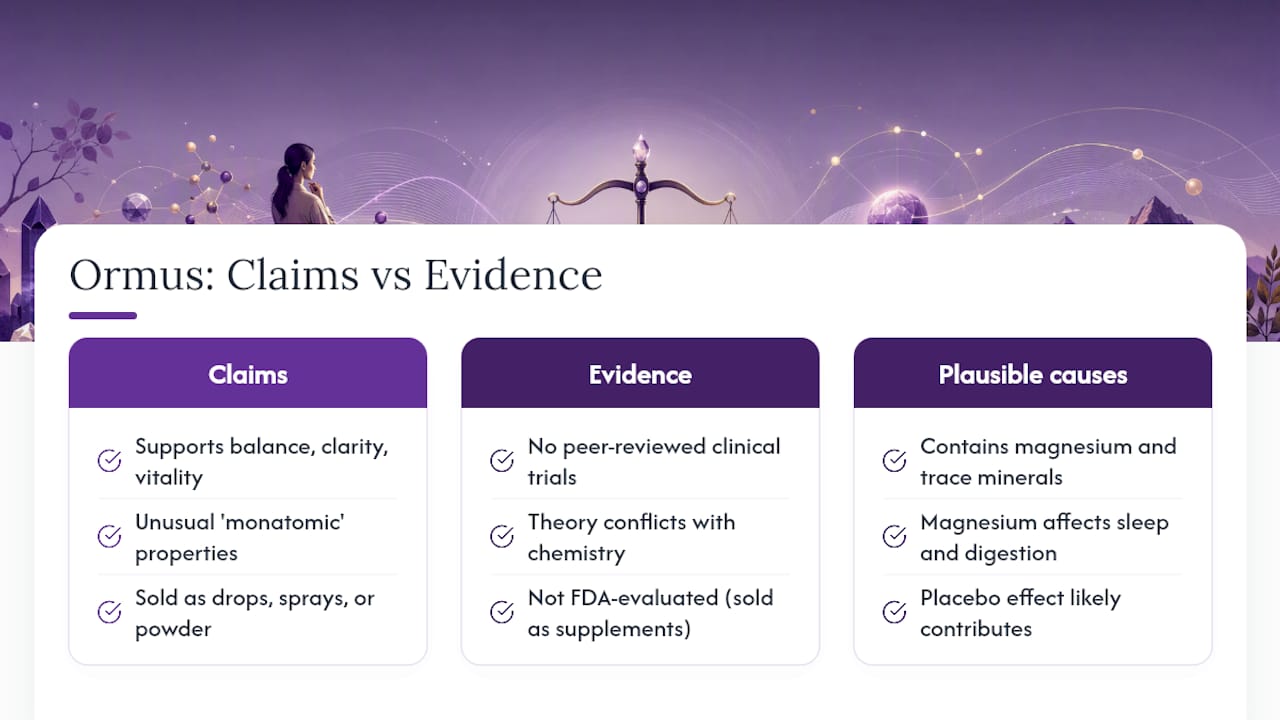
Ormus (sometimes written ORMUS or referred to as monatomic minerals) is sold as a liquid drop, spray, or occasionally a powder, marketed as a concentrated mineral substance said to support energetic balance, clarity, and vitality. Most versions on the market today come from wet extraction of sea salt, volcanic ash, or similar mineral-rich sources, processed into a form vendors describe as having unusual atomic properties.
Here’s the part worth sitting with: there are no peer-reviewed clinical trials demonstrating Ormus benefits, and the underlying “monatomic” theory conflicts with what’s currently understood in chemistry. That doesn’t automatically mean Ormus does nothing. It means the claims outpace the available evidence, and anyone selling certainty in either direction (miracle or menace) is overstating what’s known.
Ormus products are sold in the United States as dietary supplements, which means they’re not evaluated by the FDA for safety or effectiveness before they reach a shelf or a checkout page. Purity, mineral content, and manufacturing standards vary widely from one supplier to the next, and there’s no regulatory body checking that variation for you.
So where do the reported effects come from? The most plausible explanation is straightforward: many Ormus preparations contain meaningful amounts of magnesium and other trace minerals. Magnesium alone is well documented to influence sleep architecture and digestion, which lines up closely with what people describe after taking Ormus. Add in the placebo effect, which is powerful and well-studied in supplement research generally, and you have a credible, unglamorous explanation for a lot of what gets attributed to monatomic gold. This is not a dismissal. It’s a more honest map of where the effects likely come from, and it changes how you should think about dosing and sourcing.
What Are the Most Commonly Reported Ormus Side Effects?
Ask around any Ormus-using community and you’ll hear a familiar cluster of reactions, usually within the first days of starting a new bottle. None of these are unique to Ormus. They mirror what shows up when the body adjusts to a concentrated mineral intake, which is exactly the point.
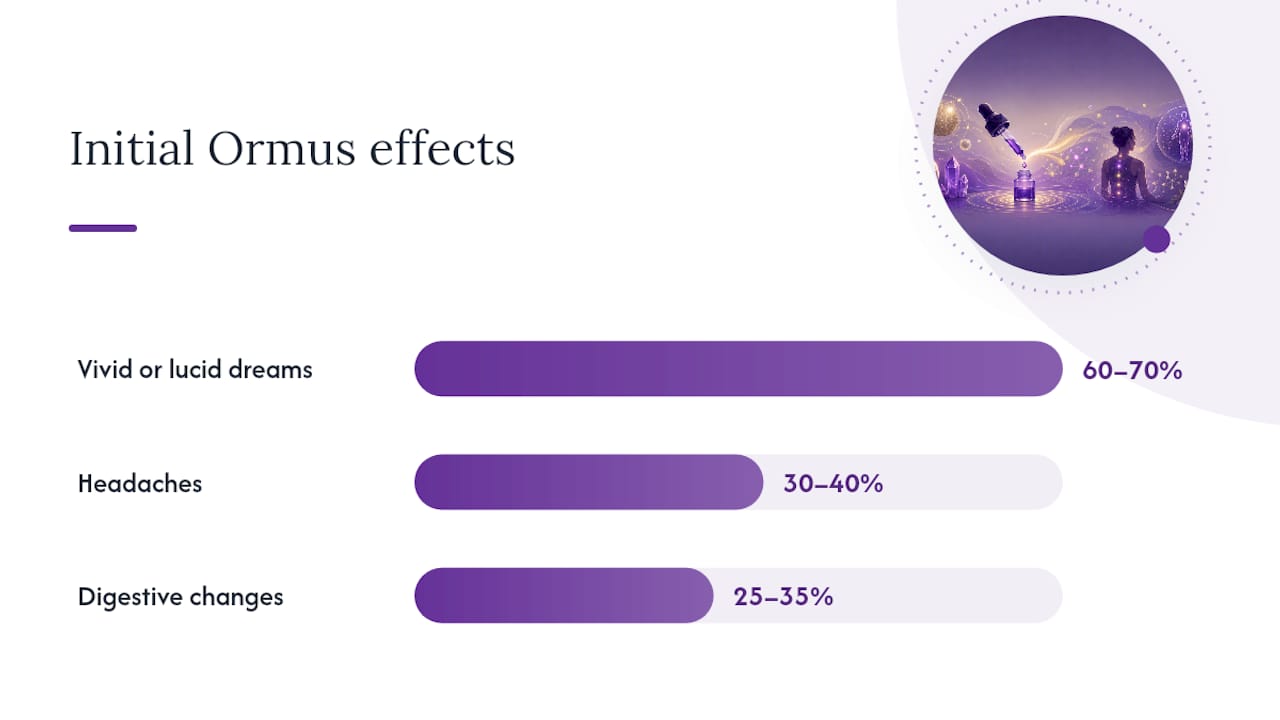
Vivid or lucid dreams top the list. Vendor and community surveys suggest a majority of first-time users notice a shift in dream intensity or recall, often within the first two or three nights. Magnesium is known to influence REM sleep patterns, so a mineral-dense supplement taken before bed is a reasonable candidate for this effect, whether or not “monatomic” properties play any role.
Headaches show up next, typically within the first 24 to 72 hours. These tend to be mild and tension-like rather than migraine-grade, and they often resolve as the body adjusts or as hydration improves. Dehydration and shifting electrolyte balance are the leading suspects here, not some deeper detox narrative.
Digestive changes, particularly loose stools and mild nausea, are common enough that most vendor guides mention them upfront. Magnesium in supplement form is a known cause of gastrointestinal loosening at higher doses, and Ormus products can carry a meaningful mineral load per serving. This effect usually eases within a week as the gut adjusts or as the dose is reduced.
Emotional sensitivity is the side effect people least expect and most often misread as a spiritual breakthrough rather than a physiological response. Increased tearfulness, irritability, or a general rawness in mood has been reported by a notable share of new users. Whether that’s a mineral effect, a sleep-quality shift from more vivid dreaming, or simple expectation at work, it’s worth naming clearly so you don’t mistake a rough week for something bigger than it is.
Fatigue rounds out the common list, usually described as a heavy, low-energy day or two rather than persistent exhaustion.
Commonly reported initial effects tend to resolve within one to two weeks as the body adjusts to a new supplement routine. That window matters: if a symptom is still present or worsening past two weeks, it’s no longer a normal adjustment reaction, and it deserves a closer look.
A quick frequency snapshot from community and vendor reporting: vivid dreams appear in roughly 60 to 70 percent of new-user reports, headaches in 30 to 40 percent, and digestive changes in 25 to 35 percent, according to community-sourced tracking. These are self-reported figures from informal surveys, not controlled clinical data, so treat them as a directional pattern rather than a guarantee of your own experience.
A smaller set of reactions falls outside the “expected adjustment” category and deserves more caution:
- Heart palpitations or an irregular heartbeat that appears after starting Ormus
- Digestive distress that persists or worsens beyond two weeks rather than easing
- Any sign of an allergic reaction: hives, swelling of the face or throat, or difficulty breathing
- Headaches lasting more than five days or increasing in severity rather than fading
- Unusual burning or irritation in the mouth or throat immediately after taking a dose
None of these are “part of the process.” They’re signals to stop the product and get evaluated, a point worth returning to later in more detail.
Why Do These Ormus Health Issues Happen? Mechanisms and Production Risks
The most useful way to understand Ormus adverse reactions is to stop looking for a hidden energetic mechanism and start looking at chemistry and manufacturing. Three factors explain almost everything reported: mineral load, residual alkalinity, and contamination.
Magnesium and electrolyte load is the simplest piece. A concentrated mineral solution taken daily adds to your existing intake from food and other supplements. In sensitive individuals, that extra load shows up as loose stools, mild cramping, or a shift in sleep quality, the same pattern seen with standalone magnesium supplements. It’s not dangerous for most healthy adults in modest doses, but it explains why “start low” isn’t just cautious advice. It’s the actual lever that controls intensity.
Alkalinity and lye residue is the production risk that deserves the most attention, and it rarely gets discussed outside specialist forums. Many Ormus preparations are made using a wet-extraction method that relies on sodium hydroxide, better known as lye, to precipitate minerals out of a salt or ash solution. Done properly, the lye is fully neutralized and washed out before the product reaches a bottle. Done carelessly, it isn’t, and what you’re left with is a product carrying caustic residue capable of irritating the mouth, throat, and digestive lining. A product that tastes sharply alkaline, metallic, or “soapy” is telling you something important: don’t ignore that signal.
Heavy metal contamination is the second production risk, and it’s tied directly to sourcing. Ormus is often made from sea salt, volcanic ash, or mined mineral deposits, none of which are guaranteed pure. Impure source material can carry trace lead, arsenic, or other contaminants straight into the final product, especially when a producer isn’t testing incoming raw materials or finished batches. This is the kind of risk that has nothing to do with dose and everything to do with who made the product and how carefully.
Put those three together and a clearer picture emerges:
- Mild, transient symptoms (dreams, headaches, mild GI upset) most likely trace back to mineral content, particularly magnesium
- Persistent burning, throat irritation, or GI distress that doesn’t resolve points toward incomplete lye neutralization
- Unexplained neurological symptoms, unusual fatigue patterns, or symptoms that appear across multiple systems at once warrant asking about heavy metal testing
This is also why the “monatomic gold” framing matters less than it sounds like it should. Whether or not the theoretical atomic structure is real, the practical risks and benefits trace to ordinary chemistry: what minerals are present, how much, and how clean the extraction process was. A responsibly made product with verified mineral content and neutral pH carries a very different risk profile than one made in an unregulated kitchen batch with no testing at all.
Who Should Avoid Ormus, and What Interacts With It?
Some readers have more at stake than a rough week of dreams and digestion, and it’s worth being direct about who that includes.
Higher-risk groups should treat Ormus with real caution, or skip it entirely without a clinician’s input:
- Pregnant or breastfeeding individuals, since there’s no safety data covering mineral supplementation at Ormus-level concentrations during pregnancy or lactation
- Anyone with diagnosed kidney disease, since impaired kidneys struggle to clear excess minerals, raising the risk of buildup
- People with an existing electrolyte disorder, where an added mineral load can push levels further out of balance
- Infants and children, for whom no dosing standard exists and body weight makes overexposure far easier
Medication interactions are theoretical rather than clinically confirmed, since no large-scale studies have examined Ormus specifically. But the mechanisms are well understood from mineral supplement research generally, and they’re worth respecting:
- Tetracycline antibiotics can bind to magnesium and other minerals in the gut, reducing how much antibiotic actually gets absorbed
- Bisphosphonates, used for bone density, face the same absorption interference from concentrated minerals
- Thyroid medications are sensitive to timing around mineral supplements, which can blunt their effectiveness
- Lithium and certain blood pressure medications interact with electrolyte shifts, making mineral loading a variable worth tracking rather than ignoring
The standard fix that clinicians and supplement guides both point to is simple: space Ormus and any prescription medication by about two hours. That gap reduces the odds of one interfering with the other’s absorption. For a deeper look at how mineral supplements can affect the way the body absorbs other compounds, this breakdown of supplement bioavailability covers the same underlying absorption principles.
Pro Tip: If you take any daily prescription medication, set a phone reminder for your Ormus dose rather than trying to remember the two-hour gap by feel. Missed spacing is the most common way well-intentioned users accidentally blunt their own medication.
When in doubt, a five-minute conversation with a pharmacist or physician costs you nothing and closes a gap that no vendor label can fill.
How Can You Reduce Ormus Risks If You Decide to Try It?
If you’ve weighed the uncertainty and decided to move forward, the difference between a smooth experience and a bad one usually comes down to three things: sourcing, dosing, and monitoring.
- Request a certificate of analysis before you buy. Ask any vendor for third-party lab testing that shows elemental mineral content and confirms the absence of heavy metals like lead, arsenic, and mercury. A supplier that can’t or won’t provide this should be treated as higher risk, full stop.
- Start at half the suggested dose. This is the single most repeated piece of practical guidance across vendor and community reporting, and for good reason: it lets you gauge your own sensitivity to the mineral load before committing to a full serving.
- Keep a simple symptom journal. Note the date, dose, and anything you notice: sleep quality, energy, digestion, mood. Two weeks of data tells you more about how your body handles Ormus than any forum thread ever will.
- Consider cycling instead of daily continuous use. Taking a few days off each week or each month gives your body a chance to reset and makes it easier to notice if a symptom is dose-related.
- Check the taste and smell before ingesting. A product with a harsh, soapy, or strongly alkaline taste may carry residual lye from incomplete neutralization. That’s not a texture preference issue. It’s a signal to stop and contact the seller.
- Order baseline labs if you plan to use Ormus regularly. A basic metabolic panel checks kidney function and electrolyte balance, and a heavy metal panel is worth requesting if you have any doubt about a product’s sourcing or purity.
Pro Tip: Ask for the pH of the finished product, not just the certificate of analysis. A properly neutralized Ormus preparation should sit close to neutral. A strongly alkaline reading is a red flag regardless of what the elemental mineral testing shows.
None of this guarantees a reaction-free experience. It does shift the odds substantially in your favor by removing the two biggest variables you actually control: what you’re buying and how much of it you take.
When Should You Stop Taking Ormus and Seek Medical Care?
Most Ormus reactions are mild and self-limiting, but a short list of symptoms should end your use of the product immediately and send you toward medical care rather than a wait-and-see approach.
Stop and seek urgent evaluation if you experience:
- A headache lasting more than five days or one that worsens rather than improves
- Persistent vomiting or digestive distress that doesn’t ease after several days
- Chest pain, heart palpitations, or an irregular heartbeat
- Difficulty breathing, throat tightness, or facial swelling, which can signal a serious allergic reaction
- Any seizure activity, regardless of how brief
If you notice any of these, stop the product immediately, keep the container and label, and either seek urgent care or call Poison Control if the reaction is severe or rapidly worsening.
When you do see a clinician, bring as much documentation as you can: the product label with its ingredient list, the timeline of when you started and how much you were taking, your symptom journal if you kept one, and any lab results you already have on hand, including a certificate of analysis if the vendor provided one. That paper trail turns a vague “I took some minerals and felt off” into something a physician can actually act on. It’s the difference between guessing and diagnosing.
What Does Long-Term Ormus Use Look Like, and Are There Cumulative Risks?
Long-term safety data on Ormus simply doesn’t exist in any rigorous form. No study has tracked users over months or years to measure cumulative mineral exposure, kidney load, or slow-building contamination effects from regular use. That absence of data is not the same as an absence of risk. It just means nobody has measured it carefully.
What’s reasonable to extrapolate from mineral supplementation research generally is this: daily, high-dose mineral intake over long periods can, in some individuals, contribute to imbalances, particularly in people with underlying kidney or electrolyte issues who can’t clear excess minerals efficiently. If a product carries even trace heavy metal contamination, regular use compounds that exposure over time rather than diluting it. This is precisely why cycling (a few days off per week or per month) gets recommended so often. It’s a rough, common-sense buffer against a scenario nobody has actually studied.
If you use Ormus regularly, periodic lab work (a basic metabolic panel every six to twelve months, more often if you have any risk factors) is a reasonable way to catch a slow-developing problem before it becomes a visible symptom. That’s a modest ask for peace of mind on something with this little long-term data behind it.
Why Do Ormus Reactions Vary So Much From Person to Person?
Two people can take the same product, at the same dose, from the same bottle, and walk away with completely different experiences. That’s not inconsistency in the product. It reflects real biological variation.
Kidney function is one obvious variable: someone with efficient renal clearance processes excess minerals faster than someone with even mild, undiagnosed kidney impairment, which changes how quickly a mineral load builds up or clears. Baseline magnesium and electrolyte status matters too. Someone already running low on magnesium from diet or medication may notice a more dramatic sleep or digestive shift than someone whose levels were adequate to begin with.
Gut sensitivity plays a role as well. People with pre-existing digestive conditions, from irritable bowel syndrome to simple lactose intolerance, often report a stronger GI response to any new supplement, mineral-based or otherwise. And expectation itself is a genuine variable, not a dismissal. Someone who has read extensively about Ormus and anticipates vivid dreams or emotional shifts is, per placebo research broadly, more likely to notice and report those exact effects.
None of this means your experience is “wrong” if it doesn’t match what a forum thread describes. It means your body’s starting point, not the bottle, is doing most of the work in determining what you feel.
Weighing Anecdote Against Evidence: An Honest Take
Here’s where we land after sitting with the reporting, the mechanisms, and the gaps in the research: the people describing vivid dreams, emotional openness, or a sense of grounding after taking Ormus aren’t imagining it. Something is happening. What’s missing is proof of why, and that gap deserves more respect than it usually gets from either side of this conversation.
We think the honest position is this: treat the mineral content as the likely driver of most mild effects, treat production quality as the real safety variable, and treat clinical uncertainty as a reason for caution rather than avoidance. That’s a very different stance from either “this is ancient alchemical gold” or “this is nothing but snake oil.” It’s messier, and it’s more useful.
If you’re going to use Ormus, track what you experience with the same rigor you’d want from a study you couldn’t run yourself. Talk to a clinician if you’re pregnant, managing kidney disease, or taking medications that interact with mineral absorption. The uncertainty here isn’t a reason to panic. It’s a reason to be careful, deliberate, and honest with yourself about what you’re actually feeling and why.
— Kejiwa
A Responsible Way to Try Ormus: What Kejiwa Alchemy Offers
If the production and sourcing risks above make you want to try Ormus only through a maker who treats those risks seriously, that’s exactly the standard we hold ourselves to. Kejiwa Alchemy’s Ormus minerals are handcrafted in small batches, not mass-produced, because consistency and transparency are harder to guarantee at scale.

In practice, sourcing of ingredients is intentional to support quality, with emphasis on transparency about pH and mineral content. If considering Ormus preparations, it is advised to start with a reduced dose, keep a simple log of observations, and seek additional product information regarding sourcing or testing before ordering.
We also carry spagyric herbal tinctures crafted with the same small-batch philosophy, for readers looking to build a broader, intentional wellness practice alongside mineral supplementation. Whatever you’re drawn to try, the goal is the same: a product you can trust because you were told the truth about what’s in it, not because a label promised you something no one can actually prove.
Sources
For readers who want to dig into the primary reporting behind this guide, these three sources cover the ground in more depth: ORMUS Side Effects: What to Know Before Taking catalogs commonly reported reactions and dosing advice from vendor and community sources. What Is an ORMUS Supplement and Does It Work? examines the lack of clinical trials and the chemistry problems with monatomic claims. Ormus Effects and Side Effects: A Verified, Long-Form Explanation details the production risks tied to lye-based extraction and heavy metal contamination.
This article is general information, not a substitute for advice from a qualified doctor. Consult a qualified healthcare professional about your own circumstances before acting on anything here.
- ORMUS Side Effects: What to Know Before Taking
- What Is an ORMUS Supplement and Does It Work? - ScienceInsights
- Ormus Effects and Side Effects: A Verified, Long‑Form Explanation
FAQ
What are the potential side effects of Ormus?
The most commonly reported Ormus side effects are vivid dreams, mild headaches, temporary digestive changes, emotional sensitivity, and fatigue, most of which ease within one to two weeks. Less common but more serious signs, including palpitations, persistent vomiting, or allergic reactions, warrant stopping the product and seeking medical care.
What are the benefits people report from taking Ormus supplements?
Users commonly describe improved sleep depth, a greater sense of calm, and increased mental clarity, though no peer-reviewed clinical trials confirm these effects. Mineral content, particularly magnesium, and placebo response are more plausible explanations than the theoretical monatomic mechanism vendors often cite.
What is Ormus made of?
Ormus is typically extracted from sea salt, volcanic ash, or similar mineral-rich source material through a wet-extraction process, often using sodium hydroxide to precipitate minerals out of solution. Quality and purity vary significantly by producer, since Ormus is sold as an unregulated dietary supplement without FDA evaluation.
What are the potential side effects of taking colloidal minerals like Ormus?
Colloidal and concentrated mineral supplements can cause digestive upset, headaches, and, in poorly produced batches, irritation from residual processing chemicals or heavy metal contamination. The safest approach is sourcing from a maker who provides third-party lab testing and starting at a reduced dose to gauge your own tolerance.
Is Ormus safe to take with prescription medications?
No large studies confirm Ormus and medication interactions, but mineral content can theoretically interfere with drugs like tetracycline antibiotics, thyroid medication, and bisphosphonates. Spacing Ormus and prescription medications by about two hours reduces this risk, and anyone on regular medication should confirm timing with a pharmacist first.
How do I know if an Ormus product is high quality?
Ask the vendor for a certificate of analysis confirming elemental mineral content, absence of heavy metals, and a neutral finished pH. Kejiwa Alchemy’s small-batch Ormus preparations are made with sourcing transparency in mind, and readers can contact customer support for details on testing practices before ordering.