


Salt is a practical, time-tested protective tool. Reach for coarse sea salt as your default, and start with the fastest ritual available: small bowls of salt in the room’s corners, or a thin unbroken line across your threshold. Reserve black salt for stronger banishing work once you understand its sharper effect. Both actions take under five minutes and require nothing you don’t already have in your kitchen.
TL;DR:
- Coarse sea salt remains the most practical choice for daily protection rituals, as it is mineral-rich, durable, and widely available for bowls, thresholds, and baths.
- Black salt, a mixture of sea salt, ash, herbs, and pepper, is better suited for banishing specific issues rather than routine protection work.
- Salt bowls in the corners of rooms and lines across door thresholds should be refreshed every two to four weeks or after stressful household events to maintain effectiveness.
- Salt should be stored in glass or ceramic containers away from moisture, and used salt must not be reused for cooking or feeding plants due to its absorbed energies.
- Safety precautions include keeping salt out of reach of pets and children, and avoiding prolonged contact with sensitive flooring or unattended candles during rituals.
Table of Contents
- Why Protective Salt Rituals Have Lasted Thousands of Years
- Which Salt Should You Use for Protection?
- How Do You Perform a Protective Salt Ritual?
- Is It Safe to Use Salt Rituals at Home?
- Practitioner Notes From Kejiwa Alchemy
- When Should You Replace or Dispose of Ritual Salt?
- A Realistic Note on Practicing This Consistently
- Bringing Botanical Aromatics Into Your Salt Practice
- Where to Learn More About Salt Magic
- Sources
- FAQ
Why Protective Salt Rituals Have Lasted Thousands of Years
Salt shows up in temple offerings from Mesopotamia, in Jewish folk customs, in Shinto purification ceremonies before sumo matches, in Hoodoo protective work, and in European doorstep traditions that predate written history. That’s not coincidence. Salt was one of the few substances ancient people could rely on to stop decay, which made it a natural stand in for something that resists corruption on a spiritual level too.
The physical logic maps almost perfectly onto the symbolic one. Salt draws moisture out of the air and out of organic material, and its preservative and absorptive properties underpin its ritual uses across cultures that never had contact with one another. If salt can absorb moisture and halt rot, the reasoning goes, it can absorb and neutralize unwanted energy too.
Modern household practice keeps that same core idea, just scaled down for apartments instead of temples:
- Corner bowls stand in for larger ceremonial salt circles once used around entire dwellings.
- Threshold lines echo the salt barriers laid across doorways in older folk traditions.
- Salt baths descend from ritual purification washes found in multiple ancient practices.
You’re not inventing something new when you pour a line of salt across your doorway. You’re continuing a habit that’s older than most religions currently practiced.
Which Salt Should You Use for Protection?
Coarse sea salt is your workhorse. It’s mineral rich, visually satisfying to pour, and gentle enough for daily use in bowls, thresholds, and baths without any specialized preparation. Fine salt works too, but it clumps in humid climates and blows around more easily outdoors, so coarse grains hold up better for anything left in place.
Black salt is a different tool entirely. It’s not a naturally occurring salt but a mixture, and a widely documented formula combines sea salt with ash, charcoal, black pepper, and protective herbs like rosemary or rue. Reach for it when you need to banish something specific, not for everyday maintenance. It’s the difference between a gentle boundary and an active eviction notice.
Himalayan pink salt suits heart-centered protective work, since many practitioners associate its color and mineral warmth with softer, nurturing boundaries rather than hard defense. Epsom salt belongs in the bathtub, not the doorway. It’s magnesium sulfate, not a true salt, and it dissolves fully for baths without leaving gritty residue.
| Salt Type | Best Use | Notes |
|---|---|---|
| Coarse sea salt | Bowls, thresholds, baths | Default choice; widely available |
| Black salt | Banishing, threshold protection | Mix of salt, ash, pepper, herbs |
| Himalayan pink | Gentle, heart-centered protection | Softer symbolic tone |
| Epsom salt | Ritual baths | Dissolves fully, no residue |
| Table salt | Emergency substitute only | Often iodized, additives possible |
Table salt works in a pinch. If it’s genuinely all you have at midnight and something feels off, use it. Just know that iodized versions carry anti-caking additives that some practitioners avoid for anything meant to touch skin or food afterward.
How Do You Perform a Protective Salt Ritual?
Each method below serves a slightly different purpose, so pick based on what you’re actually trying to accomplish rather than which one sounds most dramatic.
-
Salt circle. Gather coarse salt, a bowl for pouring, and clear floor space. Pour in one continuous motion, moving clockwise if you’re building protection or counterclockwise if you’re banishing something specific. The circle must stay unbroken; a gap is believed to weaken the whole boundary, so reseal any break immediately with a pinch more salt. Sweep the line away or vacuum it once your working ends.
-
Salt jar. Layer coarse salt at the base, add a pinch of protective herbs such as rosemary or bay, then seal the top with a thin cap of black salt for extra strength. Place it near your front door or under your bed. Expect it to hold its charge for a few weeks before it needs replacing.
-
Ritual bath. Add about half a cup to one cup of sea salt or Epsom salt to a full tub and soak for about fifteen minutes. Lavender or frankincense essential oil pairs well in small amounts, but skip citrus oils if you’ll be in direct sunlight afterward, and avoid strong oils entirely if you’re pregnant or have sensitive skin.
-
Salt spray and sachets. Dissolve salt into water for a portable spray, and mist doorways or your own aura before entering stressful spaces. Small fabric sachets filled with dry salt and herbs slip into a bag or car for on-the-go protection.
-
Renter-friendly adaptations. Loose salt on hardwood or carpet isn’t always practical. Fill a narrow fabric cord with salt and lay it as a ring instead, or keep salt contained in dishes and trays so nothing touches the floor directly.
Pro Tip: Keep a small dish of dry salt by your door specifically for quick threshold touch ups. Refreshing a broken line takes ten seconds if the salt is already within reach.
Is It Safe to Use Salt Rituals at Home?
Salt is cheap and generally low risk, but it’s not harmless, and a few precautions matter more than most guides admit.
- Keep salt bowls and sachets away from pets and small children. Concentrated salt ingestion can cause vomiting, and in dogs especially, large amounts pose real danger.
- Line hardwood, laminate, or grout with parchment paper or a shallow tray before pouring loose salt, since prolonged contact can dull finishes or work into seams.
- Never leave ritual candles unattended, and set them on stable, heat-safe surfaces away from curtains or paper.
- Guides consistently recommend food-grade salt, pet-free zones, and supervised candle use as baseline safety practice.
One overlooked issue is cultural sourcing. Hoodoo-rooted black salt formulas and Shinto salt purification carry specific histories tied to specific communities. Borrowing the technique is fine; presenting it as your own invention or stripping out its origin is not. Credit the tradition you’re drawing from when you talk about your practice with others.
Practitioner Notes From Kejiwa Alchemy
Small adjustments change a ritual’s whole tone. A few drops of rosemary or bay laurel essence added to a salt jar sharpens its defensive edge, while lavender or rose softens it toward comfort and calm rather than hard boundary work. Combining salt with botanical allies strengthens a working while still leaving room for personal preference.
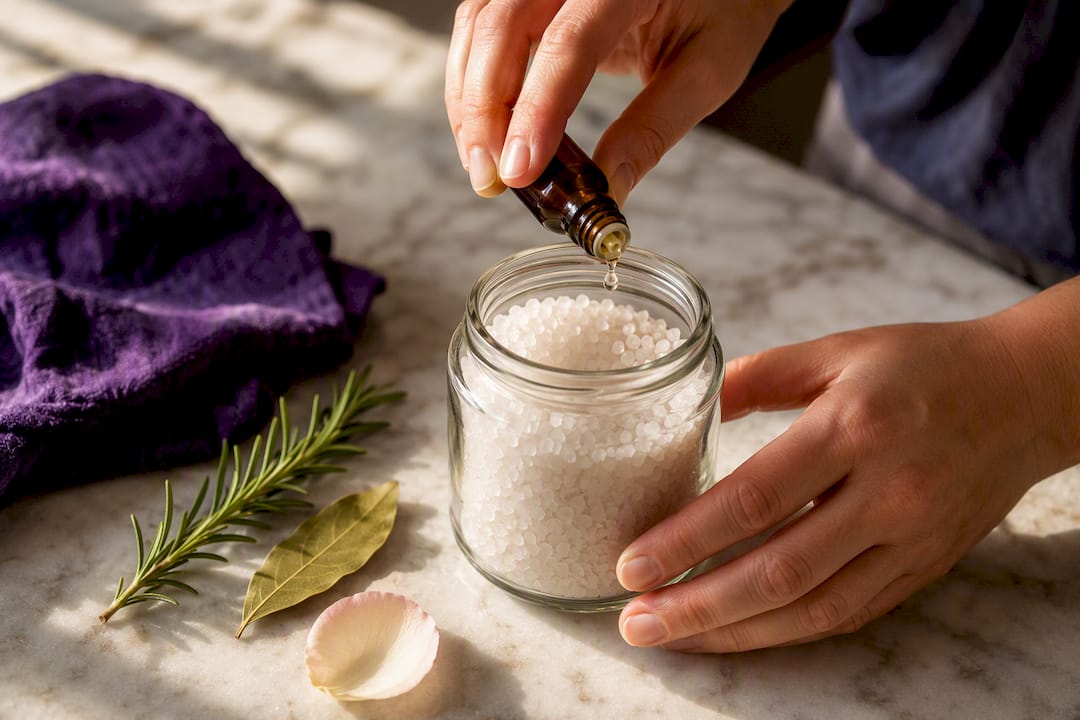
Source salt the way you’d source any ingredient you put real intention into. Unrefined, minimally processed sea salt carries fewer additives than bleached table varieties, and it tends to feel more alive in the hand, for what that’s worth to your practice. Store it in glass or ceramic, away from moisture, so it doesn’t clump before you need it.
If you want to go deeper, Kejiwastore’s guide to botanical smoke cleansing pairs naturally with salt work as a two-part cleansing sequence.
When Should You Replace or Dispose of Ritual Salt?
Replacement depends on exposure. Salt sitting quietly in a corner bowl can last two to four weeks, but practitioners recommend refreshing it monthly at minimum, and immediately after any major conflict or heavy visitor traffic through your home.
- Refresh corner bowls regularly; check them sooner after arguments or illness in the household.
- Reset threshold lines and jars every few weeks depending on how much foot traffic or stress they’ve absorbed.
- Dispose of used salt by scattering it on bare earth away from your property, or dissolving it in running water like a sink or stream.
- Never reuse charged salt for cooking or feeding houseplants. It’s considered to have absorbed whatever it was meant to catch.
A full jar rebuild differs from a simple bowl refresh. Reserve the complete ritual reset for jars and circles tied to a specific, resolved working.
A Realistic Note on Practicing This Consistently
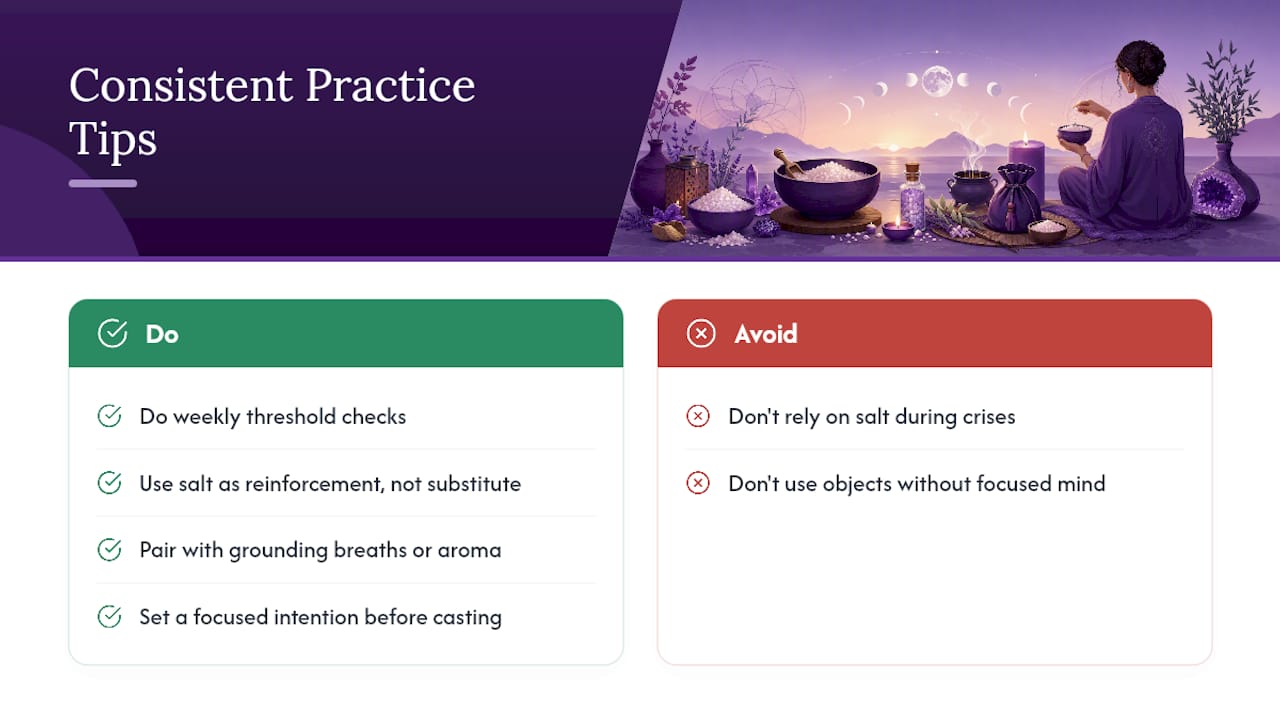
Salt rituals work best as routine, not emergency intervention. Weekly threshold checks matter more than one dramatic circle cast during a crisis. Treat the salt as reinforcement for the intention you set, not a substitute for it. Object-based protection without a focused mind behind it tends to feel hollow after a while.
Pair your salt work with a few slow, grounding breaths or a favorite aromatic before you begin. The scent and breath settle your nervous system, and a settled practitioner casts a steadier line than a rushed one.
— Kejiwa
Bringing Botanical Aromatics Into Your Salt Practice
A salt jar or ritual bath gains real depth when you charge it with something aromatic. Kejiwastore’s handcrafted botanical aromatic sprays and oils are made in small batches with wild-harvested and organic ingredients, built specifically for moments like this.

A quick spritz of a rosemary or protective herb blend directly into a salt jar before sealing it adds a scent layer that reinforces your intention every time you pass it. The same aromatics work in a ritual bath, a few drops swirled into the water alongside your sea salt. If you’re drawn to deeper energetic work, Kejiwastore’s spagyric herbal tinctures offer another way to prepare mind and body before a working, crafted with the same small-batch care as the aromatics. Browse the full collection and find a blend that matches the tone of protection you’re trying to build.
Where to Learn More About Salt Magic
For deeper study, Shadow Grimoire’s breakdown of salt types and properties and Lunary’s step-by-step spell guide both offer solid grounding. The Encyclopedia of Magical Herbs fills in botanical context. Cross-check anything borrowed from a specific living tradition before you adopt it as your own.
Sources
- Salt in Witchcraft: Types, Properties and How to Use It for Protection - Shadow Grimoire
- Salt Circle Protection: Step-by-Step Spell Guide - Lunary
- Bookshop
FAQ
How do you use salt for protection?
Pour a continuous, unbroken line of coarse salt across your threshold, or place small bowls in the corners of a room; refresh bowls monthly and reseal any gap in a poured line right away.
Which salt is best for spiritual protection?
Coarse sea salt is the standard default for everyday protection work, while black salt, a mix of salt, ash, pepper, and herbs, suits stronger banishing needs.
What does the Bible say about salt cleansing?
Salt appears in biblical passages tied to purification and covenant, most notably when Elisha purifies a contaminated water source with salt in 2 Kings, a passage often cited as an early example of salt’s cleansing symbolism.
Where should you put salt in the house for protection?
Place small bowls in the four corners of a room or near entry points, and lay thin lines across thresholds and windowsills, replacing them roughly every two to four weeks or sooner after a stressful event.