


Subtle body medicine is an approach to healing that treats the quasi-material energy system running through the body, including channels, centers, and the surrounding biofield, as a doorway to whole-person balance. It sits alongside conventional care, not in place of it. If you are managing a diagnosed condition, subtle body work is meant to complement your treatment plan, and Cleveland Clinic’s guidance is explicit that these methods are noninvasive but not a scientifically proven substitute for medical treatment.
This guide walks through:
- The traditions that first mapped the subtle body (chakras, nadis, meridians)
- Common modalities and what each one targets
- What current research does and doesn’t support
- Practical, low-risk ways to start exploring it yourself
Key Takeaways
Subtle body medicine works as a complementary, whole-person framework for balance, and it succeeds when practitioners pair traditional energy models with realistic evidence-based expectations.
| Point | Details |
|---|---|
| Definition | Subtle body medicine works with energetic channels, centers, and the biofield to support whole-person balance, not isolated symptoms. |
| Traditions vary in vocabulary | Chakras and nadis, meridians and qi, and Tibetan channel/wind/drop models all describe similar concepts differently. |
| Evidence is emerging, not settled | Research frames subtle anatomy through hypotheses like energy physiology, but no mechanism is scientifically proven. |
| Safety comes first | Use energy practices alongside, never instead of, conventional medical treatment, and avoid practitioners promising guaranteed cures. |
| Start small and track results | Try grounding breath, body scans, or visualization, and journal your response before booking ongoing sessions. |
| Ritual tools support attention | Kejiwa Alchemy’s Ormus minerals, spagyric tinctures, and botanical mists are crafted as attention supports for practice, not medical treatments. |
Table of Contents
- How Traditions Map the Subtle Body
- What Modalities Target the Subtle Body?
- Does Science Support Subtle Body Medicine?
- How to Try Subtle Body Medicine Safely
- About Kejiwa Alchemy and This Guide
- An Embodied Note on Subtle Body Practice
- Support Your Practice With Botanical Ritual Tools
- Sources
How Traditions Map the Subtle Body
Every subtle body model tries to answer the same question: where does energy move, and what happens when it gets stuck? The answers differ by tradition, but the underlying instinct, that the body has both a physical and an energetic layer, shows up again and again across cultures.
1. The Indian yogic model. Chakras are energy centers stacked along the spine, and nadis are the channels that carry prana, or life force, between them. The Encyclopedia of Buddhism describes a related tantric and Tibetan framework built on three components: nāḍī (channels), prāṇa or vāyu (inner winds), and bindu (drops). These aren’t decorative metaphors. They’re a working map that practitioners still use to guide meditation and healing techniques today.
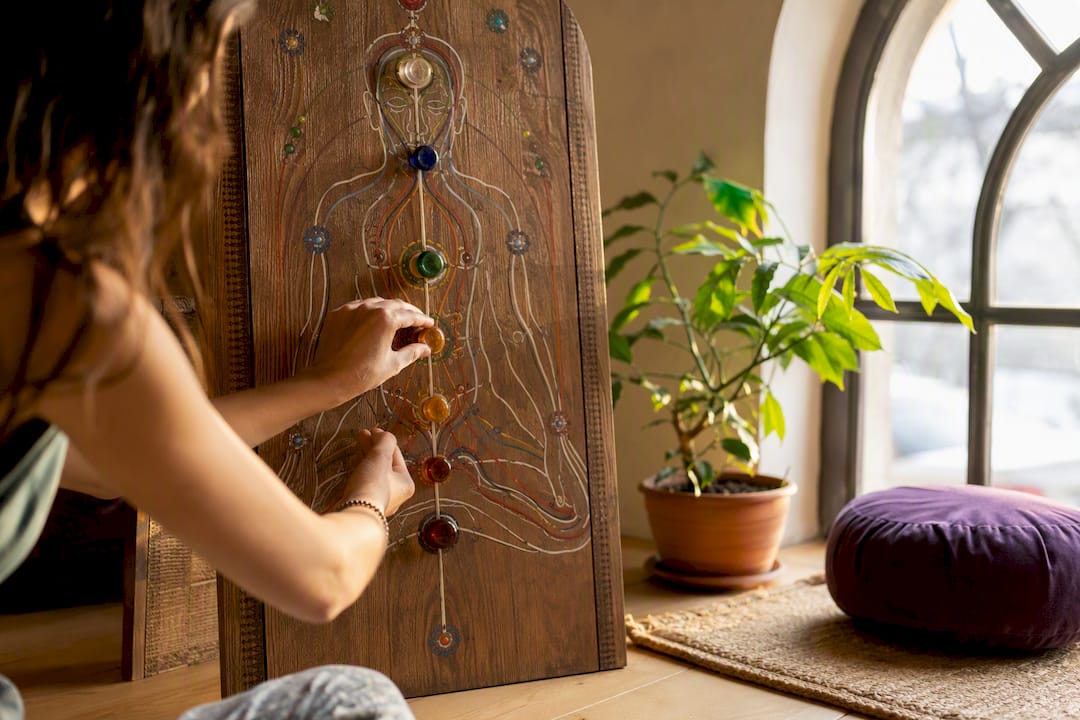
2. The Chinese and Taoist model. Here the language shifts to meridians and qi. Acupuncture is built directly on this framework: needles placed along meridian points are meant to clear blockages and restore flow. It’s a different vocabulary describing a strikingly similar concept to the nadi system.
3. The biofield concept. Modern integrative medicine often uses “biofield” as an umbrella term that lets Eastern and Western frameworks talk to each other without requiring one to defer to the other. A review of traditional subtle-body systems notes that Indian, Chinese, and Tibetan medicine each independently arrived at models of channels, centers, or fields, which is a striking convergence for systems that developed largely in isolation from one another.
Where these models genuinely differ is in emphasis. Yogic chakra work leans toward meditation and breath. Meridian theory leans toward physical intervention through needles or pressure. Practitioners generally pick the vocabulary that fits the modality they’re trained in rather than trying to reconcile all three into one unified chart.
What Modalities Target the Subtle Body?
Different practices work with different layers of the subtle body, and knowing which is which helps you choose something that actually matches what you’re looking for.
- Reiki and hands-off energy healing focus on balancing energy centers through light or non-contact touch, typically working near the body rather than manipulating it directly.
- Somatic psychotherapy uses felt-sensation work, tracking physical sensation as a doorway into stored emotional patterns. Harvard Health’s overview of somatic therapy notes that practitioners use this body-based tracking to help release tension that talk therapy alone sometimes can’t reach.
- Breathwork and pranayama direct attention to the breath itself, treated in yogic tradition as the vehicle for prana moving through the nadis.
- Acupuncture works from the meridian model, using needle placement at specific points to address what the tradition frames as blocked qi.
- Ritual adjuncts, such as aromatherapy or herbal tinctures, support attention and intention during a practice. They’re tools for focus, not medical treatments, and no reputable practitioner will present them as one.
Somatic therapists in particular report that working with subtle body concepts helps clients access material that stays out of reach through cognitive discussion alone, since the body often holds onto patterns the conscious mind has stopped tracking.
Pro Tip: If you’re new to this, start with one modality and give it a few sessions before layering in another. Mixing breathwork, Reiki, and acupuncture in the same week makes it nearly impossible to tell what’s actually helping you.
Does Science Support Subtle Body Medicine?
The honest answer: research is exploring it, but nothing about invisible energy channels has been proven in the way a blood test or an X-ray can be proven. That distinction matters, and it’s worth sitting with rather than glossing over.
A PMC review of integrative and energy medicine frames subtle anatomy as part of a whole-person model, useful for thinking about health beyond isolated symptoms, even where the underlying mechanism isn’t fully mapped by conventional biology. A hypothesis paper published in ScienceDirect goes a step further, proposing an “energy physiology” framework meant to connect subtle-body concepts to measurable biophysical phenomena. That’s a research direction, not a settled conclusion.
Energy healing is generally safe and noninvasive, but it is not scientifically proven, and it should be used to complement, not replace, conventional medical treatment.
That’s the working consensus from Cleveland Clinic, and it’s the single most important thing to carry with you into any subtle body practice.
Before booking a session or buying into a claim, run through this checklist:
- Ask about training, lineage, and how long the practitioner has worked with clients.
- Never stop or reduce a prescribed medical treatment because of an energy practice.
- Treat “guaranteed cure” language as a red flag, no matter how confident it sounds.
- Confirm you can pause or stop a session at any point; consent should never feel assumed.
How to Try Subtle Body Medicine Safely
You don’t need a practitioner to start noticing how subtle body work feels in your own system. These three exercises are low-risk starting points.
- Grounding breath. Sit comfortably, inhale for a count of four, hold for four, exhale for six. Do this for two minutes. If you feel lightheaded, return to your normal breathing pace immediately.
- Body scan for energy centers. Close your eyes and move your attention slowly from the base of your spine to the crown of your head, pausing at each traditional chakra point without forcing any sensation.
- Guided subtle-body visualization. Picture light or warmth moving through your body along an imagined channel. This is a mental exercise, not a physical one, so there’s no risk beyond ordinary meditation fatigue.
When you’re ready for a practitioner, ask about their training lineage, how many sessions they recommend before reassessing, and what a typical session includes. Session formats and fees vary widely by modality and region, so treat any quoted price as a starting point for comparison rather than a fixed standard.
Pro Tip: Keep a short journal after each session or self-practice. Note energy level, mood, and sleep quality over the following 48 hours. Patterns show up faster in writing than in memory.
Give any single practice at least three or four tries before deciding whether it suits you. One session rarely tells you much either way.
About Kejiwa Alchemy and This Guide
This guide comes from Kejiwa, founder of Kejiwa Alchemy, a small-batch botanical alchemy company built around traditional herbalism and spiritual wellness practice.
Kejiwa has written extensively on adjacent topics, including:
- Types of energetic healing modalities, covering evidence and safety in more depth
- Alchemy tinctures for shadow work, on somatic and ritual integration
- Nervous system regulation through an alchemical lens
Every Kejiwa Alchemy product is small-batch and organically sourced, crafted to support ritual attention rather than to function as a medical treatment.
An Embodied Note on Subtle Body Practice
Reading about chakras or meridians only gets you so far. Subtle body work is felt before it’s understood intellectually, and that’s not a failure of the language, it’s just the nature of the territory. You can memorize every nadi in the yogic system and still not know what grounded breath feels like until you sit down and breathe.
Pair this work with your existing medical care, not instead of it. And if you want a starting point beyond this guide, Kejiwa Alchemy’s educational resources on spiritual wellness rituals are built for exactly that kind of hands-on exploration.
Support Your Practice With Botanical Ritual Tools
Kejiwa Alchemy makes the ritual side of subtle body work tangible: small-batch, organically sourced tools designed to support your attention during breathwork, meditation, or energy-focused practice, not to replace the practice itself.
Our Ormus minerals are crafted for readers who want a ritual anchor during meditation or energy work, and our spagyric herbal tinctures blend traditional alchemy with wild-harvested botanicals for those integrating somatic or shadow work into their routine. If aromatic focus fits your practice better, the Jasmine Passion Alche-Mist is a small, sensory way to mark the start or close of a session. Browse the full collection of botanical aromatics and pick one piece to add to your next practice this week.
Sources
- Integrative and energy medicine review (PMC6396053)
- Energy Healing (Energy Medicine): Definition, Types & Benefits — Cleveland Clinic
- A cartography of energy medicine: From subtle anatomy to energy physiology — ScienceDirect
- Subtle body — Encyclopedia of Buddhism
- What is somatic therapy? — Harvard Health Blog
This article is general information, not a substitute for advice from a qualified doctor. Consult a qualified healthcare professional about your own circumstances before acting on anything here.