


In spiritual alchemy, gratitude is the active transmuting force that converts psychological lead into inner gold. It doesn’t just improve your mood — it literally reorients your energetic focus from lack to abundance, creating the conditions where real inner change becomes possible. If you want to skip straight to practice, the 7-day starter plan is in the section below.
- Energetically: Gratitude shifts your vibrational state toward what practitioners describe as the alchemical power of gratitude — a frequency aligned with love and abundance, drawing similar states into your experience.
- Neurologically: Gratitude practice activates reward-related brain areas, including the medial prefrontal cortex, and supports dopamine and serotonin shifts that build resilience over time.
- Practically: Daily gratitude builds momentum for manifestation by anchoring your attention in what is already present and working, rather than what is missing.
Table of Contents
- What does gratitude actually mean in an alchemical framework?
- Daily gratitude practices that anchor alchemical intent
- How gratitude works — and where it can go wrong
- How botanical and mineral alchemy products can support your practice
- Your 7-day gratitude-alchemy starter plan
- Common misconceptions that can derail your practice
- Key Takeaways
- What gratitude in alchemy actually asks of you
- Kejiwastore’s botanical and mineral supports for gratitude-alchemy work
- Useful sources and further reading
What does gratitude actually mean in an alchemical framework?
In everyday wellness culture, gratitude often gets reduced to a mood hack. In alchemical work, it means something more specific: the inner act of transmutation itself. The Great Work of alchemy — turning base matter into gold — maps directly onto turning fear, resentment, and contraction into wisdom, openness, and generosity. Gratitude is the heat that drives that process.
One teaching frames gratitude as an involuntary fragrance of being — something that arises naturally when you are fully present, not something the mind manufactures on command. That distinction matters for practice: authentic gratitude feels like recognition, not performance. The lead-to-gold metaphor holds here. Lead is heavy, dense, reactive — like grief, shame, or chronic worry. Gold is refined, luminous, and stable. Gratitude is the alchemical fire that makes the conversion possible, not by denying the lead, but by holding it with enough presence that it can change.
Daily gratitude practices that anchor alchemical intent
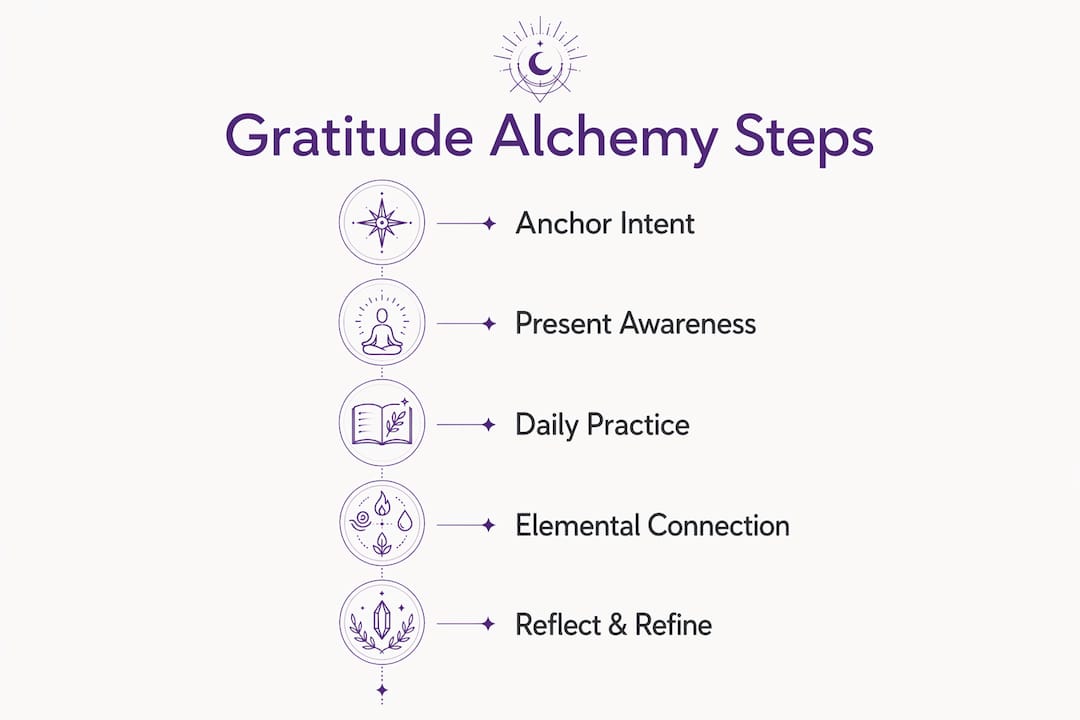
The most effective gratitude practices in alchemical work are visceral and present-moment — tied to something you are actually doing, not an abstract exercise.
Gratitude journal prompts
Write three responses each morning, keeping them specific and sensory:
- What is one thing my body did for me today that I usually ignore?
- What difficulty from this week am I beginning to understand differently?
- What small, ordinary thing — a smell, a texture, a sound — am I genuinely glad exists?
The third prompt is the most alchemically potent. It trains attention toward presence rather than achievement.
Short appreciation meditation (5 minutes)
Sit comfortably. Breathe slowly for one minute to settle the nervous system. Bring one person, place, or quality to mind that you genuinely value. Let the feeling of appreciation expand in your chest before you name it. Stay with the sensation for two to three minutes, then write one sentence about what you noticed.
Micro-practices for daily life
- Pause before drinking your morning tea or coffee and name one thing you are grateful for before the first sip.
- Before using a botanical or mineral alchemy product, set a brief intention: I receive this with gratitude and openness.
- In a difficult conversation, silently acknowledge one quality in the other person before you respond.
- After a workout or walk, thank your body for its effort — out loud if you can.
These micro-practices calibrate the nervous system in real time and build the habit of elemental awareness that deeper ritual work depends on.
| Practice | Frequency | Primary Effect |
|---|---|---|
| Gratitude journaling | Daily, morning | Anchors attention; builds manifestation momentum |
| Appreciation meditation | Daily or 3x/week | Nervous system regulation; deepens presence |
| Micro-practices | Throughout the day | Habit formation; energetic calibration |
| Weekly reflection | Once per week | Integration; tracks inner shifts over time |
How gratitude works — and where it can go wrong
Gratitude shifts your focus from what you lack to what you already have. That sounds simple, but the mechanism runs deeper than positive thinking. Neuroscience research links consistent gratitude practice to activation of the medial prefrontal cortex and changes in dopamine and serotonin pathways — the same systems involved in resilience and emotional regulation.
In practitioner communities, you’ll encounter the idea that gratitude resonates at a symbolic frequency aligned with love. Treat that as a useful metaphor for a felt energetic state, not a lab measurement. What it points to is real: when you genuinely feel grateful, your body relaxes, your perception opens, and you become more receptive to possibility.
The ethical caution is equally real. Gratitude paired with truth is alchemy. Gratitude used to skip over truth is spiritual bypass. If you are grieving, angry, or exhausted, forcing yourself to “just be grateful” doesn’t transmute anything — it suppresses the raw material the alchemy needs.
Three-step validation for authentic vs. forced gratitude:
- Acknowledge first. Name the difficult feeling or situation plainly, without softening it.
- Hold both. Ask: Can I find something true to appreciate here, even while this is hard?
- Check the body. Authentic gratitude feels like a slight opening or warmth. Forced gratitude feels effortful or hollow.
Pro Tip: When gratitude feels impossible, work with shadow material — your critics, your failures, your most uncomfortable patterns. Practitioners consistently report that appreciating contrast yields deeper transformation than gratitude applied only to easy wins.
How botanical and mineral alchemy products can support your practice
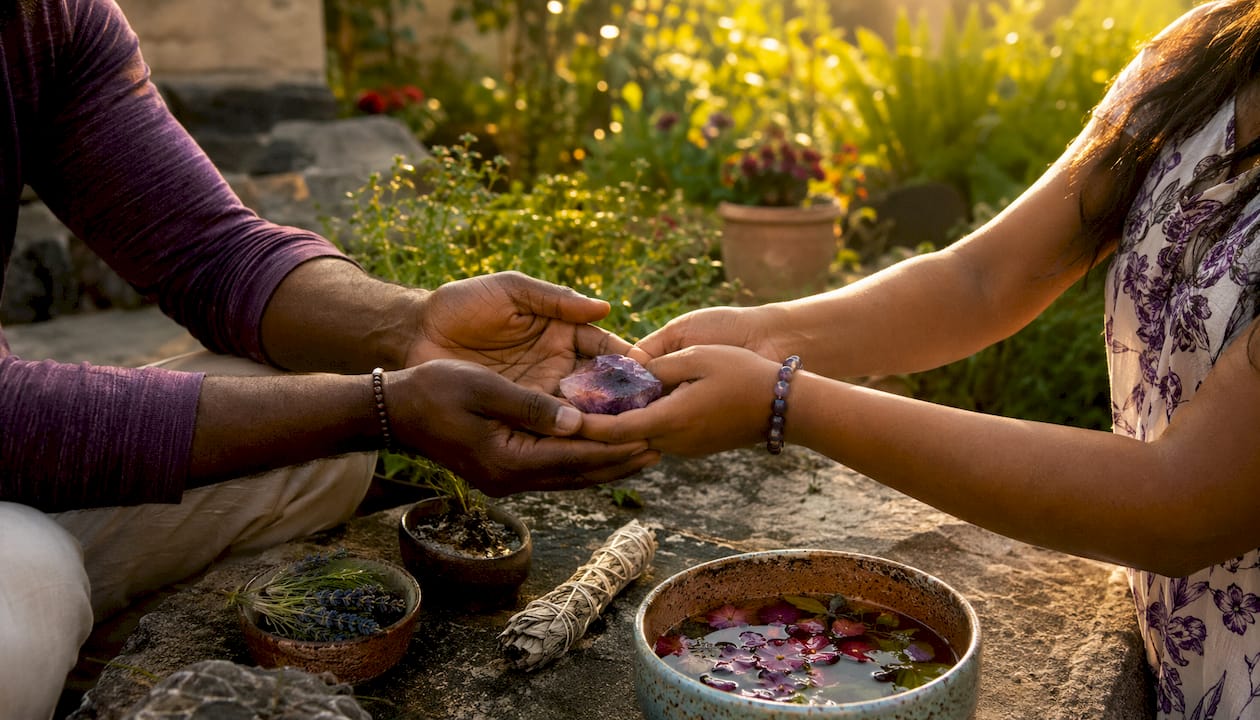
Botanical and mineral supports work best as ritual anchors — physical cues that signal to your nervous system that something intentional is happening. Kejiwastore’s handcrafted products are designed with exactly that purpose in mind.
- Frankincense, Myrrh & Gold Ormus: Take a small amount before your morning journaling or meditation. The mineral matrix and sacred resins have long been associated with prayer and inner clarity. Set the intention: I open to receive and to give thanks.
- Spagyric tinctures: These full-spectrum botanical extracts carry the plant’s body, soul, and spirit — a direct parallel to the inner alchemy you are practicing. Use a few drops before a gratitude meditation to support nervous system coherence and presence.
- Alche-Mist aromatherapy mists: Mist your space or your palms before journaling or ritual. Scent is one of the fastest pathways to a felt state, and aromatic mists in ritual can anchor a specific emotional tone quickly and reliably.
Usage ritual checklist:
- [ ] Choose one product to pair with your practice — don’t layer everything at once.
- [ ] Set a clear intention before use (spoken or written).
- [ ] Start with the smallest suggested amount and observe your response over several days.
- [ ] Note any shifts in mood, clarity, or receptivity in your journal.
Pro Tip: If you are new to mineral or botanical supports, hemp-based nervous system support can also complement a gratitude practice by reducing baseline stress reactivity — making it easier for authentic gratitude to arise naturally.
Your 7-day gratitude-alchemy starter plan
| Day | Practice | Time | Optional Kejiwa Pairing |
|---|---|---|---|
| Day 1 | Write 3 specific gratitudes; focus on the body | 5 min, morning | Frankincense, Myrrh & Gold Ormus before journaling |
| Day 2 | Appreciation meditation | 5 min | Alche-Mist in your space |
| Day 3 | Checkpoint: Review Days 1–2. Did gratitude feel forced or genuine? Adjust prompts. | 5 min | None — reflection only |
| Day 4 | Shadow gratitude: write about one difficulty and find one true thing to appreciate in it | 5 min | Piñon Pineal Spagyria before writing |
| Day 5 | Micro-practice day: use all four daily micro-practices | Throughout day | Alche-Mist mid-afternoon |
| — | Full-spectrum gratitude: write about a critic or obstacle with genuine appreciation | 5 min | Spagyric tincture before practice |
| Day 7 | Checkpoint: Full reflection. What shifted? What feels more open? Set one intention for week two. | — | Frankincense, Myrrh & Gold Ormus |
Most practitioners notice a perceptible shift in emotional tone within 7–14 days of consistent practice. If the plan feels too dense, drop to one practice per day and extend to 14 days. If it feels too light, add a weekly group reflection or wellness ritual to deepen the work.
Common misconceptions that can derail your practice
Gratitude in alchemical work is frequently misunderstood, and those misunderstandings can stall real progress.
- “Gratitude means ignoring pain.” No — it means holding pain and appreciation simultaneously. Skipping the acknowledgment step produces spiritual bypass, not alchemy.
- “Gratitude alone guarantees manifestation.” Gratitude creates the energetic conditions for manifestation; it doesn’t replace discernment, action, or timing.
- “Gratitude is a moral obligation.” Framing it as something you should feel turns it into performance. Authentic gratitude is spontaneous and involuntary — it arises from presence, not willpower.
- “Full-spectrum gratitude means toxic positivity.” Appreciating contrast and difficulty as fuel for growth is the opposite of toxic positivity — it requires honest engagement with what is hard.
- When to seek support: If grief, trauma, or persistent depression makes gratitude feel genuinely inaccessible, that is a signal to work with a therapist or somatic practitioner first. Gratitude practice complements professional support; it doesn’t replace it.
Key Takeaways
Gratitude is the active transmuting force in spiritual alchemy — it works by shifting energetic focus from lack to abundance, supported by nervous system regulation and honest engagement with difficulty.
| Point | Details |
|---|---|
| Gratitude as transmutation | Authentic gratitude converts fear and contraction into wisdom and openness — the core mechanism of inner alchemy. |
| Truth before gratitude | Acknowledge difficult feelings first; gratitude paired with honest appraisal is alchemy, not spiritual bypass. |
| Full-spectrum practice | Appreciating critics, failures, and contrast yields deeper transformation than gratitude applied only to easy wins. |
| Habit timeline | Most practitioners notice a shift in emotional tone within 7–14 days of consistent daily practice. |
| Kejiwastore as ritual anchor | Frankincense, Myrrh & Gold Ormus, spagyric tinctures, and Alche-Mist aromatherapy mists support gratitude practice as intentional nervous-system allies. |
What gratitude in alchemy actually asks of you
Here is the part most guides skip: gratitude in alchemical work is not a comfort practice. It is a confrontational one. The moment you genuinely try to appreciate a critic, a failure, or a season of loss, you run straight into every place you are still contracted, still clinging, still convinced the universe got it wrong. That friction is the raw material.
The practitioners who report the deepest shifts are not the ones who maintain a flawless gratitude journal. They are the ones who kept showing up on the days when gratitude felt impossible — and used that resistance as data. What am I still unwilling to receive? What am I still unwilling to release? Those questions, held with curiosity rather than judgment, are where the real transmutation happens.
Hard days are not failures of practice. They are the practice.
Kejiwastore’s botanical and mineral supports for gratitude-alchemy work

Kejiwastore crafts each product as a ritual ally, not a shortcut. The Frankincense, Myrrh & Gold Ormus is formulated with sacred resins and monatomic minerals to support clarity and receptivity during morning practice. The spagyric tincture collection carries full-spectrum botanical intelligence — body, soul, and spirit of the plant — making each drop a parallel to the inner work you are doing. The Alche-Mist aromatherapy sprays anchor a felt state in seconds, useful before journaling, meditation, or any moment you want to shift your energetic tone intentionally.
Start with one product, read its guidance carefully, and let your practice tell you what it needs next. Browse the full Ormus minerals collection to find the right starting point for your gratitude-alchemy ritual.
Useful sources and further reading
Kejiwastore’s own guides offer the deepest context for pairing inner work with botanical and mineral alchemy:
- The Role of Alchemy in Spirituality: A Seeker’s Guide — foundational principles of the Great Work
- Herbal Alchemy and Inner Alchemy Parallels Explained — how botanical practice mirrors inner transformation
- Types of Spiritual Wellness Rituals: A Cultural Guide — ritual frameworks to adapt gratitude practices respectfully
External perspectives from the research pool:
- The Alchemical Power of Gratitude — practitioner perspective on frequency, truth, and discernment
- Alchemy of the Soul: Transforming Hardship With Gratitude — neuroscience touchpoints and shadow gratitude
- Ways to Practice the Art of Alchemical Gratitude — full-spectrum and contrast-based approaches
- Osho on the Alchemy of Gratitude — the involuntary fragrance teaching
Use these resources as companions to practice, not substitutes for it. Read with discernment, apply with patience, and let your own experience be the final authority.
This article is general information for educational purposes. It is not a substitute for professional medical, psychological, or therapeutic advice. Consult a qualified practitioner for your specific situation.