


Spiritual alchemy is the symbolic art of transmuting the egoic self into awakened consciousness, using the ancient alchemical process as a metaphor for inner purification. Where material alchemy sought to turn lead into gold, spiritual alchemy turns the raw, unrefined aspects of the human psyche into clarity, wholeness, and realized being. This is not chemical experimentation. It is a map for the soul’s deepest work.
The framework at the heart of this tradition is the Magnum Opus, or Great Work, a sequence of symbolic stages that describe how consciousness evolves from fragmentation to integration. These stages are not steps on a checklist. They are living phases you move through, return to, and deepen over time.
Key principles that define spiritual alchemy as a transformative path:
- Metaphorical transmutation: The base metal represents the ego; gold represents awakened, purified consciousness.
- Inner orientation: The process works on the psyche, not the laboratory bench.
- Cyclical progression: Transformation spirals rather than moves in a straight line.
- Symbolic depth: Alchemical symbols encode psychological and spiritual states, not literal chemical instructions.
- Historical consensus: Scholars from Paracelsus to Carl Jung recognized alchemy’s primary significance as an inner science.
What are the four stages of the Magnum Opus?
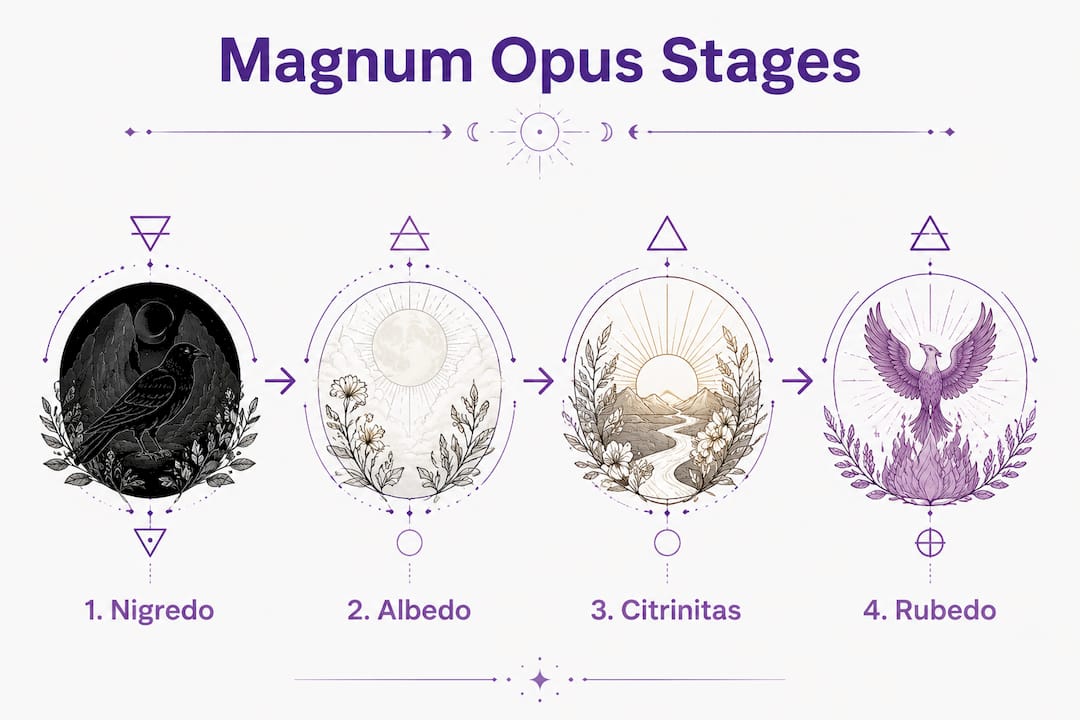
The Great Work unfolds through four primary stages, each representing a distinct phase of inner transformation. Understanding them helps you recognize where you are in your own process, especially when the path feels dark or disorienting.
- Nigredo (the Blackening): Ego structures dissolve. You confront your shadow, your grief, your illusions. This stage often arrives as crisis, and many people mistake it for failure. It is not. It is the necessary decomposition that makes everything else possible.
- Albedo (the Whitening): Clarity emerges after the dark passage. Attachments begin to release. The psyche starts integrating what was previously repressed, and a quieter, more discerning awareness takes hold.
- Citrinitas (the Yellowing): Wisdom dawns. Equanimity, compassion, and a joy no longer dependent on external conditions begin to stabilize. This stage is often overlooked in modern interpretations, but it marks genuine spiritual maturity.
- Rubedo (the Reddening): Full integration and embodiment. The sacred and the mundane are no longer separate. Realization is not a peak experience here; it lives in ordinary daily life.
The process is cyclical, not linear. You may pass through Nigredo multiple times as deeper layers of conditioning surface. Each descent is not regression. It is the Work going deeper.

How Carl Jung connected alchemy to psychological individuation
Carl Jung’s encounter with alchemical texts changed the course of depth psychology. After receiving a copy of The Secret of the Golden Flower, a Chinese alchemical text, he recognized a direct correspondence between alchemical imagery and the symbolic content arising in his patients’ dreams and visions. He named this inner process individuation: the integration of unconscious material into conscious awareness, moving the psyche toward wholeness.
For Jung, the prima materia of alchemy was the psyche’s own raw material. Specifically, it was the unconscious contents most charged, most avoided, and most resistant to change. The alchemical instruction to “find the prima materia where it lies hidden” became psychological advice: look for what carries the most density in your life. That is what goes into the crucible.
The three alchemical principles of Sulfur, Mercury, and Salt map directly onto inner forces. Sulfur represents the volatile, fiery, active dimension of the psyche. Salt represents what is fixed, embodied, and enduring. Mercury mediates between them, the principle of process and transformation itself. Balancing these three within yourself is the Work applied to the soul.
Jung’s contribution was to show that alchemy provides a symbolic map for individuation, emphasizing integration of the unconscious shadow for emotional resilience and genuine maturity. Alchemy was not superstition to him. It was the West’s most sophisticated pre-modern psychology.
What spiritual transformation actually means in 2026
Psychologists today define spiritual transformation as a fundamental change in a person’s meaning system, specifically in the place or character of the sacred in their life. Raymond Paloutzian describes it as a change in “the meaning system that a person holds as a basis for self-definition, the interpretation of life, and overarching purposes and ultimate concerns.” That is a precise, research-grounded definition, and it maps almost exactly onto what spiritual alchemy describes symbolically.
The movement is from fragmented, ego-driven awareness toward unified self-realization. You stop organizing your life around the illusions the ego constructs and begin operating from a deeper, more integrated center. This is not a single event. It is an ongoing process of discovery, conservation, and transformation across a lifetime.
Spiritual alchemy stages parallel this arc precisely. Nigredo disrupts the old meaning system. Albedo clarifies what remains. Rubedo embodies the new orientation in lived experience. The ancient symbolic framework and the modern psychological definition are describing the same territory from different angles.
Historical and theosophical perspectives on alchemy’s true purpose
Paracelsus, writing in the sixteenth century, believed that spiritual changes in the alchemist paralleled the alchemical process itself. The act of breaking down the first matter corresponded to the alchemist mercilessly examining his innermost soul. From that ruin, the spirit arose anew. This was not a side interpretation of alchemy. For many practitioners, it was the primary one.
H. P. Blavatsky, a founder of modern Theosophy, stated plainly that the truest alchemists were not seeking literal gold but psychic transformation of their own personalities. She wrote that “the philosopher’s stone symbolizes the transmutation of the lower animal nature of man into the highest and divine.” The Rosicrucians carried this same understanding, treating alchemical symbols as encoded metaphors for spiritual states rather than laboratory procedures.
One critical warning runs through this tradition: alchemical texts use intentional obscurity. The dense symbolism was designed to protect knowledge from those who would misuse it and to push sincere seekers toward experiential understanding rather than intellectual decoding. You cannot think your way through spiritual alchemy. You have to live it.
Practical ways to engage your own alchemical process
Spiritual alchemy is not an abstract philosophy. It has direct applications in how you work with your inner life, your body, and your daily practice.
- Shadow journaling: Write without editing about what triggers you, what you avoid, and what you judge in others. This surfaces the prima materia, the raw unconscious content that needs to enter the crucible.
- Somatic awareness: The body holds what the mind refuses. Practices like breathwork, yoga, or body scanning help you locate where emotional energy is fixed (Salt) and where it needs to move (Mercury).
- Ritual and symbol work: Working with alchemical symbols, archetypes, or ceremonial objects creates a container for transformation. Aromatherapy in ritual can anchor specific states of consciousness to sensory cues, deepening the symbolic dimension of your practice.
- Dream work: Jung’s patients revealed alchemical imagery spontaneously in dreams. Keeping a dream journal and working with recurring symbols can illuminate which stage of the Work you are currently in.
- Contemplative stillness: Albedo requires quiet. Meditation, time in nature, or simply sitting with discomfort without fixing it allows the purification phase to do its work.
- Plant and botanical allies: Spagyric herbalism, which applies alchemical principles to plant medicine, offers a tangible way to engage the tradition. Spagyric tinctures work with the full spectrum of a plant’s body, soul, and spirit, mirroring the integration the inner Work requires.
Some practitioners also find that CBD wellness practices support the nervous system regulation needed to stay present during the more turbulent Nigredo phases, when the body’s stress response can make inner work harder to sustain.
Common symbols and archetypes in spiritual alchemy
Alchemical symbolism is a language unto itself. Learning to read it transforms how you interpret your own inner experiences.
- The Philosopher’s Stone: Not a physical object but the symbol of perfected consciousness, the completion of the Great Work within the soul.
- Lead and gold: Lead represents the unrefined ego; gold represents awakened, integrated being.
- The Ouroboros (serpent eating its tail): Cyclical transformation, the eternal return of the Work through deeper and deeper layers.
- The Green Lion devouring the sun: The raw, instinctual nature consuming the ego’s solar identity, a Nigredo image.
- The White Queen and Red King: The union of opposites, feminine and masculine, unconscious and conscious, resolved in the sacred marriage (hieros gamos).
- The Caduceus: Mercury’s staff, representing the mediating principle that moves between polarities and enables transformation.
- The Phoenix: Death and rebirth through fire, the Rubedo archetype of emergence from dissolution.
These symbols appear across traditions because they map universal psychological dynamics. When you encounter them in dreams, art, or meditation, they are pointing to real inner processes.
How spiritual alchemy differs from traditional chemical alchemy
Traditional chemical alchemy was a proto-scientific practice combining early chemistry, metallurgy, and philosophy. Practitioners in Hellenistic Alexandria, medieval Islamic scholarship, and Renaissance Europe genuinely worked in laboratories, attempting to transmute base metals into gold, create elixirs of immortality, and produce universal medicines. The work was both literal and symbolic simultaneously, with the two streams always running in parallel.
Spiritual alchemy takes the symbolic stream as primary. The laboratory becomes the inner life. The substances being refined are psychological and energetic states, not physical metals. Where the chemical alchemist heated lead in a crucible, the spiritual alchemist sits with grief, confronts self-deception, or releases a long-held identity.
The critical distinction is orientation. Chemical alchemy sought to change the external world through material transformation. Spiritual alchemy seeks to change the practitioner through inner transformation, with any external change understood as a consequence of that inner shift. As the Hermetic axiom states: as within, so without.
Influential figures and texts that shaped spiritual alchemy
- Zosimos of Panopolis (c. 300 AD): One of the earliest alchemists to emphasize the spiritual nature of the alchemical quest, framing it as religious regeneration of the human soul.
- Paracelsus (1493–1541): Established the Tria Prima (Sulfur, Mercury, Salt) as a universal ontology and explicitly linked the alchemist’s inner transformation to the alchemical process.
- Heinrich Khunrath (1560–1605): His Amphitheatrum Sapientiae Aeternae fused Christian mysticism with alchemical symbolism, reading the Trinity through alchemical principles.
- Jacob Boehme (1575–1624): A Christian mystic whose writings on divine fire and inner transformation drew heavily on alchemical metaphor.
- H. P. Blavatsky (1831–1891): Theosophical founder who reframed alchemy as psychic transformation and the perfection of the human being as the philosopher’s stone.
- Herbert Silberer (1882–1923): Austrian depth psychologist who first recognized the unconscious foundation of alchemical symbolism in his 1914 work Problems of Mysticism and Its Symbolism.
- Carl Gustav Jung (1875–1961): His 1944 Psychology and Alchemy brought scholarly rigor to the symbolic interpretation of alchemical texts, establishing individuation as the psychological equivalent of the Great Work.
- Marie-Louise von Franz (1915–1998): Jung’s collaborator who extended his alchemical research and wrote extensively on the psychological dimensions of alchemical imagery.
Bring the Great Work into your hands
Kejiwastore crafts small-batch botanical and mineral preparations rooted in the living tradition of alchemy. From Ormus minerals that support energetic coherence and cellular vitality to spagyric herbal tinctures that embody the full body-soul-spirit integration of the alchemical process, every product is made with intentional craftsmanship and carefully sourced organic ingredients. Your inner Work deserves tangible support.
Key Takeaways
Spiritual alchemy is the symbolic process of transmuting the egoic self into awakened wholeness, mapped through the Magnum Opus stages and deepened by Jungian psychology and theosophical tradition.
| Point | Details |
|---|---|
| Core metaphor | Spiritual alchemy transforms ego (lead) into awakened consciousness (gold) through inner purification. |
| The four stages | Nigredo, Albedo, Citrinitas, and Rubedo describe dissolution, clarity, wisdom, and full embodied integration. |
| Jungian individuation | Jung identified the Great Work as a symbolic map for integrating the unconscious shadow into conscious wholeness. |
| Modern definition | Spiritual transformation is a fundamental change in a person’s meaning system and relationship with the sacred. |
| Practical entry points | Shadow journaling, somatic practice, dream work, and botanical allies all support active engagement with the alchemical process. |