


Lunar ritual bathing is a purposeful practice of bathing or soaking timed to the Moon’s phases, paired with clear intention, to support stress regulation, emotional processing, and meaningful habit change. The benefits of lunar ritual bathing are rooted in both ancient cross-cultural tradition and modern ritual psychology: when you align a bath with a lunar phase, you create a temporal landmark that focuses attention, anchors commitment, and gives your nervous system permission to reset. A session of 10 to 60 minutes is enough to experience the effect. Always check weather and privacy before bathing outdoors.
At a glance:
- Stress reduction and nervous system regulation through structured, intentional pause
- Emotional clarity and release, supported by journaling and expressive ritual
- Spiritual alignment with natural cycles, reinforcing a sense of meaning and rhythm
- Practical habit formation using the Moon’s phases as recurring commitment anchors
- Recommended session durations vary, with shorter sessions suitable for beginners and longer sessions for a more complete practice
Key Takeaways
Lunar ritual bathing works because it gives your nervous system a structured, recurring moment to reset, and that structure is what produces the real benefits over time.
| Point | Details |
|---|---|
| Evidence-based mechanism | Ritual psychology (temporal landmarks, attention focusing) drives the benefits, not a direct lunar effect. |
| Optimal timing | Schedule your ritual within 48 hours of the phase peak; new moon for intentions, full moon for release. |
| Minimum effective session | 20 minutes is enough for a first ritual; 30 to 45 minutes supports a fuller practice. |
| Track outcomes | Journal perceived stress, sleep quality, and goal clarity after each session; review monthly. |
| Kejiwastore support | Ormus minerals, spagyric tinctures, and botanical aromatherapy mists from Kejiwastore are formulated for safe, intentional ritual use. |
Table of Contents
- What is lunar ritual bathing, and where does it come from?
- What are the real benefits of lunar ritual bathing?
- How to perform a lunar ritual bath, step by step
- Which moon phase should you use for your ritual?
- What should you bring to a lunar ritual bath?
- Safety, privacy, and legal considerations
- How often should you practice, and how do you track results?
- Two sample rituals you can use tonight
- The Kejiwa Alchemy approach to lunar ritual support
- Why ritual is worth taking seriously
- Ritual-support products for your lunar practice
- Sources
What is lunar ritual bathing, and where does it come from?
Bathing as a sacred act appears across cultures and centuries: ancient Roman thermae, Japanese misogi purification, Ayurvedic cleansing practices, and Indigenous sweat ceremonies all treat water as a vehicle for more than hygiene. The Moon’s role as a timekeeper made it a natural anchor for these practices. Lunar ritual bathing, as most contemporary practitioners understand it, is the deliberate act of timing a bath or outdoor soak to a specific Moon phase while holding a clear intention for that session.
What separates a ritual bath from a regular bath is not the water temperature or the salts. It is the structure: a defined opening (setting intention), a focused middle (soaking, breathing, journaling), and a deliberate close (gratitude, grounding). That structure is what activates the psychological mechanisms that make the practice genuinely useful. For a broader look at how spiritual wellness rituals vary across traditions, Kejiwastore’s cultural guide offers helpful context.
Modern variations range widely. Some practitioners sit outside under a full moon wrapped in a blanket, letting moonlight fall on their skin. Others draw a warm bath with Epsom salts, dim the lights, and soak in near-silence. A third approach uses moon water (water left overnight under moonlight) as the ritual medium. Urban dwellers with no outdoor access often create a low-light, candlelit bathroom environment with aromatics and a journal. All of these count. The form is flexible; the intention is what matters.
What are the real benefits of lunar ritual bathing?
The benefits fall into three honest categories: evidence-supported, plausibly supported, and primarily anecdotal.
Mental and emotional benefits are the most grounded. Structured ritual creates what behavioral scientists call a temporal landmark, a moment that mentally separates “before” from “after” and makes new behavior feel more accessible. Research into ritual psychology shows that moon-timed rituals work through attention focusing, commitment devices, and expressive processing rather than any proven direct lunar effect on human physiology. That distinction matters practically: you are not dependent on the Moon doing something to you. You are using the Moon’s cycle as a reliable, recurring cue to do something for yourself.
Emotional processing is another well-supported benefit. Journaling and expressive writing during a ritual bath give your nervous system a structured outlet for stress, grief, or unresolved tension. Practitioners consistently report reduced perceived stress and greater clarity on specific goals after regular new-moon and full-moon sessions.
Physical and wellness benefits are plausibly supported. Warm water immersion reduces cortisol, relaxes muscle tension, and supports parasympathetic nervous system activation. Adding Epsom salts (magnesium sulfate) may support muscle relaxation, though the evidence for transdermal magnesium absorption remains mixed. Aromatics like lavender essential oil have a more consistent evidence base for mild anxiolytic effects. Sleep quality often improves when a warm bath is taken 60 to 90 minutes before bed, a timing that aligns naturally with an evening lunar ritual.
Spiritual benefits are primarily anecdotal and experiential, and there is nothing wrong with that. Feeling aligned with natural cycles, experiencing a sense of release at the full moon, or feeling renewed purpose at the new moon are real subjective experiences. They do not require a causal lunar mechanism to be meaningful. The House of Witchcraft’s overview of moon ritual benefits captures this well: clarity, release, and reduced stress are consistently reported across practitioners regardless of their specific tradition.
How to perform a lunar ritual bath, step by step
The minimal viable ritual: draw a warm bath, set one clear intention, soak for 20 minutes, and write three sentences in a journal before you drain the water.
For a fuller practice, follow this sequence:
- Prepare your space (5 minutes). Dim the lights or use candles. Place your journal, a pen, and any botanicals or aromatics within reach. If you are bathing outdoors, lay out a blanket and confirm your location is private and safe.
- Set your intention (2 minutes). Before entering the water, state your intention aloud or write it down. Be specific: “I am releasing the anxiety I’ve been carrying about [situation]” is more effective than “I want to feel better.”
- Enter the bath or soak (20 to 45 minutes). Add salts, a few drops of properly diluted essential oil, or a botanical infusion to the water. Breathe slowly. Let your body soften. You can play quiet music or sit in silence.
- Ritual actions mid-soak (5 to 10 minutes). Journal, visualize, or speak your intention. For a full-moon ritual, write what you are releasing. For a new moon, write what you are calling in. Even three sentences is enough.
- Close the ritual (3 minutes). Express gratitude, either silently or aloud. Drain the water consciously, imagining what you named releasing as it flows away. Step out slowly.
- Aftercare. Drink water. Wrap yourself in something warm. Avoid screens for at least 20 minutes. A short walk or quiet reading reinforces the parasympathetic state you just cultivated.
Pro Tip: If you have limited time or a small space, a standing “moon soak” works just as well. Fill a bowl with warm water and salts, place your feet in it, hold your intention, and journal for 10 minutes. The ritual structure is intact even when the bath is not.
For detailed sacred bath ritual guidance including salt and aromatic combinations, Kejiwastore’s blog covers the full approach.
Which moon phase should you use for your ritual?
The simplest rule: use the new moon to plant intentions and the full moon to release what no longer serves you. Practitioners recommend scheduling your ritual within 48 hours of the phase peak for the strongest sense of alignment.
| Moon Phase | Ritual Focus | Timing Window | Common Actions |
|---|---|---|---|
| New Moon | Setting intentions, new beginnings | Within 48 hours after the new moon | Journaling goals, visualization, planting seeds |
| Waxing Moon | Building, growth, momentum | Days 3–13 of the cycle | Affirmations, action planning, energy work |
| Full Moon | Release, gratitude, acknowledgment | Within 48 hours of peak | Releasing rituals, forgiveness work, celebration |
| Waning Moon | Clearing, letting go, rest | Days 3–13 after full moon | Decluttering, shadow work, rest practices |
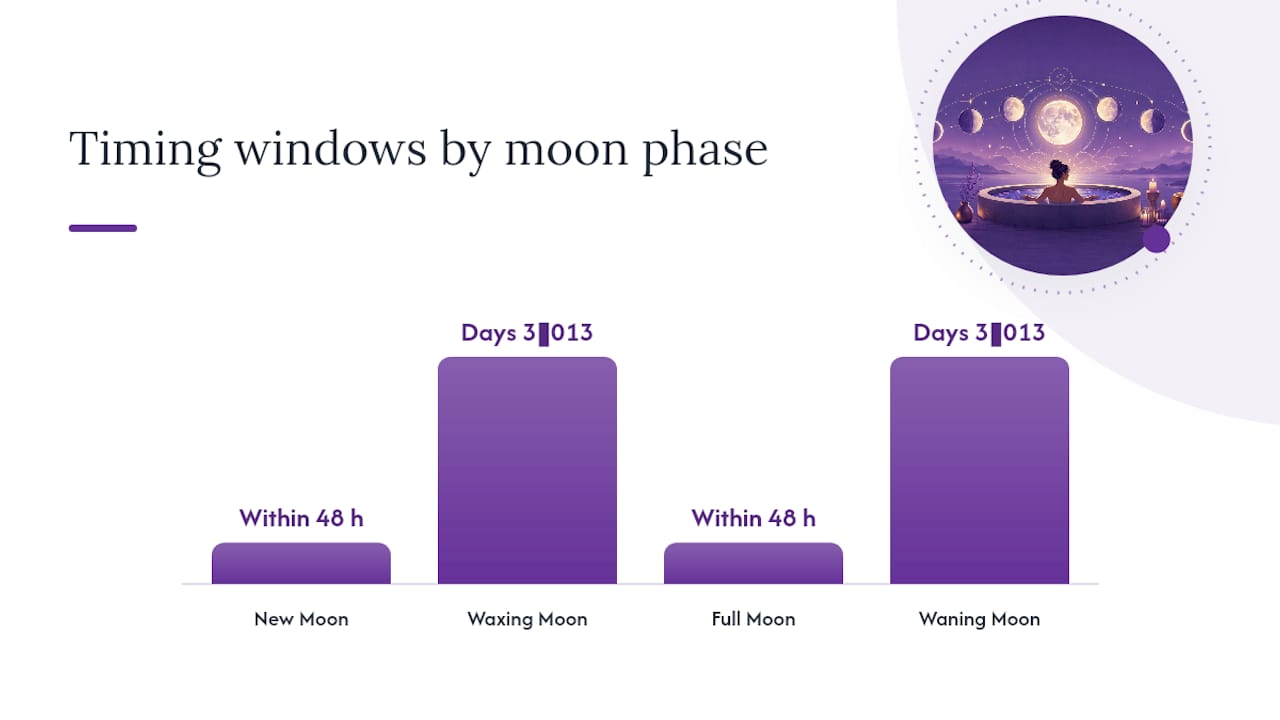
Timing is the element most practitioners underestimate. Working a release ritual during the waxing phase, or a growth ritual during the waning phase, creates an internal friction that reduces the ritual’s felt effectiveness. Aligning your intention with the Moon’s current direction, building or releasing, is what gives the practice its coherence over time.
What should you bring to a lunar ritual bath?
The tools matter less than the intention, but the right materials do deepen the experience. Here is what to consider across each category:
Water and salts form the foundation. Epsom salt (magnesium sulfate) and Himalayan pink salt are the most widely used. Both support relaxation; start with a moderate amount of salt per bath. Moon water, plain water left in a glass container under moonlight overnight, can be added for symbolic resonance.
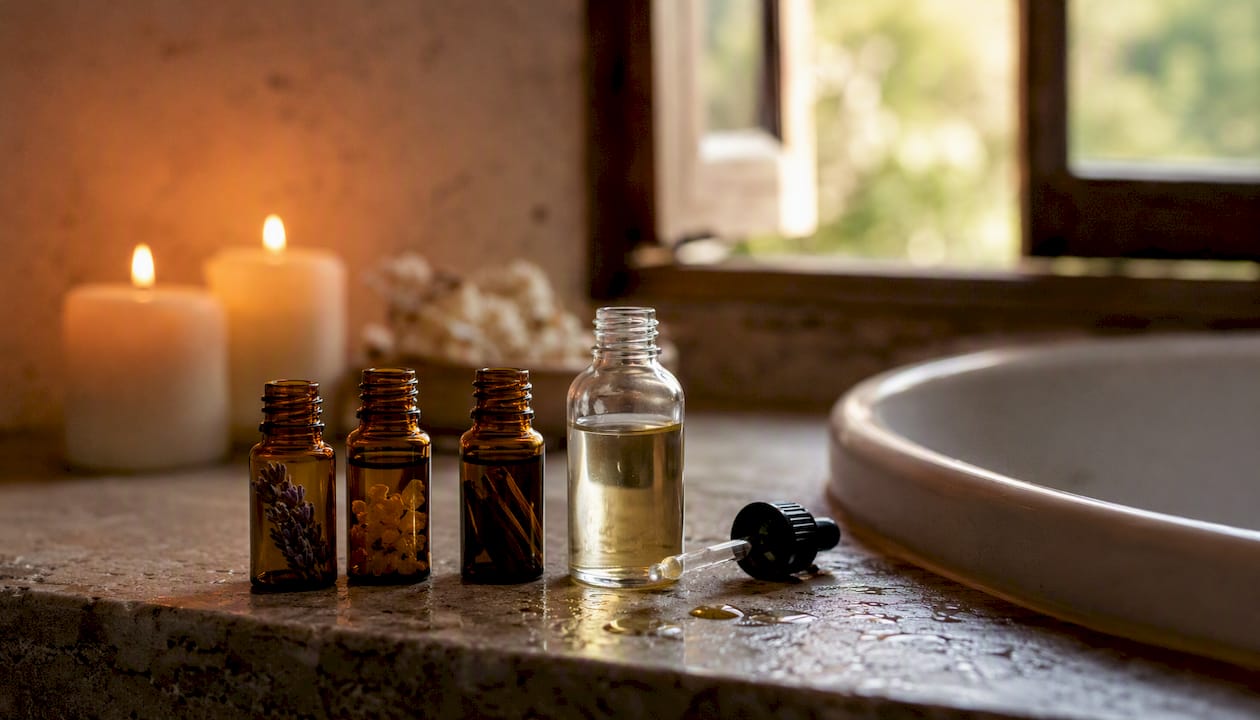
Aromatics shift the nervous system’s state quickly. Lavender, frankincense, and sandalwood are common choices for calming and grounding. Always dilute essential oils in a carrier oil (such as jojoba or sweet almond) before adding them to bathwater: a small number of essential oil drops per tablespoon of carrier oil is the recommended safe dilution. Never add undiluted essential oils directly to water. For safe dilution ratios and scent pairings, Kejiwastore’s aromatherapy in ritual guide is a practical reference.
Some practitioners find that pairing their bath ritual with a CBD relaxation technique deepens the parasympathetic response, particularly for those carrying significant stress or tension.
Herbs and smudging add botanical resonance. Dried lavender, rose petals, or chamomile can be added to a muslin bag and placed in the bathwater. If you smudge before or after your ritual, do so with adequate ventilation. Never burn herbs in a tightly enclosed bathroom.
Crystals are optional but popular. Selenite, moonstone, and clear quartz are commonly associated with lunar energy. Place them at the bath’s edge rather than in the water, as some crystals dissolve or degrade when submerged.
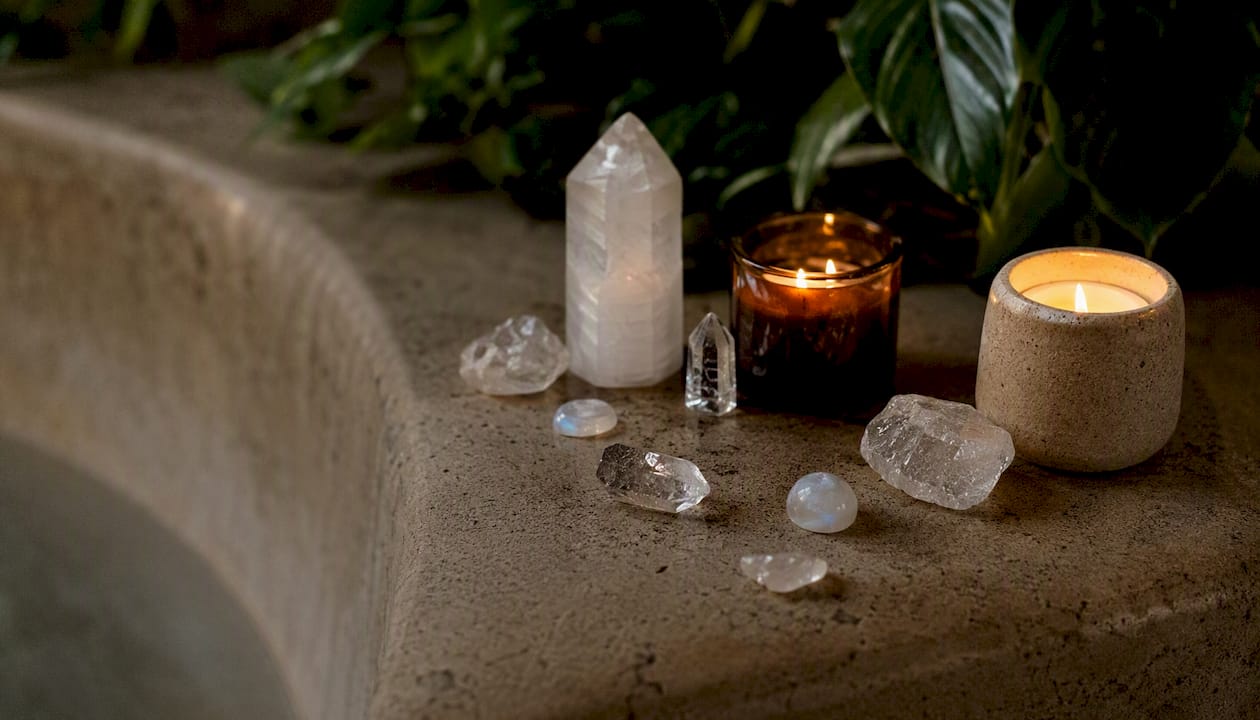
Lighting, journal, and clothing complete the setup. Candles or a low-wattage lamp create the low-light environment that supports melatonin production and a meditative state. Keep your journal and pen within arm’s reach. After an outdoor ritual, a warm, natural-fiber blanket is practical and grounding.
Kejiwastore’s sacred bath ritual blog covers how Ormus minerals, spagyric tinctures, and aromatherapy mists can be incorporated safely into this kind of practice.
Safety, privacy, and legal considerations
A ritual bath is a restorative practice. These precautions keep it that way.
Before you begin:
- Check the weather if bathing outdoors; hypothermia risk is real even in mild temperatures when you are wet and still
- Confirm your location is private; bathing or undressing in public spaces may violate local ordinances
- Test any new botanical or essential oil on a small skin patch 24 hours before full use
- Avoid adding botanicals or essential oils if you have sensitive skin, eczema, or open wounds
Outdoors specifically:
- Use only private property or designated areas within public parks that permit nighttime access; state park night-sky guidelines offer a useful model for understanding outdoor night-visit etiquette and wildlife protection
- Keep light and noise minimal to avoid disturbing wildlife and neighboring visitors
- Never trespass on private land or enter closed park areas after hours
Topical and ingestible products:
- Discontinue use of any bath additive immediately if you experience redness, itching, or irritation, and consult a healthcare professional
- If you use ingestible ritual-support products (tinctures, Ormus minerals), read labels carefully and consult a qualified healthcare provider before use, particularly if you are pregnant, nursing, or managing a health condition
General caution: this article provides general wellness information, not medical advice. Consult a healthcare professional for any health concerns before beginning a new practice.
How often should you practice, and how do you track results?
A common and sustainable cadence for lunar ritual bathing is approximately twice per lunar cycle, aligned with new and full moons. That frequency is enough to build a meaningful habit without creating pressure. If frequent sessions feel overwhelming, practicing about once per month can still support emotional clarity and stress management over time
Sessions around 20 minutes can effectively support relaxation. Longer sessions up to about an hour can provide a fuller experience
To track whether the practice is working for you, keep a simple ritual journal. After each session, note:
- Perceived stress level (1 to 10) before and after
- Sleep quality the night of and the night after
- Clarity on one specific goal or intention
- Any emotional shifts, even subtle ones
Review your notes monthly. Practitioners who track outcomes and pair rituals with small concrete actions report significantly higher perceived effectiveness and adherence over time. If you notice no shift after three full cycles, adjust the ritual’s structure, timing, or tools rather than abandoning the practice entirely.
Two sample rituals you can use tonight
Full-moon release ritual (30 to 45 minutes)
Materials: Epsom salt (1 cup), 5 drops lavender essential oil in 1 tablespoon carrier oil, candle, journal, pen.
- Draw a warm bath and add salts and the diluted oil.
- Light your candle and dim all other lights.
- Before entering, write down one to three things you are ready to release: a belief, a habit, a resentment.
- Soak for 20 to 30 minutes. Breathe slowly. Let the water hold you.
- Read what you wrote aloud. Then tear the paper into small pieces and place it in the water (use plain paper with no ink if you prefer not to add ink to bathwater, or simply hold the paper and then discard it after).
- Drain the bath while visualizing what you named releasing flowing away.
- Dry off, drink water, and sit quietly for 5 minutes before returning to your evening.
Accessibility variation: If a full bath is not accessible, use a foot soak in a bowl with the same salts and oil. The ritual structure remains identical.
New-moon intention-setting ritual (20 to 30 minutes)
Materials: Himalayan salt (½ cup), frankincense or sandalwood oil (diluted), journal, pen, one small object to serve as an intention anchor (a stone, a crystal, a coin).
- Draw a warm bath and add salts and the diluted oil.
- Before entering, write your single clearest intention for the coming lunar cycle. Frame it as already true: “I am building a creative practice that feeds me.”
- Soak for 15 to 20 minutes. Hold your intention anchor in your hand. Breathe it in.
- Write three small, concrete actions you will take this cycle to move toward your intention.
- Close by placing the intention anchor somewhere visible in your home as a daily reminder.
- Aftercare: avoid heavy conversation or screens for 30 minutes. Let the intention settle.
Urban/overcast variation: If you cannot see the Moon, the ritual works indoors with a candle representing lunar light. The Moon’s phase still applies regardless of cloud cover.
The Kejiwa Alchemy approach to lunar ritual support
Kejiwa Alchemy approaches ritual bathing from the intersection of traditional herbalism, spagyric alchemy, and modern botanical science. The product categories most relevant to lunar ritual support include:
- Ormus minerals: small-batch, monatomic mineral preparations used to support energetic coherence and meditative depth during ritual; add to bathwater or take as directed on the label
- Spagyric herbal tinctures: full-spectrum botanical extracts prepared using alchemical methods that preserve both the plant’s physical and energetic properties; used before or after ritual to support nervous system regulation
- Botanical aromatherapy mists: organic, wild-harvested aromatic sprays for grounding, clearing, or uplifting the ritual space; safe for room misting and skin-safe formulations
When sourcing any ritual-support product, look for: certified organic or wild-harvested ingredients, transparent labeling of all components, small-batch production that prioritizes quality over volume, and clear usage guidance.
Safety note: always read product labels in full before use. Ingestible products, including tinctures and Ormus minerals, are not substitutes for medical treatment. Consult a qualified healthcare professional before using any ingestible supplement, especially if you are pregnant, nursing, or managing a health condition. For topical products, patch-test before full use.
For guidance on working with botanical tools in elemental rituals, Kejiwastore’s guide covers safe and traditional applications in depth.
Why ritual is worth taking seriously
Ritual is not superstition dressed up in salt and candlelight. It is one of the oldest technologies humans have for creating psychological structure around change. The Moon’s cycle works as a ritual anchor because it is reliable, visible, and culturally resonant across almost every tradition on Earth. You do not have to believe the Moon is doing something to your biofield for a lunar ritual bath to shift your nervous system state, clarify your thinking, or give you a recurring moment of genuine self-care.
What I find most compelling about this practice is that it asks almost nothing of you technically, and yet it rewards consistency in ways that more effortful practices often do not. The practitioner who shows up imperfectly, with a bowl of warm water and a single sentence of intention, every new moon for six months, will almost always report more benefit than the one who plans an elaborate ritual and never begins.
Adapt freely. The Moon does not grade your ritual.
Ritual-support products for your lunar practice
If you want to simplify your ritual preparation and trust that your botanical ingredients are clean, small-batch, and intentionally made, Kejiwastore’s product range is built for exactly this. A grounding aromatherapy mist can replace a complicated essential-oil setup in seconds. Ormus minerals offer a ritual-bath additive with a depth of energetic and mineral support that standard bath salts do not provide. Spagyric tinctures can anchor your pre- or post-ritual nervous system state with the full-spectrum intelligence of the plant.
Every product is made with organic or wild-harvested ingredients, transparent labeling, and the kind of care that comes from a small operation that actually uses what it makes. Browse the full collection at Kejiwastore and find what fits your practice. As always, consult a healthcare professional before using any ingestible supplement, and read all labels before topical application.
Sources
- Moon Manifestation: Ritual, Placebo, or Circadian Science? What 40,000 Years of Lunar Practice Actually Does to Your Brain | Vibrae
- Unlock Lunar Magic: Ultimate Guide to Moon Rituals 2026 – Moon Ritual Library
- Stateparks
This article is general information, not a substitute for advice from a qualified doctor. Consult a qualified healthcare professional about your own circumstances before acting on anything here.