


Hydrosols are aromatic waters made for gentle, ready-to-use mists and toners, while essential oils are concentrated aromatic oils meant to be diluted or used sparingly. Reach for a hydrosol when you want something you can spray directly on skin, hair, or linens throughout the day. Reach for an essential oil when you need a potent, targeted effect in a diffuser, a diluted blend, or a formulation.
TL;DR:
- Hydrosols contain approximately 0.05% aromatic compounds, making them safe for direct skin and facial use without dilution.
- Essential oils are fully concentrated, oil-soluble, and require dilution into a carrier or emulsifier for safe topical application or water-based blends.
- True hydrosols are water-based distillates with water-soluble botanical compounds, not simply diluted essential oils or shortcuts sold as floral waters.
- Both products should be stored away from heat and light, with hydrosols kept refrigerated after opening for a longer shelf life.
- Quality hydrosols disclose plant source, distillation process, and batch details; beware of unsubstantiated claims or products lacking transparency.
Table of Contents
- Hydrosol vs Essential Oil: The Basic Chemistry Explained
- How Are Hydrosols and Essential Oils Actually Made?
- Composition and Potency: Why the Concentration Gap Matters
- Best Uses for Hydrosols vs Essential Oils in Your Routine
- Safety, Storage, and Shelf Life for Both Products
- How Do You Choose Between a Hydrosol and an Essential Oil?
- How Kejiwa Alchemy Approaches Hydrosol and Essential Oil Quality
- Giving Hydrosols and Essential Oils Their Own Roles
- Ready-Made Hydrosols and Mists for Your Own Practice
- Sources
- FAQ
Hydrosol vs Essential Oil: The Basic Chemistry Explained
The difference between hydrosol and essential oil comes down to one word: solubility. Essential oils are lipophilic, meaning they bond with fats and oils, not water. Hydrosols are hydrophilic, carrying water-soluble aromatic compounds that dissolve directly into water without needing an emulsifier.
That single distinction explains almost everything else in this comparison, from how each is made to how you use it safely.
An essential oil is the concentrated, oil-soluble aromatic fraction pulled from a plant, usually through steam distillation. A hydrosol (sometimes called a floral water or plant water) is the water-based co-product of that same distillation, carrying trace amounts of the plant’s volatile compounds along with its water-soluble constituents.
The numbers show why this matters so much in practice:
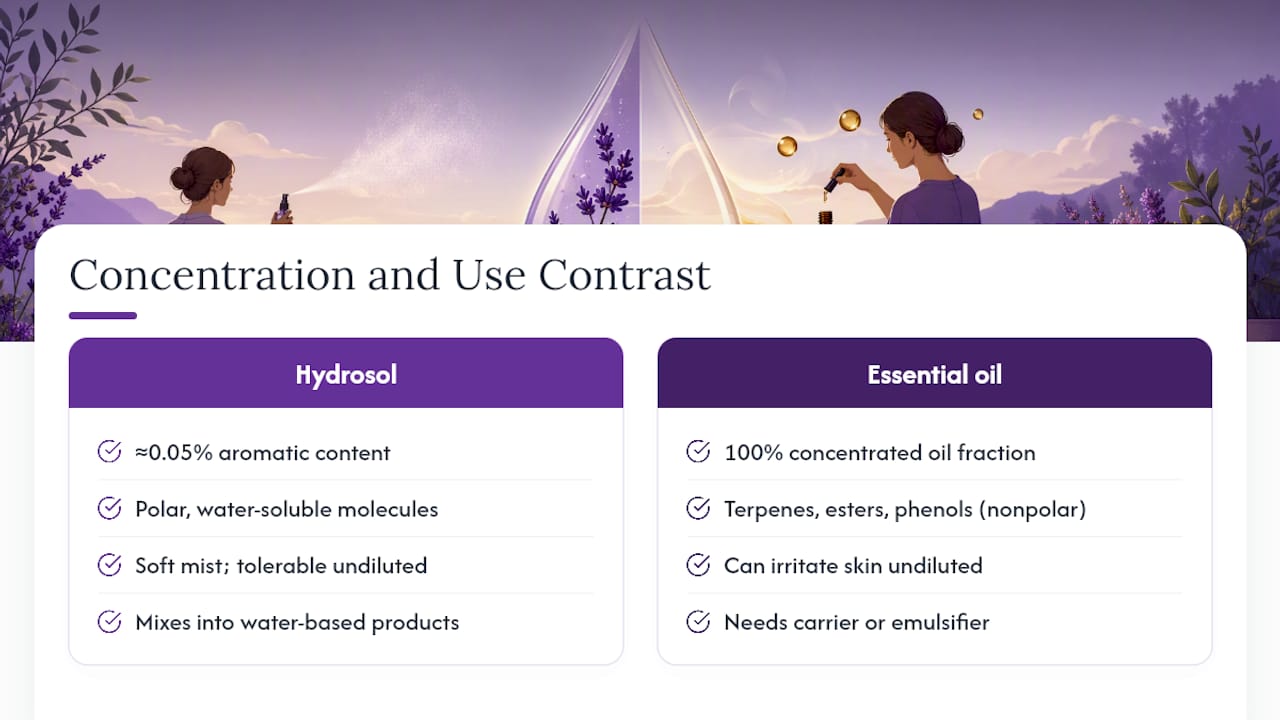
- Essential oils are 100% concentrated aromatic oil.
- Hydrosols contain roughly 0.05% aromatic constituents, with the remaining 99.95% being water.
- That gap, several orders of magnitude, is why an essential oil can burn skin undiluted while a hydrosol can be misted directly onto your face.
Hydrosols also run acidic, typically landing in a pH range around 3.5 to 6.5, which affects how they behave in formulations and why some need a preservative system to stay stable over time.
How Are Hydrosols and Essential Oils Actually Made?
Both products usually start in the same still, which is exactly why people confuse them. The separation happens through a process that has stayed largely unchanged for centuries, even as the equipment has modernized.
- Steam or hydro-distillation begins. Plant material sits in or above water, and steam is passed through it, rupturing the tiny sacs that hold aromatic compounds.
- Vapor carries the compounds upward. The steam, now loaded with both oil-soluble and water-soluble aromatics, moves into a cooling condenser.
- The vapor condenses and separates into two phases. Oil-soluble compounds float to the top as essential oil. Water-soluble compounds and trace amounts of oil remain suspended in the water below, forming the hydrosol.
- The two fractions are collected separately, though a well-run distillery treats both as finished products, not one as a byproduct of the other.
Collection timing, the ratio of plant material to water, and the specific distillation method all shift the final hydrosol’s aroma, acidity, and shelf stability. A rushed or overloaded still produces a thinner, less characterful hydrosol even when the essential oil yield looks fine.
This is also where quality gets murky in the marketplace. A true hydrosol is a genuine distillate carrying its own water-soluble chemistry, not a convenience product made by stirring a few drops of essential oil into water. Many bottles labeled “floral water” on store shelves are exactly that shortcut, and they do not carry the same water-soluble botanical constituents as a real hydrosol. If a label skips distillation details entirely, treat that as a red flag rather than an oversight.
Composition and Potency: Why the Concentration Gap Matters
The concentration difference between these two products is not subtle. It is the entire reason your skin can tolerate one undiluted and not the other.
By the numbers: Hydrosols run at roughly 0.05% aromatic constituents against 99.95% water, while essential oils are the fully concentrated oil fraction. That gap of several orders of magnitude is why a rose hydrosol feels like a soft mist and rose essential oil, undiluted, can irritate skin within seconds.
Hydrosols carry mostly polar, oxygenated, water-soluble molecules, along with faint traces of the plant’s essential oil. GC-MS studies commonly identify compounds like linalool, carvacrol, and alpha-terpineol in hydrosols, and these have shown measurable antioxidant and antimicrobial activity in lab settings, though that activity varies by plant species and how the batch was distilled.
Essential oils, by contrast, pack a dense mix of terpenes, esters, and phenols in their full, undiluted form. That density is exactly what makes them powerful in a diffuser and risky against bare skin.
The solubility difference also dictates how each behaves once you try to use it. Hydrosols mix into water-based products immediately, no extra step required. Essential oils resist water entirely and need a carrier oil, emulsifier, or solubilizer before they will blend into anything water-based without separating into an oily film on top.
Best Uses for Hydrosols vs Essential Oils in Your Routine
Matching the product to the task is where most people go wrong, usually by treating a hydrosol like it needs dilution or an essential oil like it doesn’t.
Where hydrosols shine:
- Facial toners and setting mists, used directly after cleansing
- Linen and room sprays, since the water base won’t stain fabric
- The water phase in homemade lotions, gels, or sprays, where it replaces plain water
- Cooling compresses or aftersun mists for a light aromatic lift
Where essential oils shine:
- Diluted massage or body oil blends, mixed into a carrier oil
- Perfumery and layered scent work, where precision matters
- Targeted aromatherapy, like a drop on a cotton pad or in a personal inhaler
- Strong diffusion, where a little goes a long way through an entire room
Formulation is where the split gets practical. A hydrosol fits directly into any water-phase product, no extra ingredients needed. An essential oil dropped into water alone will just float, so it needs a carrier oil for skin application or a solubilizer if you want it to blend into a spray without separating.
Pro Tip: Pair the two intentionally rather than choosing one over the other. A lavender hydrosol makes an excellent gentle carrier for a pillow mist, and adding one or two properly diluted drops of lavender essential oil (mixed first into a small amount of solubilizer or carrier) gives that same mist more staying power without overwhelming the blend.
Safety, Storage, and Shelf Life for Both Products
Neither hydrosols nor essential oils are risk-free, even though hydrosols feel far gentler in daily use.
For essential oils, the rules are stricter because the concentration demands it:
- Dilute before skin contact. A common practitioner range for adult facial blends runs 0.5% to 2%, lower still for sensitive skin, children, or anyone pregnant.
- Patch test every new oil on a small area of skin and wait 24 hours before wider use.
- Keep oils away from eyes and mucous membranes entirely, since even diluted blends can sting badly on delicate tissue.
- Check with a doctor before use during pregnancy or with young children, since several common oils carry specific cautions for those groups.
Hydrosols are gentler by nature but not automatically risk-free. They can still trigger irritation or allergic reactions in sensitive individuals, and because they are water-based, a poorly preserved batch is vulnerable to microbial growth over time.
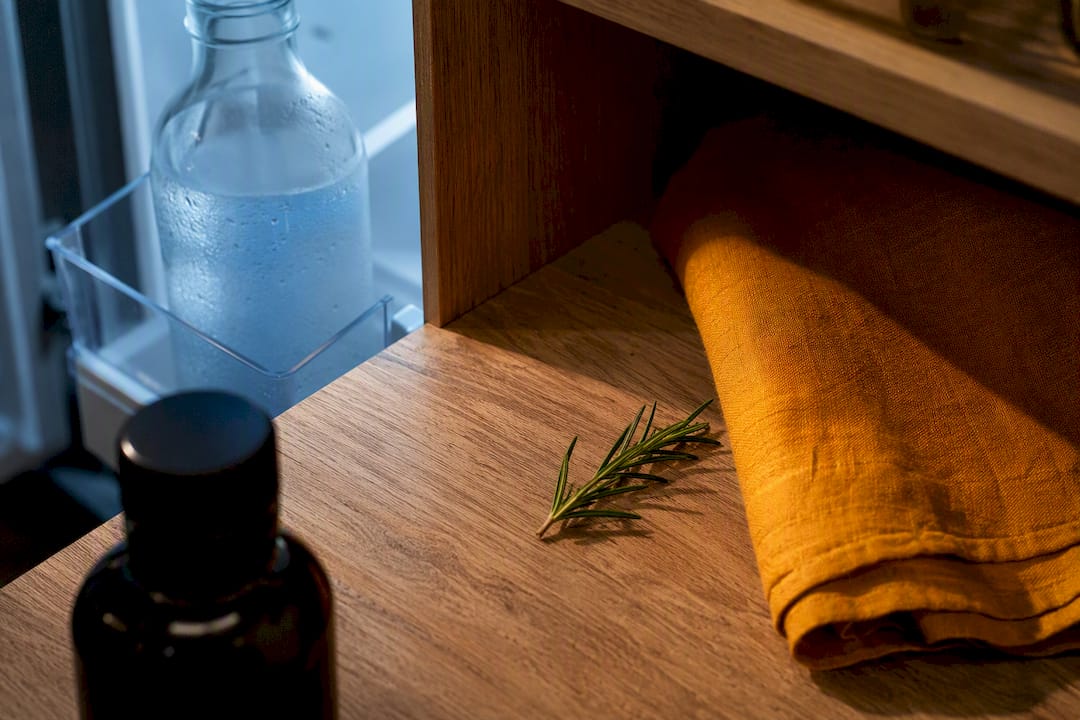
Store both away from direct sunlight and heat. Essential oils, kept in dark glass bottles with tight lids, typically hold their quality for one to several years depending on the oil. Hydrosols are more delicate. Most keep for six months to a year unopened, and refrigeration after opening extends that window and slows any microbial activity, particularly for batches without an added preservative system.
One more thing worth knowing: there is no standardized FDA oversight specifically for hydrosols in the United States. That regulatory gap means quality varies enormously between producers, so favor brands that share their distillation method, plant source, and batch details openly rather than hiding behind a pretty label.
How Do You Choose Between a Hydrosol and an Essential Oil?
Start with the question of frequency and contact. If you’re spraying something on bare skin multiple times a day, a hydrosol is almost always the safer, more sustainable choice. If you need a concentrated, specific effect, whether that’s a deep massage blend or a strong scent in a diffuser, an essential oil diluted correctly is the right tool.
A few checks make the decision easier every time you shop:
- Does the label name the plant’s botanical name, not just a common name like “lavender”?
- Does the seller disclose distillation method and batch or harvest date, which signals a transparent, true distillate rather than a stirred-together floral water?
- Is GC/MS or lab testing data available, even as a summary, confirming what’s actually in the bottle?
- Does the product come with clear dilution guidance if it’s an essential oil meant for skin use?
For a simple, safe starter routine: mix a facial mist using a hydrosol as your entire base, no dilution needed after a patch test. For a massage oil, start conservatively with essential oil diluted into a carrier at around 0.5% to 2% for adult use, adjusting down for sensitive skin. Detailed grounding essential oil blend recipes walk through these ratios step by step if you want a guided starting point.
Pro Tip: When in doubt about a skin reaction, stop using the product and consult a dermatologist rather than trying to “power through” irritation. Concentrated botanicals are not something to troubleshoot on your own.
How Kejiwa Alchemy Approaches Hydrosol and Essential Oil Quality
Small-batch production means every distillation run gets individual attention, not a factory average. [brand_signal] That approach shapes how Kejiwa Alchemy sources plant material, tracks batches, and shares information with customers who want to know exactly what’s in their bottle.
[author_bio]
Judging hydrosol quality starts with the same questions any careful formulator asks: What plant, what part, what distillation method, what batch date? A true hydrosol carries its own water-soluble chemistry, distinct from simply diluting an essential oil in water, and that distinction only matters if the producer is willing to document it.
In practice, that transparency shows up in a few places:
- Clear botanical naming on every product, not vague marketing terms
- Batch-specific production notes available to anyone who asks
- A breakdown of plant alchemy preparation types so customers understand what separates a hydrosol from a tincture or an aromatic oil
- Guidance on ritual-friendly uses, like daily misting for grounding or diluted blends for intentional practice
Giving Hydrosols and Essential Oils Their Own Roles
Treat hydrosols as your daily companion and essential oils as your occasional, intentional tool. A rose or lavender hydrosol can live on your nightstand for misting anytime, while a diluted essential oil blend earns its place in a specific ritual or a targeted moment, not constant use. That division keeps you safe and keeps each product doing what it does best. When you’re unsure about a reaction or a new oil, a patch test and a little patience go further than guessing.
— Kejiwa
Ready-Made Hydrosols and Mists for Your Own Practice
If everything above has you convinced but you’d rather not manage your own still, some companies offer botanical aromatics and aromatherapy mists designed to provide a balance between quality and convenience.

Some producers create batches that are small and source from organic and wild-harvested botanicals, following transparency standards such as clearly identifying plant sources, distillation details, and batch information. Before you buy any aromatic mist or oil, anywhere, check whether the seller will actually answer questions about sourcing and production. Our guide to verifying aromatherapy ingredient quality walks through exactly what to look for, and the same sourcing logic applies whether you’re shopping for botanical CBD products or aromatic hydrosols.
If you’re ready to bring a ritual-grade mist or elixir into your routine, browse the current aromatherapy mist collection and pick a scent that matches the role you want it to play, whether that’s grounding, focus, or evening wind-down.
Sources
- Hydrosol — Tisserand Institute
- Unlocking the Potential of Hydrosols: Transforming Essential Oil Byproducts into Valuable Resources — PMC
- Hydrosol: Uses and safety — Healthline
- Antioxidant and Antimicrobial Activity of Plant Hydrosol and Its Potential Application in Cosmeceutical Products — Journal article (DOI)
FAQ
What do you use hydrosol for?
Hydrosols work as facial toners, setting mists, linen sprays, and the water base in homemade lotions or gels, offering a gentle way to add plant aromatics to a routine without dilution.
Do hydrosols need to be refrigerated?
Refrigeration isn’t mandatory but extends shelf life and slows microbial growth, especially after opening; most hydrosols last six months to a year unopened when stored away from heat and light.
Is hydrosol good for your skin?
Hydrosols are generally gentle enough for direct skin use and some show antioxidant or antimicrobial activity in lab studies, though they can still cause irritation in sensitive individuals, so a patch test is worth doing first.
Can hydrosol replace essential oil?
Not entirely. Hydrosols suit gentle, frequent skin contact, while essential oils deliver the concentrated potency needed for strong diffusion or targeted aromatherapy that a hydrosol simply can’t match.
Is hydrosol the same as essential oil diluted in water?
No. A true hydrosol is a genuine distillate carrying its own water-soluble compounds, while diluting essential oil in water creates a different, less stable product that lacks the same chemistry.