


Yes, essential oil mists are safe to use, but only within limits your nose can’t measure on its own. Dilute every blend, run diffusers in intervals rather than around the clock, and keep bottles and devices away from children, pets, and anyone managing asthma or COPD. Skip undiluted sprays and continuous heavy misting entirely. And if a bottle is ever swallowed, call Poison Control at 1-800-222-1222 before you do anything else.
TL;DR:
- Diffuse essential oils in intervals of 30 to 60 minutes on, then off, to prevent nose adaptation and reduce volatile organic compound buildup.
- Use diffuser devices that are easy to clean and placed in ventilated areas, avoiding open flames or unattended warmers that pose fire risks.
- Dilute oils at 1% to 5% for adults and lower concentrations for children and sensitive individuals, ideally using about 3 to 5 drops per reservoir.
- Keep mists away from pets, especially cats and birds, by ensuring animals have access to scent-free rooms, and consult a doctor before diffusing around pregnant women or infants.
- Store oils in dark glass bottles with labels indicating dilution and expiry dates, and call Poison Control immediately if ingestion occurs.
Table of Contents
- What Does Safe Essential Oil Mist Use Actually Look Like?
- How Do You Calculate a Safe Essential Oil Dilution?
- Who Needs Extra Caution With Essential Oil Mists?
- How Do You Choose a High-Quality, Safer Essential Oil Mist?
- Storing Mists Safely and Handling Accidental Exposure
- Kejiwa Alchemy’s Approach to Formulating Safer Mists
- Does Sunlight Change the Rules for Essential Oil Mists?
- What I’ve Noticed About Common Mist Mistakes
- A Pre-Diluted Option for Readers Who Want the Guesswork Removed
- Sources
- FAQ
What Does Safe Essential Oil Mist Use Actually Look Like?
Most safety complaints trace back to one habit: leaving the diffuser running for hours because the room “just needs a little more scent.” That instinct works against you. The Tisserand Institute’s safety guidelines recommend intermittent diffusion, roughly 30 to 60 minutes on, then 30 to 60 minutes off, instead of continuous operation. Constant misting does two things you don’t want: it trains your nose to stop noticing the scent (so you crank up the dose to compensate), and it lets volatile organic compounds build up faster than your room can clear them. The EPA’s research on indoor air quality points to short bursts of open-window ventilation as the more effective fix, not heavier misting.
Device choice matters just as much as timing.
- Ultrasonic diffusers use a water reservoir, which is gentle on oils but can grow bacteria or mineral buildup if not cleaned between fills.
- Nebulizing diffusers disperse a more concentrated mist with no water dilution, meaning smaller rooms need shorter run times.
- Heated oil warmers work by gently warming oil to release scent, but they carry a real fire risk if left unattended near fabric or paper.
- Open-flame burners should be avoided entirely; a candle warming a dish of oil is one of the easiest ways to start a house fire.
Placement rounds out the picture. Set devices in ventilated rooms, away from curtains, bedding, and electrical outlets, and high enough that curious toddlers and pets can’t tip them over. Keep heated diffusers away from smokers and open flames, and never leave one running in a room you’re not in.
Pro Tip: Set a phone timer the moment you switch a diffuser on. It sounds almost too simple, but it’s the single easiest habit that prevents all day misting.
How Do You Calculate a Safe Essential Oil Dilution?
Dilution is where most home blenders either play it too safe or drastically overshoot. Kaiser Permanente’s guidance puts general adult topical and diffusion use at 1% to 5% concentration, with lower ranges of roughly 0.5% to 2.5% recommended for children and anyone with sensitive skin or respiratory conditions.
The math is simpler than it looks:
- 1% dilution ≈ 6 drops of essential oil per ounce of carrier or water.
- A 2-ounce room spray at 1% uses about 12 drops of essential oil topped with witch hazel or distilled water.
- A standard diffuser reservoir (roughly 100 to 150 mL of water) typically needs only 3 to 5 drops total, since the mist disperses across the whole room rather than sitting on skin.
Undiluted oil belongs nowhere near skin contact. Never pour it straight into a bath (it floats on the surface and sits directly against skin instead of dispersing) and never spray a concentrated blend where it might land on bare arms or a child’s face. Cold-pressed citrus oils add a separate wrinkle: lemon, bergamot, and other expressed citrus oils are phototoxic, meaning they raise your skin’s sensitivity to UV light dramatically after topical contact, according to the American College of Healthcare Sciences.
Who Needs Extra Caution With Essential Oil Mists?
Some households need a stricter set of rules than the general guidance above, and it’s worth spelling out exactly who and why.
- People with asthma or COPD. The American Lung Association notes that prolonged exposure to concentrated VOCs from any scented mist can trigger respiratory irritation, so anyone managing a chronic lung condition should talk to a clinician before adding diffusion to their routine.
- Pets, especially cats and birds. Microdroplets settle on fur and feathers, and animals ingest them during grooming or preening. Cats process compounds very differently from humans, and birds have famously sensitive respiratory systems. Keep a pet-free room available and leave doors open so animals can leave a scented space on their own.
- Pregnant people and infants. Certain oils are commonly discouraged during pregnancy or around babies, and reactions in infants can escalate faster than in adults. A quick conversation with a doctor or midwife before diffusing anything new is worth the five minutes, and light, well-ventilated diffusion (or skipping it altogether in a nursery) is the safer default.
How Do You Choose a High-Quality, Safer Essential Oil Mist?
Essential oils are regulated as cosmetics, not pharmaceuticals, which means purity claims on a label aren’t independently verified unless the brand does that work voluntarily. That’s why Kaiser Permanente points to independent testing as a meaningful trust signal, and GC/MS batch testing (gas chromatography, mass spectrometry) is the standard method labs use to confirm an oil is what the label says it is, free of synthetic fillers or contaminants. Kejiwastore breaks down what that testing actually catches in its guide to verifying quality aromatherapy ingredients.
Beyond testing, a trustworthy label tells you:
- The botanical name (not just “lavender,” but Lavandula angustifolia).
- Extraction method, since cold-pressed citrus oils carry different phototoxic risks than steam-distilled ones.
- A recommended dilution percentage for the specific product.
- Storage and shelf-life information.
Walk away from anything listing a vague “fragrance blend” with no ingredient breakdown, a heavily alcohol-based formula with no safety instructions, or a bottle with no childproof cap. Those gaps usually mean the maker skipped steps you’d want done for you.
Storing Mists Safely and Handling Accidental Exposure
Store essential oils and finished mists in dark glass bottles with childproof caps, kept in a locked or high cabinet well out of reach. If you blend your own sprays at home, label each bottle with its dilution percentage and the date you made it. Undiluted oils degrade faster than most people expect, and an unlabeled bottle six months from now is a guessing game you don’t want to play.
If an accident happens, act fast and in this order:
- Ingestion: Call Poison Control immediately at 1-800-222-1222. Do not induce vomiting, and keep the bottle nearby so you can read the label to the operator.
- Eye exposure: Flush with a fatty oil like olive or sesame oil first to help lift the essential oil, then rinse with water, and seek medical care if pain or vision changes persist.
- Skin irritation: Rinse the area and apply a fatty carrier oil or full-fat milk to absorb any residue; stop use and get medical attention if redness spreads or worsens.
Kejiwa Alchemy’s Approach to Formulating Safer Mists
Kejiwastore builds every aromatherapy mist in small batches, using organic and wild-harvested botanicals sourced with the same care we’d want if we were the ones bringing a bottle home. Transparency isn’t an afterthought here; it’s built into how we write product pages, because we’d rather you know exactly what’s in a bottle than trust a vague label.
If you want the practical side of things, our post on aromatherapy mist uses for sleep, mood, and focus walks through recommended use intervals for different intentions. Pre-formulated mists should always include dilution guidance and suggested frequency on the label itself, and we’d encourage checking for batch-test information wherever a brand offers it, ours included.
Does Sunlight Change the Rules for Essential Oil Mists?
Yes, and this is the safety detail most people skip entirely. Phototoxicity, the dramatic increase in UV sensitivity caused by certain oils, comes primarily from furocoumarins found in cold-pressed citrus oils like bergamot, lemon, and lime, according to ACHS. The risk is almost entirely a topical one: it happens when oil sits on skin that later meets sunlight, not from ambient mist drifting through a room.
That distinction matters for how you use a mist outdoors versus indoors. Spraying a citrus-forward blend into the air on a patio is generally fine, since you’re not applying it to skin. The danger shows up when a fine mist settles on exposed arms, shoulders, or a face and that skin heads outside within the next several hours. Indoors, the same caution applies if you’re near a sunny window; a mist that lands on skin can still react to strong indirect sunlight through glass.
A few practical adjustments cover most situations:
- Skip citrus-forward mists on skin (not just perfume, but any spray that could land on bare skin) before beach days, pool time, or long stretches outdoors.
- If a mist does land on skin before sun exposure, wash the area with soap and water as soon as you can.
- For outdoor diffusion, choose enclosed or shaded areas where drifting mist is less likely to settle directly on sunbathing skin.
- Reserve citrus-heavy blends for evening use or fully indoor spaces away from direct light exposure.
None of this means citrus oils are off limits. It means matching the oil to the setting, the same way you’d think twice about a strong sunscreen day versus a quiet evening at home.
What I’ve Noticed About Common Mist Mistakes
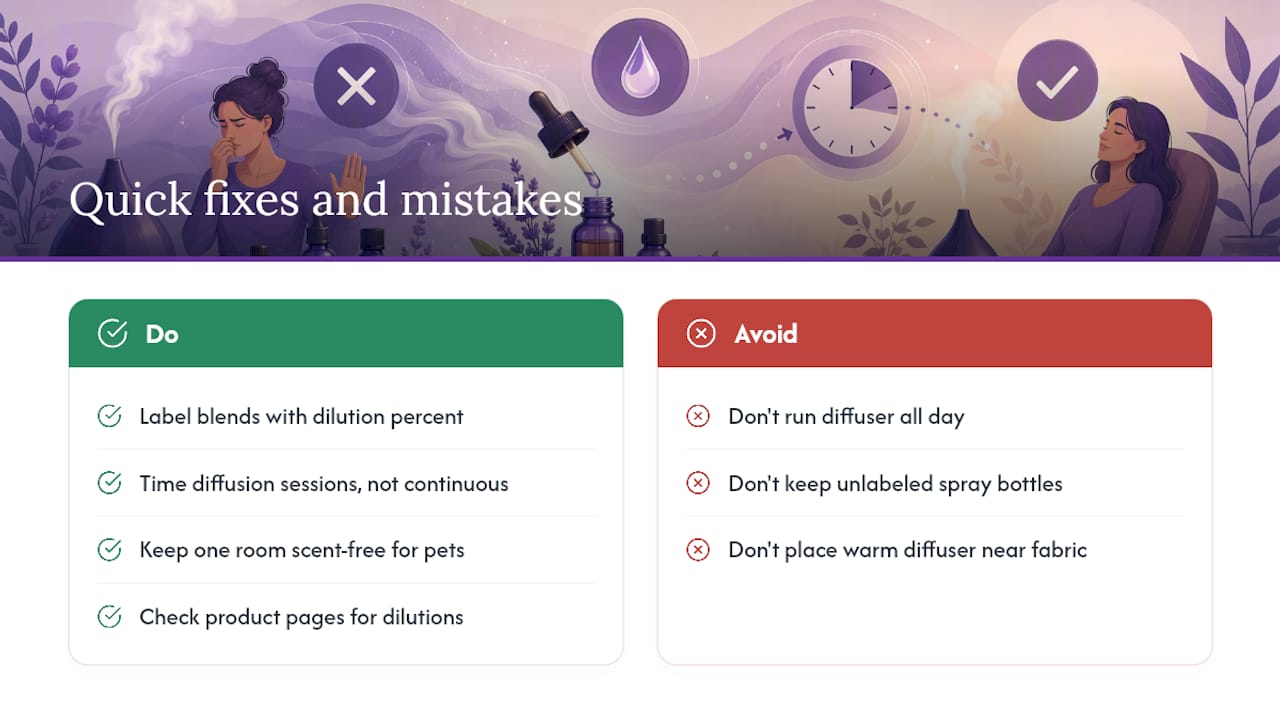
The mistakes I see most often aren’t dramatic. They’re small habits that compound over weeks: a diffuser left running from morning until bedtime, a homemade spray bottle with no label six months after it was mixed, a warm diffuser sitting an inch from curtain fabric.
The fixes are just as small. Label every blend with its dilution percentage the day you make it. Time your diffusion sessions instead of letting them run indefinitely. If you share a home with a cat, bird, or dog, leave one room scent free and let the door stay open. None of this requires expertise, just a little consistency. If you’re ever unsure about a specific blend, our product pages spell out exact dilution instructions rather than leaving you to guess.
— Kejiwa
A Pre-Diluted Option for Readers Who Want the Guesswork Removed
If calculating drops per ounce and tracking dilution percentages sounds like more math than you signed up for, Kejiwastore’s Botanical Aromatics collection offers ready-made mists formulated for safe aromatic use from the start.

Each product page in the collection includes recommended dilution and usage guidance, so you’re not left estimating how many drops belong in a 2-ounce bottle or wondering whether a blend is strong enough for a nursery versus a living room. For readers who’d rather spend their evening lighting candles and settling into a ritual than measuring milliliters, that’s the whole point of a pre-formulated mist. Browse the Botanical Aromatics line and pick a blend suited to your space, or pair it with a spagyric herbal tincture if you’re building out a broader wellness routine.
Sources
- Essential oils: are they safe? | Kaiser Permanente
- Essential oils: harmful or helpful? | American Lung Association
- Safety guidelines | Tisserand Institute
Talk to a doctor about anything specific to your medical history or medications before starting a new aromatherapy routine.
This article is general information, not a substitute for advice from a qualified doctor. Consult a qualified healthcare professional about your own circumstances before acting on anything here.
FAQ
How many drops of essential oil equal a 1% dilution?
About 6 drops of essential oil per ounce of carrier or water gives you roughly a 1% dilution, the low end of the typical adult range.
Can I diffuse essential oil mists around my cat or bird?
Keep a pet-free room available with the door left open, since cats and birds are especially sensitive to volatile compounds and can ingest droplets during grooming or preening.
What should I do if a child swallows essential oil?
Call Poison Control immediately at 1-800-222-1222, don’t induce vomiting, and keep the bottle handy so you can read the ingredients to the operator.
How long should I run a diffuser at one time?
Run it for 30 to 60 minutes, then turn it off for 30 to 60 minutes, rather than diffusing continuously throughout the day.
Are pre-diluted mists safer than mixing my own?
Pre-formulated mists often list recommended dilution and usage guidance on the label, which removes the guesswork involved in measuring your own blends.