


Work with the moon by matching your action to the light: set intentions and clear space at the New Moon, build and grow through the Waxing Moon, harvest and charge at the Full Moon, and release or work with roots during the Waning Moon. Choose herbs by the plant part your ritual calls for. Aerial parts (flowers, leaves) tend to peak in potency as the moon grows toward full, while roots are traditionally gathered as the light fades.
- New Moon: clear the space, whisper or write your intention over a cup of chamomile tea.
- Waxing Moon: prepare a lavender or jasmine infusion to support growth and momentum.
- Full Moon: harvest mugwort or cedar, set out a charging bowl of water on your windowsill.
- Waning Moon: pull roots like burdock, brew a releasing tea, compost what you’re letting go.
A few cautions before you begin: harvest only what you can responsibly regrow, test any new herb for allergies, and consult a qualified herbalist before medicinal use. If you want the full script, a ready-to-do ritual sits later in this guide, timed to run about 10 to 12 minutes.
Key Takeaways
Lunar plant medicine works by matching a specific ritual action, herb, and plant part to each of the moon’s four major phases.
| Point | Details |
|---|---|
| Match action to phase | New Moon for intention, Waxing for growth, Full for charging/harvest, Waning for release. |
| Harvest by plant part | Gather aerial parts (leaves, flowers) as the moon waxes; roots as it wanes. |
| Full Moon shows the strongest signal | A comparative study found higher phytochemical concentration in Full Moon harvests. |
| Source ethically | Rotate wild-harvest sites, buy organic where possible, and defer to Indigenous custodians on restricted plants. |
| Prefer ready-made ritual tools | Kejiwastore’s spagyric tinctures and aromatic mists apply phase-aware charging without requiring your own harvest and prep time. |
Table of Contents
- What Lunar Herbalism Actually Means
- Phase-by-Phase Plant Medicine Rituals
- Turning Herbs Into Ritual Medicine: Teas, Tinctures, Smudges, and Moon Water
- Choosing and Sourcing Herbs Without Doing Harm
- A Ritual You Can Do Tonight
- What the Research and the Traditions Actually Say
- Sources
What Lunar Herbalism Actually Means
Lunar herbalism is the practice of timing plant harvest, preparation, and ritual use to the moon’s phases, on the belief that lunar light and gravitational pull influence both plant chemistry and human receptivity. It differs from general herbalism mainly in structure: you’re not just choosing the right herb for the right ailment, you’re choosing the right moment for that herb to do its work, wrapped in ritual intention that gives the act meaning beyond biochemistry.
This isn’t a fringe idea invented by modern wellness culture. Traditional ecological calendars like New Zealand’s maramataka assign specific lunar phases to specific plant tasks, guiding rongoā practitioners on when to harvest roots versus aerial parts, often at dawn to preserve what’s described as the plant’s mauri, or life force. A global ethnobotanical review found similar lunar harvest customs across Pliny’s Rome, Polynesian navigators, Maya farmers, and First Nations communities. That’s not coincidence. It’s a pattern worth taking seriously, even as scientists continue testing why it might work.
Traditional knowledge holders across unrelated cultures independently arrived at the same conclusion: when you harvest a plant changes what that plant can offer you.
The practical logic splits into two layers. One is botanical: moonlight may act as a subtle signal that shifts sap flow, cellular activity, and even gene expression in some plants. The other is ritual: setting an intention under a particular quality of light gives your nervous system a cue to focus, just as a bedtime routine cues sleep. Match plant part to phase this way:
- Flowers and leaves: harvest during the Waxing to Full Moon, when aerial growth is believed to be most concentrated.
- Roots and bark: harvest during the Waning Moon, when energy is thought to draw downward and inward.
Phase-by-Phase Plant Medicine Rituals
Each lunar phase calls for a different kind of herbal work. Below is a practical breakdown you can follow tonight or build into a monthly rhythm.
New Moon: Clearing and planting intentions
The New Moon is dark, quiet, and ideal for starting fresh. This is when you clear old clutter, energetic or literal, before you plant anything new.
Herbs to use: chamomile for calm clarity, or an ethically sourced smudging herb (avoid white sage unless you’ve sourced it from a supplier committed to sustainable, non-extractive harvesting, since wild sage populations have been under real pressure).
Micro-ritual script:
- Light a candle or simply sit in near darkness.
- Brew a cup of chamomile tea and hold it in both hands.
- Speak or write one intention for the coming cycle.
- Sip slowly, letting the warmth settle the intention into your body.
- Extinguish the candle and let the cup sit until morning.
Pro Tip: Write your New Moon intention on a small strip of paper and tuck it under your tea jar. When the Full Moon arrives, you’ll have a tangible marker of what’s actually shifted, rather than relying on memory alone.
Waxing Moon: Manifesting and building
As the moon grows, so does momentum. This phase favors herbs associated with growth, attraction, and confidence.
Herbs to use: lavender for calm focus, jasmine for warmth and magnetism.
This is also the best window to start a tincture or infusion meant to support a goal you’re actively building toward, since the maceration period (typically two to six weeks) will carry through to completion right around the next Full Moon.
- Steep jasmine buds in warm oil for a manifestation-focused body oil.
- Add lavender to a journaling ritual focused on one goal per week of the waxing phase.
Full Moon: Charging and harvesting
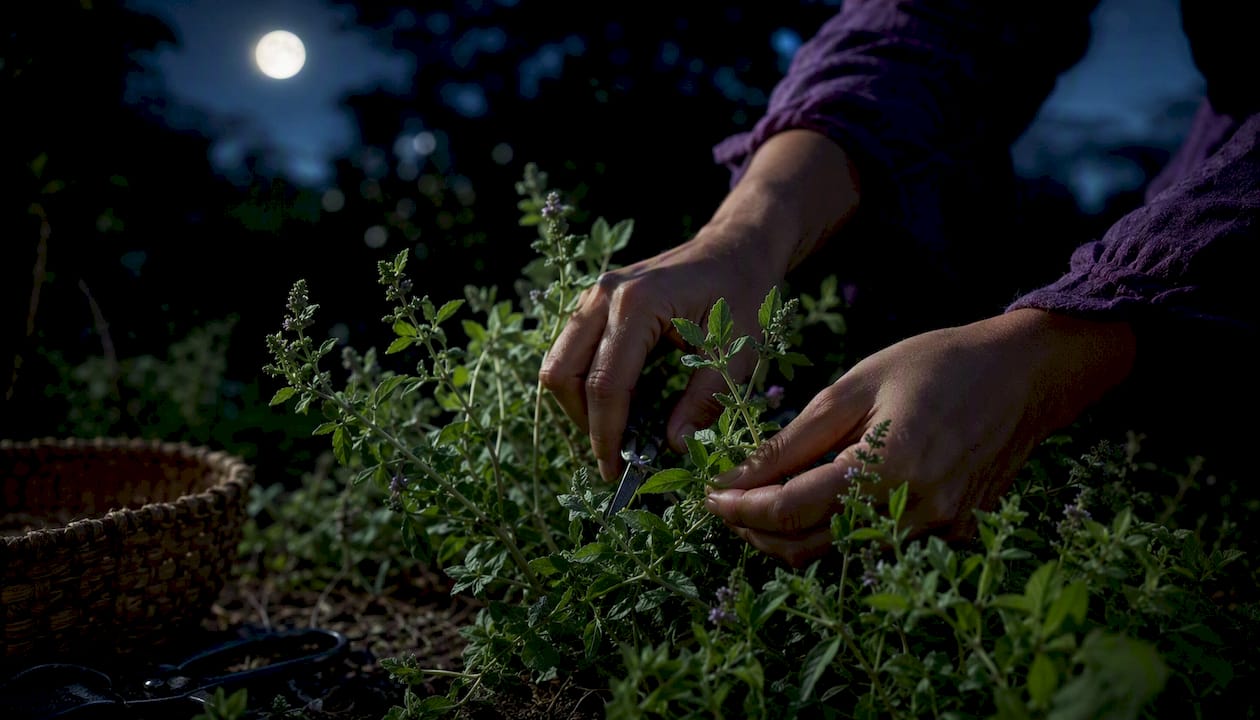
The Full Moon is the high tide of lunar ritual work, the point traditional harvesters across cultures singled out most consistently. A comparative phytochemical study found higher concentrations and bioactivity in plant material collected specifically during the Full Moon compared with other phases, a small but genuinely useful data point for anyone who’s wondered whether the old harvest rules had any chemistry behind them.
Herbs to use: mugwort for dreamwork and intuition, cedar for grounding, lotus if it’s available to you as a fresh or dried offering.
Ritual actions:
- Harvest aerial parts (mugwort leaves, flowering tops) after sunset, when temperatures have dropped and essential oil content in many aromatic herbs is believed to concentrate.
- Lay harvested herbs on a clean cloth to dry away from direct light.
- Set a bowl of spring water on a windowsill or outdoor surface where moonlight reaches it overnight.
- In the morning, use that moon-charged water to water a plant, add to a ritual bath, or simply drink it.
Night harvesting carries real risk if you’re unfamiliar with terrain, so bring a light, tell someone where you’ll be, and never harvest near roadways where car exhaust settles on leaves.
Waning Moon: Releasing and root work
As light fades, attention turns downward, toward roots, and toward what you’re ready to let go of.
Herbs to use: white willow bark for release work, mint for mental clarity during the process, burdock root for grounding and detox-support rituals.
Micro-ritual script:
- Pull or purchase burdock root and rinse it clean.
- Simmer a small piece in water for 15 to 20 minutes to make a root tea.
- Name aloud what you’re releasing as the tea steeps.
- Drink slowly, then compost the used root as a physical act of letting go.
Pro Tip: Dry excess root harvest on a screen in a dark, ventilated space rather than direct sun. Roots hold moisture longer than leaves and can mold if dried too quickly or stored before they’re fully brittle.
Turning Herbs Into Ritual Medicine: Teas, Tinctures, Smudges, and Moon Water
Once you know which herb belongs to which phase, the next question is how to actually prepare it. Four methods cover almost everything you’ll need for a home practice, and a guide to core ritual botanical methods walks through the fuller mechanics if you want to go deeper.
- Ritual tea: steep one to two teaspoons of dried herb in freshly boiled water for 8 to 10 minutes, covered, to keep volatile oils from escaping.
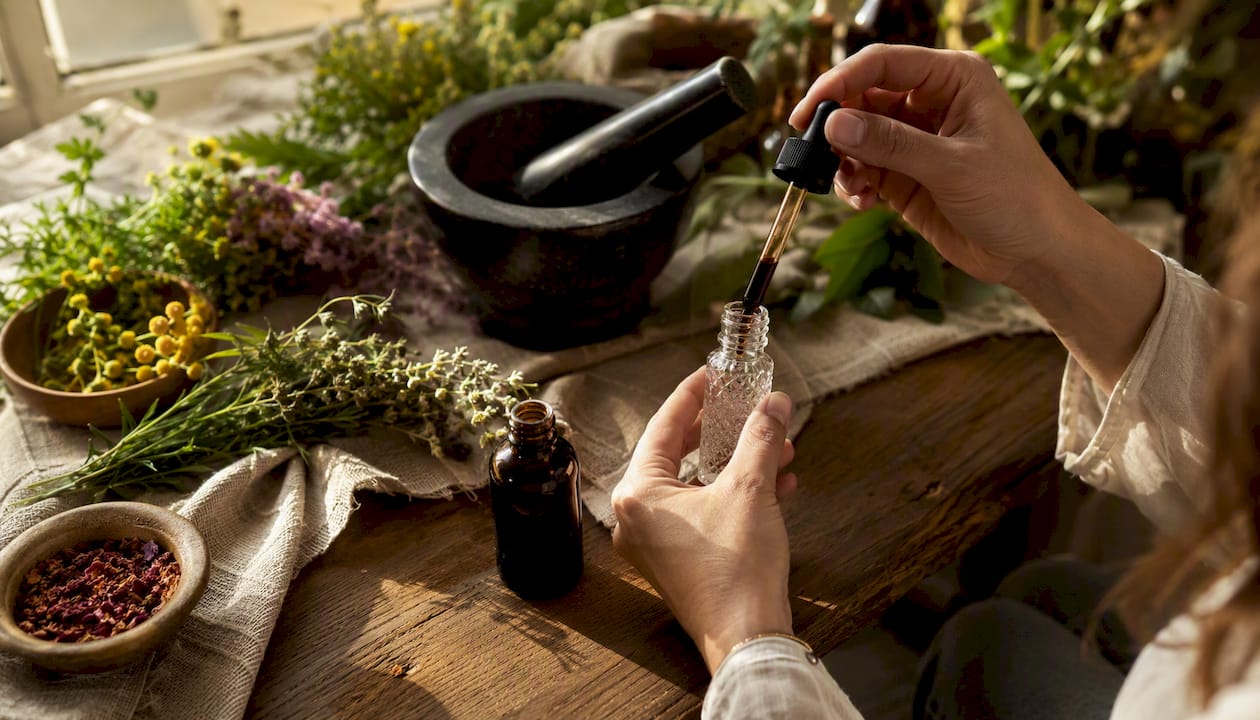
- Basic tincture: cover dried herb with 80 proof (or higher) alcohol in a clean glass jar, seal, and macerate for four to six weeks, shaking occasionally; for an alcohol-free version, use food-grade glycerin instead, though extraction will be gentler and shelf life shorter.
- Smudge bundle: bundle dried herb stems with cotton string, let cure fully (one to two weeks) before burning, and always burn over a fireproof dish with a window cracked. A step-by-step smoke cleansing guide covers safe technique in more detail.
- Moon-charged water: fill a clean glass bowl with filtered water, set it where moonlight can reach it (a windowsill works fine), and bring it in before sunrise.
Equipment checklist: a small pot, glass jars with tight lids, muslin cloth or a fine strainer, and one bowl reserved only for altar water.
Ingestion and topical use are not interchangeable. Some herbs, mugwort included, are fine in a diluted tea but shouldn’t be used during pregnancy or in concentrated tincture form without professional guidance. Always check for known allergies before your first use of any herb, and start with a small amount.
Choosing and Sourcing Herbs Without Doing Harm
Picking the right herb matters less than picking it responsibly. Before you harvest or buy, run through a short mental checklist: is this plant local to your region, is the part you need actually in season, and is there a lower-impact substitute nearby?
- Favor organic-certified or reputable wild-harvested sources over unverified wildcrafted material.
- Rotate harvest sites if you gather your own herbs, and never take more than a third of any wild stand.
- Leave root systems intact where possible so the plant population can recover.
- Skip culturally restricted or sacred plants unless you’ve been directly taught or invited to use them by a knowledge holder from that tradition.
Some plants, white sage among them, have become so commercially popular that wild populations are genuinely strained, which is exactly why wild-harvested botanicals sourced with real ethics matter more than convenience. Chamomile pairs surprisingly well with other calming botanicals too. Some practitioners now combine chamomile with CBD for an extra layer of nervous-system support in evening rituals.
| Situation | What to do instead |
|---|---|
| Sage is unavailable or ethically questionable | Substitute rosemary or cedar for clearing work |
| Mugwort isn’t legal or available locally | Use lavender for dream and intuition support |
| Fresh herbs are out of season | Use dried versions; potency is lower but usable |
Pro Tip: Match substitutions by energetic property, not appearance. A clearing herb swaps for another clearing herb, a grounding root swaps for another grounding root, regardless of whether they look or smell alike.
A Ritual You Can Do Tonight
You don’t need a full apothecary to start. Gather a cup of loose herbal tea (chamomile works for any phase), a small candle, a bowl of water, and a single herb sachet you can hold.
- Minutes 0-2: Sit, light the candle (or skip it in an apartment with fire restrictions), and take five slow breaths.
- Minutes 2-5: Brew your tea. While it steeps, hold the herb sachet and name your intention aloud or in your mind.
- Minutes 5-9: Drink slowly. Set the water bowl on a windowsill to catch moonlight as you finish.
- Minutes 9-12: Close with a single sentence of gratitude, then blow out the candle.
Apartment dwellers can skip open flame entirely and rely on the windowsill water bowl as the visual anchor instead.
- No candles allowed? Use a small battery tea light.
- No fresh herbs on hand? A quality tea bag works fine for a first ritual.
Pro Tip: Keep the ritual under 12 minutes the first few times you try it. Consistency matters more than length, and a short practice you actually repeat monthly beats an elaborate one you do once.
What the Research and the Traditions Actually Say
The honest answer is that evidence is real but limited, and it’s worth holding both traditional knowledge and lab data with equal respect rather than picking one over the other.
On the science side, one peer-reviewed study found that full moonlight exposure altered plant nuclear size, DNA methylation, and metabolite profiles, and even boosted mustard seedling growth, suggesting moonlight functions as a genuine biological signal rather than folklore. Broader indexed literature on lunar and biological rhythms shows mixed results depending on species and method, so treat any single finding as a data point, not proof of universal lunar power.
Cross-referencing a controlled laboratory finding with centuries of maramataka harvest timing doesn’t prove causation, but it does suggest traditional practitioners were tracking something real long before anyone had a microscope to explain it.
Kejiwa Alchemy builds its own sourcing and preparation windows around this same overlap. Full Moon harvest timing informs when wild-harvested botanicals get gathered, and the traditional spagyric process, which separates and recombines a plant’s mineral, essential, and spirit components, leans on phase-aware charging during preparation rather than convenience-based batching.
A note from the practice
I’ve learned most of what I know about lunar timing from Indigenous and traditional practitioners who were generous enough to share it, and that generosity comes with responsibility: ask before you borrow a specific practice, and give credit when you use one. Adapt every ritual here to whatever grows near you. Start small, notice what actually shifts in your own body and mood, and talk to a qualified herbalist before using any plant medicinally at meaningful doses.
Ready-made options when you’d rather skip the prep work
Not every reader has the time, climate, or local plant access to harvest and prepare herbs by hand every month, and that’s exactly the gap Kejiwa Alchemy’s ritual line is built to close. Our spagyric herbal tinctures are prepared in small batches using traditional alchemical timing, so the phase-aware charging described above is already built into the bottle before it reaches you.

Every ingredient is sourced with the same ethics laid out in this guide: certified organic where available, wild-harvested only from suppliers who rotate their sites and leave enough behind for the next season. If you want a ready-made tool for tonight’s ritual rather than a full prep session, browse the botanical aromatics collection for a mist you can use immediately for space clearing or intention setting, no steeping or maceration required.
Sources
- HerbalGram: Review on lunar influence and traditional harvest timing
- PubMed: literature on lunar and biological rhythms (indexed studies)