


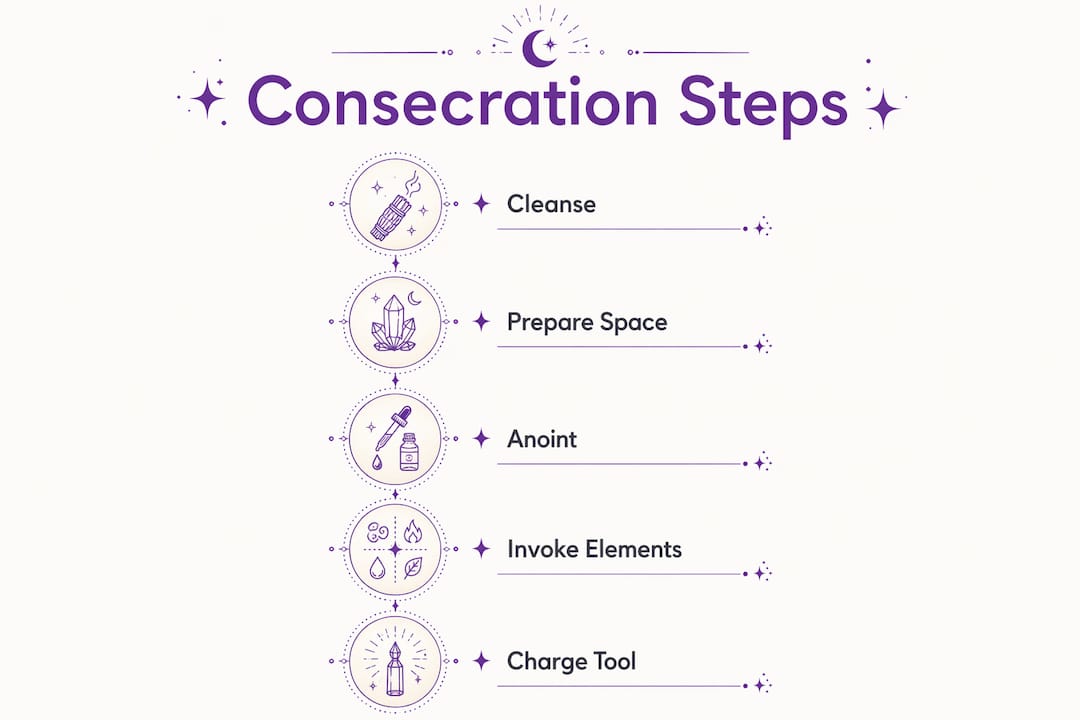
Consecrating a ritual tool can take a short amount of time for a single object or longer when preparing a full altar set, and the result is a tool that resonates with your specific intent rather than carrying ambient or residual energy from its origins. The consecration process works in three stages: cleanse the object to remove prior energetic residue, consecrate it by dedicating it to a specific purpose, then charge it to amplify and fix that energy in place.
The core ritual sequence:
- Cleanse the tool using smoke, salt water, earth, sound, or light for a brief period
- Purify your space and cast a simple circle or boundary
- Anoint and consecrate with oil, herbs, or elemental passes while speaking your intention aloud
- Charge under moonlight, sunlight, or with breath and visualization, with charging time varying
- Close and ground by sealing the consecration verbally and grounding your own energy
Safety note before you begin: If you are using smoke-based cleansing, open a window, disable nearby smoke alarms temporarily, and confirm you have no respiratory sensitivities or plant allergies. If any of those conditions apply, skip to the smoke-free alternatives listed in each section below.
Table of Contents
- Why do you consecrate tools, and when should you do it?
- What to gather before you start
- How to prepare and sanctify your working space
- Which cleansing method works best for your tool?
- How to consecrate your tool with herbs, oils, and elemental rites
- How to charge your tool after consecration
- Three herbal recipes you can make for ritual use
- When does a tool need re-cleansing or retirement?
- How to ground yourself and close the ritual properly
- A complete sample ritual you can use today
- Key Takeaways
- What practitioners often get wrong about consecration
- Ready-made ritual herbs and tinctures from Kejiwa Alchemy
- Useful sources and further reading
Why do you consecrate tools, and when should you do it?
Ritual herbs and the tools they are used with carry energetic impressions from every hand that touched them, every environment they passed through, and every use they have been put to. Consecration clears that residue and replaces it with a deliberate signal: this object belongs to this work, held by this practitioner, for this purpose.
Practically speaking, the practitioner’s mind is the primary instrument of any magical working. Consecration functions as a tuning ritual that signals intent and primes your awareness to treat the object as sacred. That shift in perception is not trivial. It changes how you handle the tool, how much attention you bring to it, and how consistently you use it in ritual context.
When to consecrate:
- First use: always, before a new tool enters your practice
- After lending: any object that has been in another person’s hands for more than a brief moment
- After heavy or binding work: tools used in banishing, grief rituals, or intense energetic work absorb what they contact
- Seasonal refresh: many practitioners re-consecrate at each sabbat or at the new and full moons
- After physical damage or repair: a crack, a replacement handle, or a deep cleaning resets the object’s energetic state
Timing matters more than most guides acknowledge. New moon energy supports fresh starts and new dedications; full moon energy amplifies and charges what is already in place. If you are consecrating a tool for psychic work, the full moon is the stronger choice. For a tool meant to cut through confusion or begin a new phase of practice, the new moon fits better.
Pro Tip: Keep a small ritual log — a notebook or a dedicated page in your Book of Shadows — with the date, moon phase, herbs used, and intention for each consecration. Over time, this record becomes one of the most useful documents in your practice, letting you track which combinations produced the strongest resonance and when tools need refreshing.
What to gather before you start
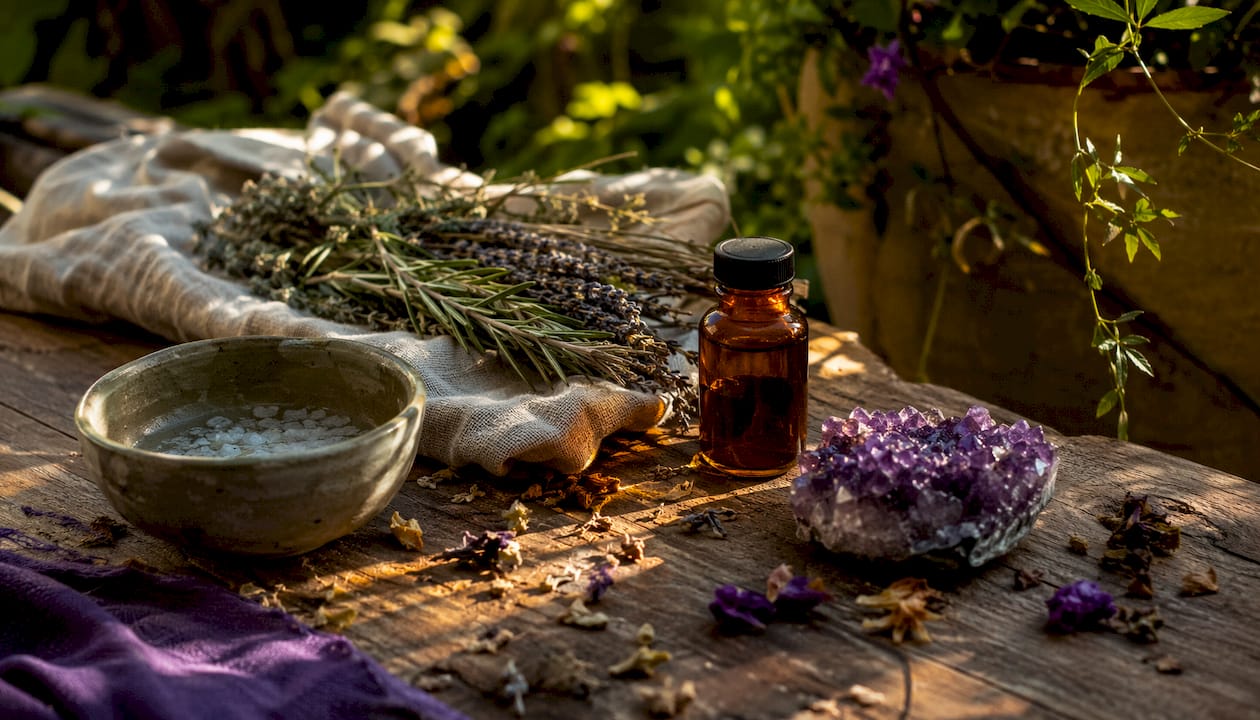
Arriving at your altar mid-ritual to realize you forgot the salt is a fast way to break your focus. Lay everything out beforehand.
Ritual tools checklist
- Wand (wood; lavender, eucalyptus, or mint leaves for anointing)
- Athame or boline (blade; fresh basil, rosemary, or oak leaves)
- Chalice or cauldron (gardenia, rose, or violet oil for the chalice; fresh gathered leaves for the cauldron)
- Pentacle or altar coin (dried parsley, patchouli, or fresh jasmine)
- Altar cloth (lay among lavender and cedar sachets when storing)
- Crystals (mugwort for cleansing; clear quartz for amplification)
- Cloth bag or wrapping for storing the consecrated tool afterward
Herbal and material checklist
- Smudging herbs or resin (white sage, cedar, copal, frankincense, or palo santo)
- Consecration oil (pre-made or homemade; recipe in Section 8)
- Fine salt and a small bowl of spring water
- Charcoal disc and fireproof dish if burning loose resin
- A candle for each element you plan to invoke (white or elemental colors)
- Small dish of earth or sand
Safety checklist
- Open at least one window before lighting anything
- Keep a small fire extinguisher or a bowl of water nearby
- Temporarily disable smoke alarms in the immediate room if using heavy smoke
- Re-enable them the moment you finish
- Check every herb against a plant-safety resource if you have respiratory conditions, are pregnant, or take medications (rue and wormwood, for example, are for external ritual use only and carry contraindications for internal use or skin contact for sensitive individuals)
Smoke-free alternatives: an aromatic mist spray, a bowl of salt water, or placing the tool in direct moonlight all accomplish the cleansing step without any combustion. Kejiwastore’s botanical aromatics collection includes ready-made ritual sprays that work well here.
Pro Tip: Lay out your materials on a tray the night before. This small act of preparation is itself a form of ritual intention, and it means your actual working time stays focused on the energetic work rather than logistics.
How to prepare and sanctify your working space
A consecration performed in a cluttered, energetically noisy space is like tuning an instrument in a loud room. The space itself needs a moment of clearing first.
Quick space purification
Sweep the floor physically, moving from the center outward. Follow with a brief smudge or an aromatic spray, moving clockwise around the perimeter of the room. If you are using a spray, Kejiwastore’s Jasmine Passion Alche-Mist works as a fast, smoke-free room-clearing option. Three slow passes around the space are enough.
Opening a circle
A circle creates a focused container for the work. You do not need elaborate words. Something this simple works:
Walk clockwise around your space as you say it, holding your wand or your dominant hand extended. The circle is cast when you complete the full loop and return to your starting point.
Calling the quarters
Face each direction in turn, beginning with East. Speak briefly and directly to each element:
East (Air): Invite clarity, communication, and the power of breath into your space. A single candle or a feather on the altar represents this quarter.
South (Fire): Call in will, transformation, and the energy of activation. A lit candle or a piece of red jasper anchors the South.
West (Water): Welcome intuition, emotional depth, and the cleansing power of water. Your chalice filled with spring water serves this quarter.
North (Earth): Ground the space in stability, material form, and the wisdom of the body. Your dish of salt or earth sits here.
Pro Tip: When time or space is limited, you can compress the entire opening into a single spoken intention and one clockwise walk. The full quarter-calling is meaningful but not mandatory for every working. Consistency in your chosen format matters more than complexity.
Which cleansing method works best for your tool?
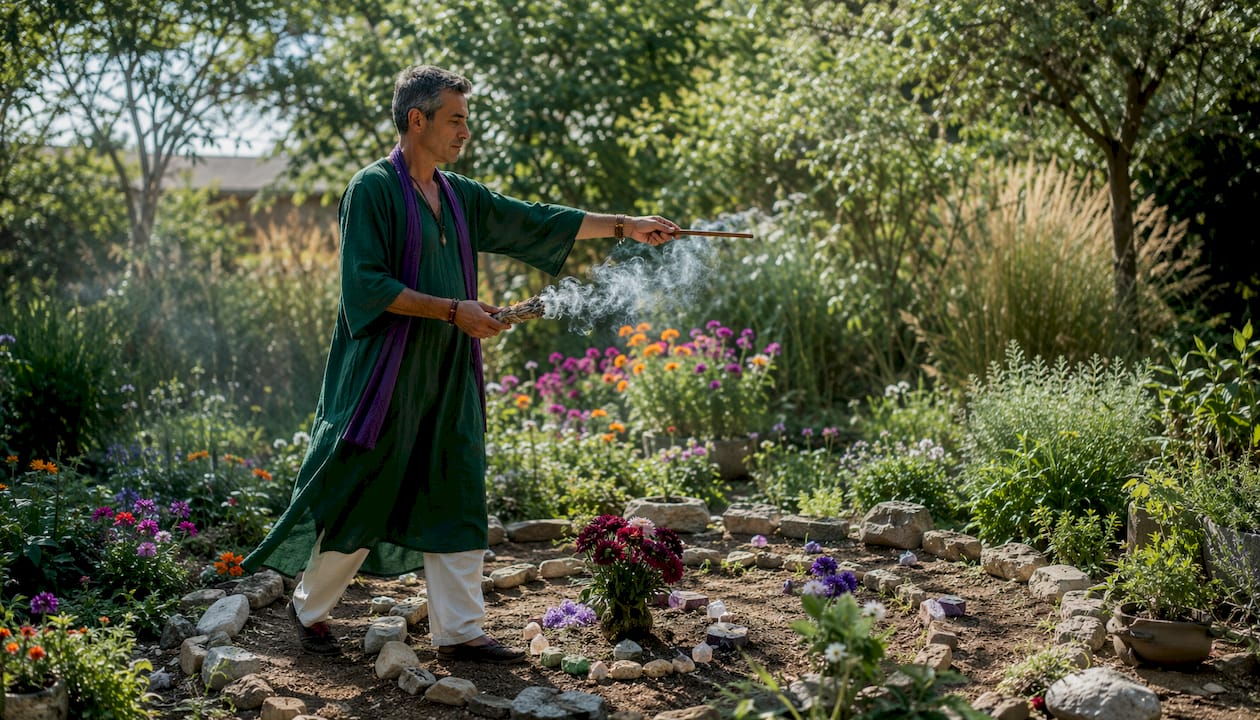
Cleansing always precedes consecration. You cannot dedicate a tool to a new purpose while it still carries the energetic signature of its previous context. Think of it as clearing a whiteboard before writing something new.
Common cleansing methods include smudging with herbs, salt or water immersion, earth burial, light exposure, and sound clearing. Each has a different risk profile depending on your tool’s material.
Method-by-method protocols
Smudging (herbs or resin) Light your smudge bundle or charcoal disc. Hold the tool in the smoke for 30–60 seconds, rotating it so all surfaces are touched. Move the smoke counterclockwise (widdershins) to release old energy, then clockwise (deosil) to invite fresh alignment. White sage, cedar, and copal are all effective. For detailed herb profiles, Kejiwastore’s smudging guide covers correspondences and burn characteristics.
Salt and water Dissolve a tablespoon of fine salt in a bowl of spring water. Submerge non-porous tools (glass, sealed stone, ceramic) for 10–30 minutes. For metal tools like an athame, a brief rinse followed by immediate drying prevents corrosion. Never submerge porous stones (selenite, malachite, pyrite) or wood in salt water.
Earth burial or grounding Wrap the tool in a natural cloth and bury it a few inches deep in clean soil overnight, or nestle it in a bowl of dry earth for several hours. This method is slow but thorough, and it works well for tools that have absorbed heavy or binding energy.
Sunlight or moonlight soak Place the tool on a windowsill or outdoors for several hours. Full moonlight is particularly effective for psychic tools like crystals and chalices. Note that prolonged direct sunlight fades some crystals (amethyst, rose quartz) and can warp wood.
Sound clearing Strike a singing bowl, bell, or tuning fork near the tool and let the vibration wash over it for several minutes. This is the most portable and material-safe method, suitable for any tool regardless of composition.
Cleansing method comparison
| Method | Speed | Best for | Avoid with | Smoke-free? |
|---|---|---|---|---|
| Smudging | Fast (1–2 min) | Most tools, fabrics, books | Respiratory sensitivities | No |
| Salt water | Moderate (10–30 min) | Glass, ceramic, sealed stone | Porous stone, bare metal, wood | Yes |
| Earth burial | Slow (overnight) | Heavily charged tools | Delicate finishes | Yes |
| Sunlight/moonlight | Slow (hours) | Crystals, chalices | Fade-prone crystals, wood | Yes |
| Sound | Fast (2–5 min) | Any material | Nothing | Yes |
Safety callouts:
- Never leave a burning smudge bundle unattended
- Dry metal tools immediately after any water contact
- Check that porous materials (raw wood, unglazed clay) are fully dry before anointing with oil
- Confirm plant allergies before handling any herbal material directly
How to consecrate your tool with herbs, oils, and elemental rites
Once a tool is cleansed, consecration dedicates it to its specific purpose — choosing high-quality materials is essential; learn more about woran gutes CBD erkennen to ensure purity when including CBD extracts in ritual oils. This is where herbal anointing transforms the object from a cleaned neutral item into a charged instrument of your practice.
Anointing with oils and herbs
The direction of your rubbing motion carries meaning. Use clockwise (deosil) strokes to draw energy in and bind the intention to the tool. Use counterclockwise (widdershins) strokes only when you want to release or banish. For a standard consecration, deosil is correct.
Apply a small amount of consecration oil to your fingertips. Work from the center of the tool outward, or from base to tip for a wand or blade. As you anoint, hold the tool’s purpose clearly in your mind: not a vague wish, but a specific function. A wand consecrated for healing work carries a different charge than one dedicated to divination.
Fresh leaves work when you have no oil prepared. Rub basil or rosemary directly onto a blade, lavender or mint onto a wand, and mugwort onto a crystal or scrying tool. The plant’s oils transfer to the surface and carry the herb’s symbolic resonance into the object.
Sample consecration invocation
Adapt this to your tradition, your deities, or your own language:
Speak the words aloud. The vibration of your voice is part of the consecration.
Elemental pass method
Hold the tool toward each element in turn, pausing at each for a breath or two:
- East/Air: Pass through incense smoke or hold toward an open window. Say: “Blessed by Air, may this tool carry clarity.”
- South/Fire: Pass briefly over a candle flame (safely, without scorching). Say: “Blessed by Fire, may this tool carry will.”
- West/Water: Sprinkle a few drops of spring water or dip a fingertip and touch the tool. Say: “Blessed by Water, may this tool carry depth.”
- North/Earth: Press the tool gently into a dish of salt or earth. Say: “Blessed by Earth, may this tool carry strength.”
Using elementally aligned oils deepens this step: fir or vetiver for the North/Earth pass, sandalwood or frankincense for spiritual connection in the East, cedar or cinnamon for the South, and rose or violet for the West.
Pro Tip: For tools with a specific elemental correspondence (a wand for Air, a cauldron for Water), you can spend more time at that element’s pass and treat the others as brief acknowledgments. This focuses the consecration rather than spreading it evenly across all four.
How to charge your tool after consecration
Charging fixes and amplifies the energy you set during consecration. Think of it as the final seal. The method you choose depends on the tool’s purpose and how much time you have.
- Full moon soak: Place the tool outdoors or on a windowsill from moonrise to sunrise. Best for psychic tools, divination objects, crystals, and anything used in intuitive work. One full night is sufficient; three consecutive nights deepens the charge.
- Sunlight charge: Leave the tool in direct morning sunlight for 1–3 hours. Best for tools used in active, outward-facing work: a wand for manifestation, an athame for cutting through obstacles. Avoid for fade-prone materials.
- Crystal amplification: Place the tool on or beside a piece of clear quartz, selenite, or citrine for several hours or overnight. Selenite is particularly useful because it does not require its own cleansing between uses.
- Breath and visualization: Hold the tool in both hands. Take three slow, deep breaths. On each exhale, visualize a specific color or quality of light entering the tool and filling it completely. This method is intimate and immediate, taking only 3–5 minutes. It is especially effective for tools you use in personal, private work.
- Group charge: If you practice with a coven or circle, pass the tool around the group and have each person hold it briefly while projecting a shared intention. Group energy is multiplicative rather than additive.
You can combine methods for a stronger result. A common sequence: anoint with consecration oil during the consecration step, then leave the tool on a crystal grid overnight, then seal with a breath charge in the morning before first use. Each layer reinforces the one before it. Between methods, wipe your hands and take a breath to clear your own energy field before adding the next layer.
Three herbal recipes you can make for ritual use
These recipes are practitioner-grade: specific quantities, clear steps, and honest safety notes. All three use materials that are widely available from ethical suppliers.
Recipe 1: Purification smudge blend
| Ingredient | Amount | Role |
|---|---|---|
| Dried white sage | 2 parts | Primary clearing herb |
| Dried cedar leaf | 1 part | Grounding and protection |
| Dried rosemary | 1 part | Purification and memory |
| Dried lavender | ½ part | Calming and balance |
Steps:
- Combine dried herbs in a bowl. Crumble lightly to mix without turning to powder.
- Spread on a clean surface and allow to dry completely if any moisture remains (24 hours minimum).
- Bundle tightly with natural cotton twine, or burn loose on a charcoal disc in a fireproof dish.
- Store in a paper bag or open cloth pouch in a cool, dry place. Use within 12 months.
Safety note: Rosemary smoke can trigger headaches in sensitive individuals. Lavender is generally well-tolerated but check for sensitivities. Always burn in a ventilated space.
Recipe 2: Consecration anointing oil
Infused herbal oils are prepared by macerating plant matter in a stable carrier oil for a minimum of seven days, up to a full lunar cycle for dried botanicals.
| Ingredient | Amount | Notes |
|---|---|---|
| Sunflower or safflower oil | 4 oz | Stable, neutral carrier |
| Dried rosemary | 1 tbsp | Purification, dedication |
| Dried lavender | 1 tbsp | Clarity, spiritual alignment |
| Dried mugwort | 1 tsp | Psychic enhancement |
| Optional: frankincense resin | ½ tsp | Spiritual elevation |
Steps:
- Combine herbs and oil in a clean glass jar with a tight lid.
- Place in a sunny window for 7–14 days, shaking gently each day.
- Strain thoroughly through cheesecloth, pressing out all plant matter. Removing all particles is critical: residual plant matter causes rancidity.
- Transfer to a dark glass bottle. Label with date and botanicals used.
- Store in a cool, dark place. Shelf life is 1–2 years when plant matter is fully removed and a stable carrier oil is used.
Contraindications: Mugwort is not safe for use during pregnancy. Frankincense resin can cause skin sensitivity in some individuals; patch-test before applying to skin.
Recipe 3: Consecration powder
A powder suits tools where oil application is impractical (porous stone, raw wood, fabric) or when you want a dry, storable option.
- Grind equal parts dried rosemary, dried lavender, and orris root powder in a mortar and pestle until fine.
- Add a pinch of fine salt and a pinch of dried lemon peel for purification and brightness.
- Sift through a fine mesh strainer to remove coarse particles.
- Store in a sealed glass jar away from moisture. Use within 6 months.
To apply: Sprinkle lightly over the tool, then brush off gently with a natural-fiber cloth while speaking your intention. For fabric items like altar cloths, wrap the cloth around a small sachet of the powder overnight.
Sourcing note: Prioritize organically grown or ethically wildcrafted herbs from suppliers who practice sustainable harvesting. For guidance on ethical plant relationships and sourcing, Kejiwastore’s plant medicine guide covers the principles clearly. Always verify that any wildcrafted herb was harvested legally and with the landowner’s permission.
When does a tool need re-cleansing or retirement?
Tools are not static. Their energetic state shifts with use, and a well-maintained tool performs differently than one that has been neglected or overworked.
Triggers that call for re-cleansing or re-consecration:
- The tool was used in heavy, binding, or grief-related work
- Another person handled it without your permission or awareness
- You experienced a significant life transition (illness, loss, relocation, a shift in practice)
- The tool feels “flat” or you notice a drop in your engagement with it during ritual
- Herbal oils or dried bundles have visibly degraded, gone rancid, or lost their scent
Practical maintenance between full re-consecrations:
- A brief pass through incense smoke or a spray of aromatic mist after each use keeps the energetic field clear without requiring a full ritual
- Refresh the anointing oil on a wand or athame at each new or full moon
- Rinse crystals in cool water and place them on selenite overnight to reset between uses
- Keep altar cloths stored with lavender sachets to maintain their energetic cleanliness
Retiring a tool
Some tools reach the end of their useful life. A cracked cauldron, a wand that has splintered, or a crystal that has shattered carries a different energetic signature than it did when whole. Retirement is not failure; it is completion.
- Return herbs and plant matter to the earth by burying them with a small offering of water or grain
- Metal tools can be recycled or given to a smith for transformation into something new
- Broken stone or ceramic can be buried at the base of a tree with a spoken acknowledgment of the tool’s service
- Wood can be burned in a ritual fire with gratitude, releasing its energy back to the element it came from
Pro Tip: Before retiring a tool, hold it one last time and speak a brief release: “Your work here is complete. I release you with gratitude.” This closes the energetic bond cleanly and prevents the lingering sense that something is unfinished.
How to ground yourself and close the ritual properly
Closing a ritual is not a formality. It seals the consecration, releases the circle’s energy safely, and returns you to ordinary awareness. Skipping it leaves the energetic container open, which can feel disorienting for hours afterward.
Closing script
Speak this (or your own version) aloud as you walk counterclockwise around your space:
Two grounding exercises
Breathwork: Sit or stand with both feet flat on the floor. Take five slow breaths, each time visualizing roots extending from the soles of your feet down into the earth. On the exhale, release any excess energy downward through those roots. This takes about two minutes and is effective even if you feel only slightly ungrounded.
Earth touch: Step outside barefoot if possible, or place both palms flat on the floor. Hold for 60 seconds while breathing normally. Physical contact with a grounded surface is one of the fastest ways to return your nervous system to baseline after energetic work.
Storing consecrated tools
Wrap each consecrated tool in natural cloth (linen, cotton, or silk) before storing. Keep tools used for different purposes separate from each other. Store in a dedicated box, drawer, or altar space away from electronics and high-traffic areas. A consistent ritual container with the same sensory cues (same cloth, same storage herbs) reinforces the energetic bond over repeated use.
Pro Tip: Place a small piece of selenite or a dried sprig of rosemary inside the storage cloth with each tool. Both help maintain energetic clarity between uses without requiring active maintenance.
A complete sample ritual you can use today
This ritual covers a single tool from start to finish. Adapt the words freely. The structure matters more than the exact phrasing.
Total time: approximately 35–45 minutes
-
Prepare (5 minutes). Lay out all materials. Light a candle. Take three slow breaths to shift your awareness from ordinary time into ritual space.
-
Purify the space (5 minutes). Walk clockwise around the room with your smudge bundle or aromatic spray. Cast your circle using the script from Section 4, or your own words.
-
Call the quarters (3–5 minutes). Face East, South, West, North in turn. Speak a brief invitation to each element as described in Section 4.
-
Cleanse the tool (5–10 minutes). Choose your method from Section 5. For a smoke-free option: submerge a non-porous tool in salt water for 10 minutes, or hold it in the light of a candle flame at a safe distance while visualizing white light dissolving all prior impressions.
-
Consecrate (5–10 minutes). Anoint the tool with consecration oil using deosil strokes. Speak your dedication aloud. Perform the elemental passes if time allows.
-
Charge (5 minutes or overnight). For an immediate charge: hold the tool in both hands, breathe three times into it, and visualize it filled with the specific quality you need. For a deeper charge, place it in moonlight or on a crystal grid overnight.
-
Close and ground (5 minutes). Speak the closing script from Section 10. Walk counterclockwise to release the circle. Ground with the breathwork or earth-touch exercise. Wrap the tool in natural cloth and store it.
Smoke-free full alternative: Replace the smudge in steps 2 and 4 with an aromatic mist spray and a salt-water bowl. Replace the candle passes in step 5 with a visualization of golden light. The ritual is equally complete.
Key Takeaways
Consecrating herbal tools requires three sequential steps: cleanse to clear residual energy, consecrate with intention and herbal anointing, then charge to fix and amplify the energetic bond.
| Point | Details |
|---|---|
| Cleanse before consecrating | Always remove prior energetic residue first; salt water, sound, or moonlight work without smoke. |
| Match herbs to tool purpose | Rosemary and basil suit blades; lavender and mugwort suit psychic tools; cedar grounds any object. |
| Re-consecrate after heavy use | Tools used in binding or grief work, or handled by others, need a full cleanse and re-dedication. |
| Safety and sourcing matter | Check plant contraindications before handling; source herbs from ethical, organic suppliers. |
| Kejiwastore supports the practice | Kejiwastore’s botanical aromatics, smudge bundles, and spagyric tinctures map directly to the cleansing, anointing, and charging steps in this ritual. |
What practitioners often get wrong about consecration
Most guides treat consecration as a one-time event. You buy a new wand, you run it through some smoke, you say a few words, and you consider it done. That framing misses something fundamental about how energetic bonds actually work.
A consecration is more like an ongoing relationship than a single ceremony. The first ritual sets the intention and clears the field. But the bond deepens every time you use the tool with focused awareness, every time you re-anoint it at a moon cycle, every time you store it with care rather than tossing it in a drawer. The tools that feel most alive in a practitioner’s hands are almost never the ones that were consecrated most elaborately at the start. They are the ones that have been tended consistently.
The other thing practitioners underestimate is the role of specificity. A vague intention (“may this wand serve my magic”) produces a vague result. A specific one (“may this wand amplify my healing work with clients who are processing grief”) gives the tool a clear frequency to hold. The herbs you choose reinforce that specificity: mugwort for psychic clarity, rosemary for memory and dedication, cedar for grounding and protection. The preparation method alters your own state of awareness, which is ultimately what the consecration is tuning. Your mind is the instrument. The ritual is the tuning fork.
Personalization is not optional decoration. It is the mechanism. When the words, herbs, and timing reflect your actual practice rather than a template copied from a book, the consecration lands differently. You feel it. And that felt sense of resonance is exactly what you are trying to create.
Ready-made ritual herbs and tinctures from Kejiwa Alchemy
If you want to skip the preparation and go straight to the ritual, Kejiwastore’s small-batch collections are built for exactly this kind of work.

The botanical aromatics collection includes aromatic mists and ritual oils that serve as smoke-free cleansing and anointing alternatives, ready to use in the space-purification and consecration steps. The smudging herbs collection offers ethically sourced bundles and resins for practitioners who prefer traditional smoke-based cleansing. For energetic maintenance and deeper support between rituals, Kejiwastore’s spagyric tinctures are crafted using traditional alchemical methods with organic and wild-harvested botanicals. Each product is made in small batches with the same intentional sourcing this guide recommends. Browse the collections and choose what fits your ritual role.
Useful sources and further reading
The sources below informed the recipes, method comparisons, and practitioner guidance in this article. Consult plant-safety resources before any internal use of ritual herbs.
- Using Herbs to Dedicate & Consecrate Ritual Tools — Jaguar Moon: Detailed herb-by-tool pairings for traditional Wiccan practice; the primary source for anointing correspondences in this guide.
- Wildcrafted Herbal Blessing Oil — The Druids Garden: Practical recipe and shelf-life guidance for infused blessing oils; used for maceration and storage notes in Recipe 2.
- Magickal Practices in the Herbal Way — A Solitary Pagan: Covers carrier oil selection, elemental oil correspondences, and directional application technique.
- Apothecary: Ritual Herbs — Sacred Plant Co.: Explains why herbs are chosen for symbolic resonance and how preparation method affects practitioner state.
- Tool Consecration Ritual for Beginners — Witchcraft For Beginners: Accessible overview of the consecration process and its energetic purpose; useful for practitioners new to formal ritual.
- Witch’s Guide to Herbal Magick — Madhukotiya: Covers cleansing methods including smudging, earth burial, and light exposure with practical notes on each.
- Spiritual Tea Ceremonies: A Practitioner’s Guide — Modern Magic Grimoire: Demonstrates how consistent sensory ritual cues reinforce energetic bonds; informs the charging and storage guidance.
- Spell: Divination Tool Blessing — Llewellyn Worldwide: A concise powder-based blessing spell from a major pagan publisher; referenced for the consecration powder recipe structure.
- A Guide to Smudging Herbs — Kejiwa Alchemy: Herb profiles and smudging technique guidance from a practitioner-focused botanical source.
This article is general educational information for spiritual practice, not medical or professional advice. Always verify plant safety with a qualified herbalist or plant-safety resource before internal use, and consult current guidelines for any herb you are unfamiliar with.