


Vibrational frequency healing is defined as a complementary wellness practice that uses targeted sound, acoustic, and electromagnetic frequencies to support the body’s natural balance and well-being. Classified as a form of energy medicine, it spans measurable modalities like vibroacoustic therapy and binaural beats, as well as biofield-based practices like Reiki. Understanding what is vibrational frequency healing means recognizing both its grounded physical mechanisms and its roots in traditional energetic medicine. The science is real, the benefits are documented, and the applications are more accessible than most people realize.
What is vibrational frequency healing and how does it work?
Vibrational frequency healing works by applying specific sound or vibration frequencies to the body, nervous system, and brain to shift physiological and mental states. The human body is not static. Every cell, tissue, and organ vibrates at its own natural frequency, and external frequencies can interact with those internal rhythms in measurable ways.
The core mechanism is resonance. When an external frequency matches or complements the body’s natural oscillation, it can amplify or shift that state. Think of a tuning fork held near a guitar string: the string begins to vibrate without being touched. Your nervous system responds the same way to sound.
Three physical processes explain most of the documented effects:
- Mechanotransduction: Sound vibrations activate cellular signaling pathways involved in repair and inflammation control. Infrasound enhances bone growth signaling, while audible sounds promote cell migration and epidermal activity.
- Brainwave entrainment: Rhythmic sound frequencies guide neural oscillations toward specific brain states. Delta waves support deep sleep, Theta supports creativity and meditation, and Alpha supports calm focus.
- Parasympathetic activation: Sound-based interventions stimulate the vagus nerve and limbic structures, shifting the nervous system from a stress response toward rest and repair.
The body’s high water content, approximately 60%, acts as a conductor for low-frequency vibrations. This physical property facilitates effects like lymphatic flow improvement and muscle tension relief that go beyond simple auditory relaxation.
Pro Tip: If you want to feel the physical reality of sound on the body, place your hand on a speaker playing a low bass tone. That sensation is mechanotransduction in action, the same principle used in clinical vibroacoustic therapy.
What are the main vibrational healing techniques?
Vibrational healing techniques range from clinically studied therapies to ancient sound practices. Each works through a distinct mechanism, and knowing the difference helps you choose what fits your needs.
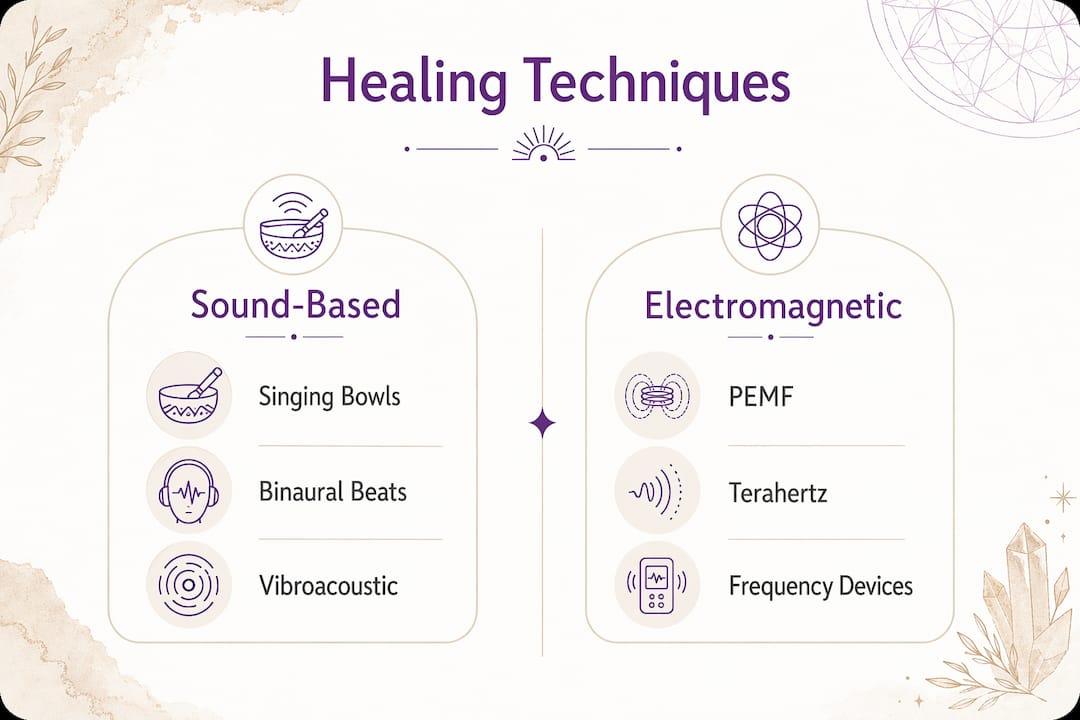
Vibroacoustic therapy
Vibroacoustic therapy uses sine wave vibrations in the 30–120 Hz range, delivered through transducers embedded in mats, chairs, or beds. The vibrations travel directly into the body’s tissues, bypassing the auditory system entirely. Clinical sessions typically run 20–45 minutes and have shown measurable improvements in pain scores, depression, and autonomic regulation.

Binaural beats and brainwave entrainment
Binaural beats work by playing two slightly different frequencies in each ear. The brain perceives the difference as a third tone and begins to synchronize its neural activity to that frequency. A 10 Hz difference, for example, guides the brain toward Alpha state, associated with relaxed alertness. This technique requires headphones and produces results within minutes of listening.
Traditional sound instruments
Singing bowls, tuning forks, and gongs produce rich harmonic overtones that interact with the body’s resonant frequencies. Tibetan and crystal singing bowls, in particular, generate sustained tones that practitioners use to support meditation and energetic balance. Tuning forks applied directly to acupressure points combine sound with physical vibration for localized effect.
Emerging electromagnetic approaches
Pulsed Electromagnetic Field therapy (PEMF) and Terahertz frequency devices represent the electromagnetic end of the spectrum. These modalities use non-ionizing electromagnetic fields rather than acoustic waves, but operate on the same principle of frequency interaction with biological tissue.
The table below clarifies the key differences between the primary modalities:
| Modality | Delivery method | Primary mechanism | Frequency range |
|---|---|---|---|
| Vibroacoustic therapy | Transducer mat or chair | Mechanotransduction | 30–120 Hz |
| Binaural beats | Stereo headphones | Brainwave entrainment | 1–40 Hz differential |
| Singing bowls / tuning forks | Direct sound or contact | Resonance and relaxation | 40–1,000+ Hz |
| PEMF therapy | Electromagnetic coil | Electromagnetic field interaction | 1–100 Hz |
What are the proven benefits of vibrational therapy?
The benefits of vibrational therapy cluster around three areas: stress reduction, neurological support, and pain management. The evidence base is strongest for sound-based interventions, particularly music therapy and vibroacoustic therapy.
Sound therapy reduces cortisol, shifts brainwave activity, and improves both mood and sleep quality. Cortisol reduction matters because chronic elevation of this stress hormone suppresses immune function, disrupts sleep, and accelerates cellular aging. Lowering it through non-pharmacological means is a meaningful clinical outcome.
Neurological benefits are particularly compelling at the 40 Hz frequency range. 40 Hz stimulation activates gamma brain waves associated with cognitive processing and neuroprotection. MIT research has shown that 40 Hz light and sound stimulation reduces hallmarks of Alzheimer’s pathology in animal models. That finding has driven significant interest in frequency-based neurological support.
“Sound-based interventions, especially music therapy, carry the strongest and most reproducible clinical evidence for improving subjective well-being and reducing anxiety and pain. The mechanisms are measurable, the outcomes are consistent, and the risk profile is low.”
Pain relief through vibrational healing operates through the gate control theory of pain. Low-frequency vibrations stimulate large-diameter nerve fibers, which effectively “close the gate” on pain signals traveling to the brain. Clinical studies on vibroacoustic therapy show significant improvements in chronic pain, depression scores, and autonomic regulation across randomized controlled trials and case reports.
Two important boundaries apply here. First, not all audio frequencies produce healing effects. Benefits relate primarily to stress reduction and nervous system regulation, not to curing specific diseases. Second, vibrational healing works best as a complement to conventional medical care, not a replacement for it. Integrative medicine experts consistently emphasize evidence-based integration over unproven cure claims.
For those managing chronic stress or supporting their nervous system naturally, vibrational healing offers a low-risk, high-accessibility tool worth adding to your practice.
How can you start using frequency healing methods safely?
Starting with frequency healing methods requires no equipment and no clinical setting. The most accessible entry points are free, immediate, and surprisingly effective.
- Hum or chant daily. Humming and chanting produce measurable shifts in mood and brainwave activity within minutes. The vagus nerve runs through the vocal cords, so intentional voice work directly stimulates parasympathetic activation. Five minutes of sustained humming after waking is a practical starting point.
- Listen to binaural beats. Free resources for binaural beat recordings are widely available online. Use stereo headphones, choose a frequency range matching your goal (Theta for meditation, Alpha for focus), and listen for 15–20 minutes. Track how you feel before and after for two weeks.
- Attend a community sound bath. Sound baths using singing bowls or gongs offer a group experience of sustained harmonic tones. Many yoga studios and wellness centers offer these sessions at low or no cost. Beginners can explore free sound baths before committing to professional sessions.
- Book a vibroacoustic therapy session. Professional sessions run 20–45 minutes and are offered at integrative health clinics and some physical therapy practices. Ask specifically about the frequency range used and the clinical training of the practitioner.
- Combine with complementary practices. Vibrational healing deepens when paired with breathwork, meditation, and herbal nervous system support. The physiological states they each promote overlap significantly. Understanding what happens during deep meditation helps you see why these practices amplify each other.
Pro Tip: Keep a simple log of your sessions: date, modality, duration, and a 1–10 rating of your stress level before and after. After 30 days, patterns emerge that tell you which approach works best for your nervous system.
One firm boundary: do not use vibrational healing to delay or replace diagnosis and treatment for serious medical conditions. Use it alongside your existing care, not instead of it.
Key Takeaways
Vibrational frequency healing works through measurable physical mechanisms including resonance, mechanotransduction, and brainwave entrainment, making it a credible complement to conventional wellness care.
| Point | Details |
|---|---|
| Core definition | Vibrational frequency healing uses sound and electromagnetic frequencies to support nervous system balance and well-being. |
| Scientific basis | Mechanotransduction, brainwave entrainment, and vagus nerve stimulation are the primary documented mechanisms. |
| Strongest evidence | Music therapy and vibroacoustic therapy carry the most reproducible clinical evidence for anxiety, pain, and sleep. |
| 40 Hz benefit | Gamma wave stimulation at 40 Hz links to cognitive support and neuroprotection in current research. |
| Safe starting point | Humming, binaural beats, and community sound baths are free, low-risk entry points for daily practice. |
What I’ve learned from working with vibrational healing
The most common mistake people make with vibrational healing is treating it as either magic or pseudoscience. Both positions miss the point. The physical mechanisms are real and documented. The outcomes are real and measurable. What is not real is the idea that a specific frequency will cure a disease or replace a doctor.
What I’ve found, working with people who use energetic and sound-based practices, is that the greatest benefit comes from consistency, not intensity. One 45-minute sound bath a month does less than five minutes of daily humming. The nervous system responds to rhythm and repetition. You are training a physiological state, not performing a one-time intervention.
The gap between traditional energetic models and physical science is real, and I think it is worth naming honestly. Concepts like biofields and subtle energy are not yet measurable by standard instruments. That does not make them false. It makes them unverified. Holding that distinction with intellectual honesty, staying open while staying grounded, is the most useful orientation you can bring to this practice.
Vibrational healing works best when it is part of a larger framework: good sleep, nourishing food, breathwork, community, and herbal support where appropriate. It is one instrument in the orchestra, and a genuinely powerful one when played well.
— Kejiwa
Kejiwastore’s botanical support for your vibrational practice
Vibrational healing works at the level of the nervous system, the biofield, and cellular coherence. The plants and minerals you bring into your body work at those same levels.
At Kejiwastore, the Ormus minerals are crafted to support energetic balance and cellular coherence, making them a natural companion to sound and frequency practices. The spagyric herbal tinctures draw on traditional alchemy and herbalism to support nervous system regulation and intuitive clarity. For those who work with scent as a vibrational anchor, the botanical aromatics collection offers handcrafted aromatherapy mists and oils made from organic and wild-harvested botanicals. Each product is made in small batches with intentional craftsmanship, designed to support the same physiological and energetic states that frequency healing cultivates.
FAQ
What is vibrational frequency healing in simple terms?
Vibrational frequency healing is the use of specific sound, acoustic, or electromagnetic frequencies to support the body’s natural balance, nervous system regulation, and well-being. It is classified as a complementary form of energy medicine, not a standalone medical treatment.
How does frequency healing work on the body?
Frequency healing works through three main mechanisms: mechanotransduction (sound activating cellular signaling), brainwave entrainment (rhythmic frequencies guiding neural oscillations), and vagus nerve stimulation (parasympathetic activation through sound). The body’s high water content conducts low-frequency vibrations directly into tissues.
What are the most evidence-backed vibrational healing techniques?
Music therapy and vibroacoustic therapy carry the strongest clinical evidence, with documented improvements in anxiety, chronic pain, depression scores, and sleep quality across multiple studies. Binaural beats and 40 Hz stimulation also have growing research support for cognitive and neurological benefits.
Is vibrational frequency healing safe?
Vibrational healing is considered low-risk when used as a complement to conventional medical care. Humming, sound baths, and binaural beats carry no known adverse effects for most people. Anyone with a pacemaker, seizure disorder, or acute medical condition should consult a physician before using electromagnetic or high-intensity vibroacoustic devices.
Can you practice vibrational healing at home?
Yes. Humming, chanting, and listening to binaural beats through stereo headphones are all effective home practices that produce measurable shifts in mood and brainwave activity within minutes, with no equipment cost required.