


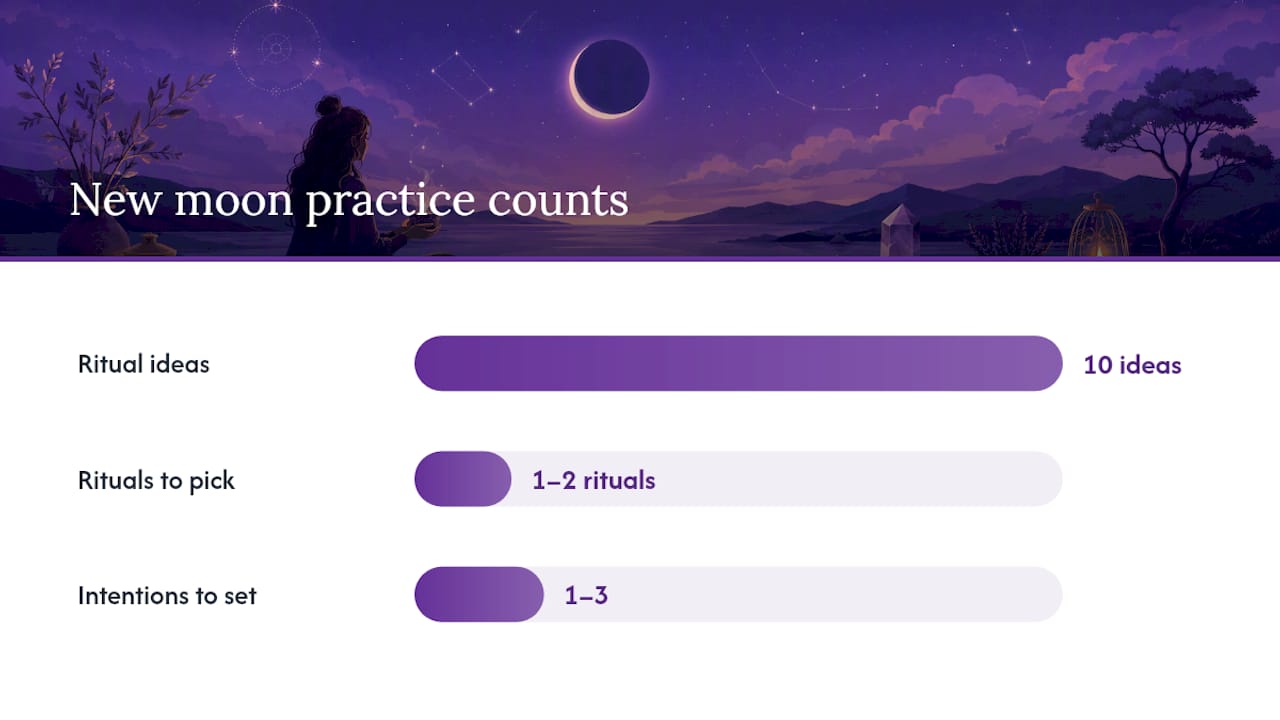
Here are 10 simple new moon ritual ideas you can do tonight to plant intentions and begin a monthly practice. Simple, accessible practices like these work whether you have five minutes or a full evening, and none of them require an elaborate setup.
- Journaling: Write 1–3 present-tense intentions in a notebook. Best for: clarifying what you’re calling in this cycle.
- Candle work: Light a white or colored candle and speak your intention aloud. Best for: anchoring your focus with a sensory cue.
- Ritual bath: Soak in a bath with salt and a few drops of lavender or rosemary essential oil. Best for: releasing energetic residue and opening to renewal.
- Moon water: Set a jar of water on a windowsill overnight. Best for: creating a charged tool to use in future rituals or morning routines.
- Altar refresh: Clear and reset your altar with fresh flowers, a new candle, or a meaningful object. Best for: marking a clean energetic start.
- Smudging or space clearing: Use an ethically sourced herb bundle or a botanical spray to clear your space. Best for: shifting the energy in a room before ritual.
- Bury or plant an intention: Write a wish on paper and bury it in soil, or plant a seed as a living symbol. Best for: grounding long-term goals in physical action.
- Tarot or oracle pull: Draw one card as a theme or guiding message for the lunar cycle. Best for: receiving intuitive direction.
- Vision board or vision card: Cut or sketch images that represent your intentions. Best for: visual learners who anchor goals through imagery.
- Charm bag: Fill a small pouch with herbs, crystals, or written words aligned with your intention. Best for: creating a portable talisman to carry through the month.
Practitioners consistently find that keeping the ritual count small and the intention count at 1–3 produces more focus than trying to cover everything at once. Pick one or two from this list and go deep rather than wide.
Key Takeaways
A consistent new moon practice built on 1–3 present-tense intentions, one sensory anchor, and a single follow-up action within 24 hours produces more lasting results than any elaborate one-time ceremony.
| Point | Details |
|---|---|
| Timing window | The first 8 hours after the exact new moon are most potent; the full 48-hour window and waxing crescent are also valid. |
| Intention wording | Write 1–3 present-tense intentions that include a feeling state; drop “I want” for “I am” or “I have.” |
| 24-hour action rule | Take one small, concrete step toward each intention within 24 hours to ground the energetic work. |
| Full moon follow-up | Review your intentions at the full moon to see what has shifted and release what no longer serves. |
| Kejiwastore ritual aids | Ethically sourced aromatherapy mists, smudging herbs, and crystal kits from Kejiwastore lower friction and support a repeatable practice. |
Table of Contents
- How do you prepare for a new moon ritual?
- Ten step-by-step new moon ritual ideas with time estimates
- Which ritual fits the time and energy you have tonight?
- How to write new moon intentions that actually work
- Working with crystals, herbs, and moon water safely
- What to avoid in your new moon practice
- What actually makes a new moon practice sustainable
- Ritual aids from Kejiwastore that support these practices
- Sources
How do you prepare for a new moon ritual?
Preparation is where most beginners skip a step, and it shows. A few minutes of physical and mental setup creates the container that makes the ritual feel different from a regular evening.
Timing. The most potent window is within the first 8 hours of the exact new moon, and the full 48-hour window following it carries meaningful energy. If you miss both, the waxing crescent still supports beginning a new practice. Check a moon-phase app or almanac for your local exact time.
Physical prep checklist:
- Tidy the space you’ll use, even briefly. Clutter competes with focus.
- Set up a simple surface: a candle, one crystal, a pen, and your journal is enough.
- Review fire safety: never leave a burning candle unattended, keep it away from fabric, and have a snuffer or lid nearby.
- If you’re doing a ritual bath, fill the tub before you begin so you’re not breaking the mood mid-ritual.
- Put your phone on Do Not Disturb.
Mindset prep. Take three slow breaths before you begin. That’s it. You don’t need a lengthy meditation to enter ritual space. Set a limit of 1–3 intentions for the cycle — more than that dilutes your energetic attention across the month.
Substitutions for accessibility. No candle? Use a small LED tea light. No crystals? A smooth stone from outside works. No journal? A folded piece of paper is fine. The ritual is in the intention, not the equipment.
Pro Tip: Choosing one consistent sensory anchor — the same candle scent, the same essential oil mist, the same tea — trains your nervous system to enter a focused state faster each month. Habit formation in ritual practice is largely sensory.
If the moon isn’t visible due to weather or light pollution, sitting in a dark, quiet room and centering yourself is a fully valid method. Presence and intention matter more than literal sighting.
Ten step-by-step new moon ritual ideas with time estimates
These are structured so you can follow one exactly or pull elements from several. Each includes materials, a time estimate, and clear steps.
-
New moon journaling Materials: Journal, pen. Time: 5–15 minutes. Sit quietly. Write the date and moon phase at the top. Then write 1–3 intentions in present tense: “I am building a creative practice that sustains me.” Include a feeling word: “I feel grounded and purposeful.” Close by writing one action you’ll take within 24 hours.
-
Candle intention ritual Materials: White or colored candle, candle holder, matches or lighter, snuffer. Time: 10–20 minutes. Place the candle safely on a heat-resistant surface. Light it and speak your intention aloud three times. Sit with the flame for several minutes, visualizing the outcome. Snuff (don’t blow) the candle when done. Never leave it burning unattended. An LED candle is a safe and equally effective substitute.
-
Ritual bath Materials: 1–2 cups Epsom salt, 5–8 drops lavender or rosemary essential oil, optional dried herbs. Time: 30–45 minutes. Add salt and essential oil to warm (not hot) water. Do a patch test if you have sensitive skin. Soak while holding your intention in mind. For a deeper guide on bath ritual preparation, including Ormus and botanical combinations, Kejiwastore has a full walkthrough.
-
Moon water charging Materials: Glass jar with lid, filtered or tap water, label and pen. Time: 5 minutes active, overnight passive. Fill the jar, label it with the date and moon phase, and set it on a windowsill or outdoor surface overnight. In urban settings, a windowsill works fine even without direct moonlight. Use the water to anoint your wrists, add to a bath, or water a plant tied to your intention.
-
Altar refresh Materials: Fresh flowers, a new candle, a meaningful object, a cloth. Time: 10–15 minutes. Clear everything from your altar surface. Wipe it down. Replace items intentionally: one object per intention area. Light a candle to signal the new cycle has begun.
-
Smoke or spray cleansing Materials: Ethically sourced herb bundle or botanical room spray. Time: 5–10 minutes. Move through your space from back to front, directing smoke or spray toward corners and doorways. Open a window to let stagnant energy exit. See the ethics note in the botanicals section before choosing your herb.
-
Tarot or oracle pull Materials: Your deck. Time: 5–10 minutes. Shuffle while holding a single question: “What energy supports my intentions this cycle?” Draw one card. Journal two or three sentences about what it reflects for you right now.
-
Bury or plant an intention Materials: Paper, pen, small pot of soil or outdoor garden. Time: 10 minutes. Write your intention on a small piece of paper. Fold it and bury it in soil, or plant a seed on top of it. Water it. This grounds the intention in a living, physical act.
-
Vision board or vision card Materials: Magazine clippings, printed images, index card or small paper, glue. Time: 20–45 minutes. Choose images and words that represent how you want to feel this cycle, not just what you want to acquire. A single index card “vision card” works as well as a full board and is easier to keep near your altar.
-
Charm bag Materials: Small cloth pouch, dried herbs, one crystal, a written intention slip. Time: 15 minutes. Place your chosen items in the pouch while stating your intention aloud. Tie it closed. Carry it with you or keep it on your altar until the full moon. For crystal and botanical pairing guidance, Kejiwastore’s pairing ritual guide walks through combinations by intention type.
Which ritual fits the time and energy you have tonight?
Accessible rituals scale from 5-minute practices to longer ritual evenings, and the one you actually do is always better than the elaborate one you postpone.
- 5 minutes: Write one present-tense intention in your journal and light a candle (or LED candle) while you read it aloud. That’s a complete ritual. It plants the seed and creates a sensory anchor.
- 15–30 minutes: Combine moon water charging (5 minutes to set up) with a focused journaling session. Or draw a tarot card first, let it inform your intention writing, then set out your moon water jar before bed.
- 60+ minutes: Full altar refresh, a ritual bath with Epsom salt and botanicals, a vision board or vision card, and a closing candle meditation. This is the version for nights when you have the energy and want to go deep.
If you’re tired, choose the 5-minute version and commit to one follow-up action tomorrow. Honoring your energy is part of the practice. A depleted ritual performed out of obligation carries less intentional charge than a simple, present one.
How to write new moon intentions that actually work
The wording matters more than most guides admit. A structured practice moves through release, clarify, write, affirm, and commit phases, and the writing step is where most people lose the thread.
Why 1–3 intentions. Spreading your focus across eight goals means none of them receive sustained energetic attention across the 28-day cycle. One to three gives you enough to work with without fragmenting your follow-through.
The wording shift that changes everything. Drop “I want” and “I hope.” Both locate the desire in the future and in lack. Replace them with present-tense, feeling-inclusive language:
- ✗ “I want to feel less anxious about money.”
- ✓ “I am building a calm, trusting relationship with my finances.”
- ✗ “I hope to find a creative community.”
- ✓ “I am surrounded by people who inspire and support my creative work.”
Writing intentions in present tense and including a feeling state keeps them active in your awareness rather than passive on a page.
The 24-hour action rule. Within 24 hours of writing your intentions, take one small, concrete step toward each one. Send the email. Schedule the appointment. Buy the journal. This grounds the energetic work in physical reality and signals to your nervous system that the intention is real.
28-day follow-up cadence:
| Lunar phase | Timing | Suggested micro-action |
|---|---|---|
| New moon (most potent) | 0–8 hours after exact new moon | Write intentions, light candle, commit to one action |
| New moon window | the full 48-hour window following it | Full ritual if you missed the first window |
| Waxing crescent | Days 3–7 | Review intentions, take one visible step |
| First quarter | Day 7 | Check in: what resistance has appeared? Adjust approach |
| Full moon | full moon days | Review what has shifted; release what no longer serves |
| Waning phase | Days 15–28 | Rest, reflect, clear space for the next cycle |
The new moon’s role is seeding and planning, distinct from the full moon’s function of release and completion. Treating them as a pair deepens both practices.
Working with crystals, herbs, and moon water safely
The materials you choose carry real energetic and physical properties, and a few practical notes keep the practice both safe and ethically grounded.
Moon bath recipe variations:
- Calming: 1 cup Epsom salt + 5 drops lavender essential oil + dried chamomile flowers
- Clarifying: 1 cup Epsom salt + 4 drops rosemary essential oil + a sprig of fresh rosemary
- Always do a skin patch test before adding new botanicals to bath water. Avoid essential oils directly on skin without a carrier. If you’re pregnant or have a skin condition, consult a healthcare provider before using herbal baths.
Moon water at the new moon. The new moon produces charged water that carries the energy of new beginnings rather than the amplified energy of the full moon. Use a glass container, label it clearly with the date and phase, and store it in the refrigerator if you plan to use it within a week. Don’t drink moon water made in a container with crystals inside, as some stones are water-soluble or toxic.
Crystal choices for new moon intentions:
- Clear quartz: amplifies any intention; easy to cleanse under running water
- Moonstone: aligned with lunar cycles and intuition; avoid prolonged water exposure
- Rose quartz: supports intentions around love, self-worth, and relationships; generally water-safe for brief rinses
For deeper guidance on crystal properties and care, Kejiwastore’s crystals in alchemy guide covers cleansing methods, porous stone cautions, and pairing logic.
Herb and smoke-cleansing ethics. White sage (Salvia apiana) and palo santo are both subject to overharvesting concerns and, in the case of white sage, hold deep significance in specific Indigenous traditions. If you are not from those traditions, using them without acknowledgment of their cultural context is worth reconsidering. Alternatives with strong clearing properties include garden sage, rosemary, cedar, mugwort, or a botanical room spray. Kejiwastore’s smudging herbs collection sources ethically and offers alternatives for practitioners who want responsibly made options.
For a thorough look at smoke-cleansing methods and sourcing ethics, the botanical smoke-cleansing guide at Kejiwastore covers the full picture.
Pro Tip: Keep your ritual toolkit to three items or fewer per session. A single crystal, one herb or spray, and your journal is a complete kit. Accumulating more tools before you’ve built the habit is one of the most common ways new practitioners stall.
What to avoid in your new moon practice
A few patterns consistently undermine new moon practices, and most of them come from good intentions taken too far.
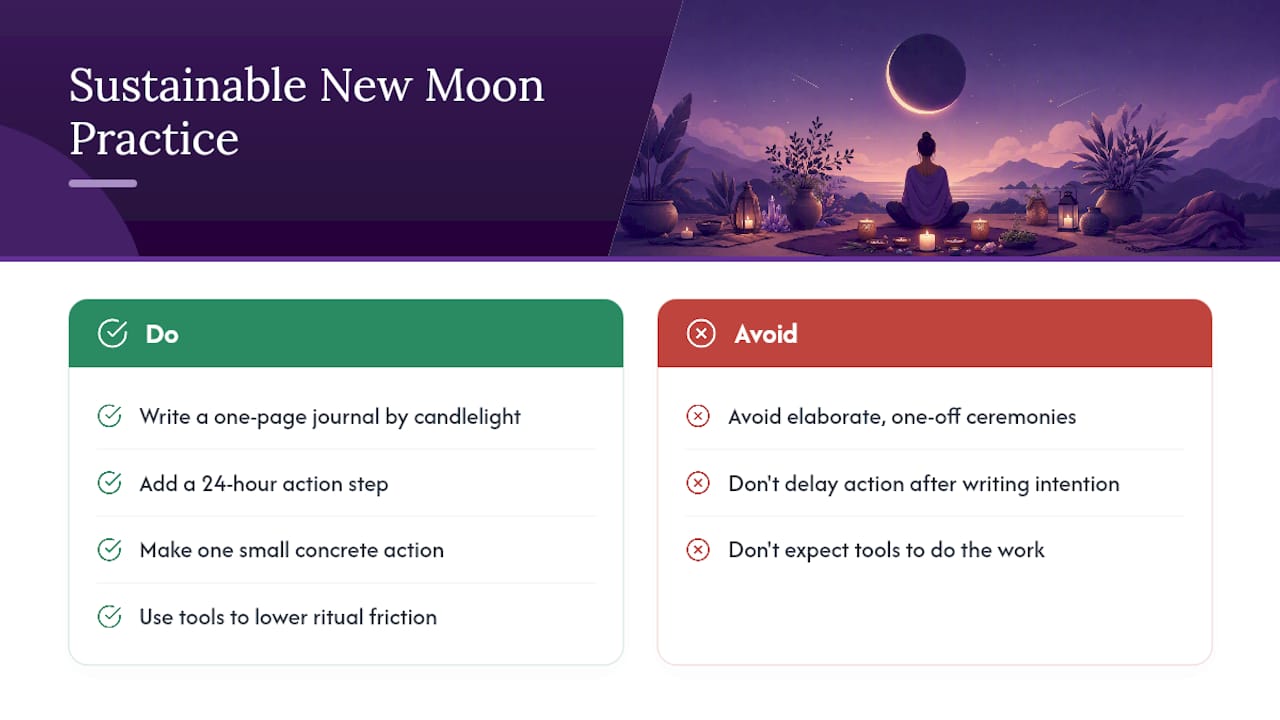
- Overcomplicating the ritual. A 12-step ceremony you can’t sustain is less effective than a 5-minute practice you repeat every month. Complexity is not depth.
- Setting too many intentions. More than three dilutes focus. If everything is a priority, nothing receives the sustained attention that produces change.
- Treating ritual as passive wishing. Intention without action is a wish. The ritual creates alignment; the follow-up action creates results. New moon practices that combine intention with a concrete next step produce more durable outcomes than those that don’t.
- Unsafe fire practices. Never leave a burning candle unattended. Keep flames away from fabric, hair, and paper. Use a proper candle holder on a stable, heat-resistant surface. An LED candle is a completely valid substitute.
- Unsafe water practices. Don’t place water-soluble or potentially toxic crystals (malachite, selenite, pyrite) in drinking water or bath water. Label and date moon water clearly.
- Allergy and skin sensitivity. Patch-test any new essential oil or botanical before adding it to bath water. Dilute essential oils in a carrier oil or Epsom salt before skin contact.
On cultural appropriation: Smudging with white sage and burning palo santo are practices rooted in specific Indigenous and South American traditions. Using these materials without understanding their cultural context, or purchasing them from sources that exploit those traditions, causes real harm. If you’re drawn to smoke cleansing, consider herbs from your own cultural heritage or bioregion, and source from suppliers who work directly with Indigenous-led harvesters. Respectful practice means knowing where your tools come from and who they belong to first.
What actually makes a new moon practice sustainable
Most people approach new moon rituals the way they approach New Year’s resolutions: with maximum effort in the first week and nothing by the third. The practices that last are almost always the smallest ones.
The single ritual that tends to stick across months is a one-page journal entry written by candlelight. Not because it’s the most powerful thing you can do, but because it’s the most repeatable. Repeatability is the mechanism. A ritual you perform twelve times a year, even simply, builds more energetic coherence than an elaborate ceremony you do once.
What shifted the practice from occasional to consistent was adding the 24-hour action step. Writing an intention and then doing nothing for two weeks keeps the intention abstract. Sending one email, making one call, or clearing one drawer within 24 hours makes the intention physical. That small act closes the loop between the energetic and the material, and it’s the difference between a ritual that feels meaningful and one that actually moves something.
Kejiwa Alchemy’s work with botanical alchemy and responsibly sourced ritual aids comes from this same understanding: the tools support the practice, but the practice is yours. A well-made aromatherapy mist or a thoughtfully sourced herb bundle doesn’t do the work for you. It lowers the friction, sharpens the sensory anchor, and makes the ritual easier to return to. That’s what good ritual tools do.
Ritual aids from Kejiwastore that support these practices
You don’t need any products to perform a meaningful new moon ritual. A pen, a candle, and five minutes of honest attention are enough. That said, the right tools can lower the friction between intention and action, and Kejiwastore’s small-batch botanical offerings are made specifically for practitioners who want quality they can trust.

Kejiwastore’s botanical aromatherapy mists work as both a space-clearing spray and a sensory anchor, replacing smoke for those who prefer a flame-free or scent-sensitive practice. The smudging herbs collection is ethically sourced and curated with cultural context in mind. For ritual baths, the spagyric herbal tinctures offer plant-based support for body alignment and energetic preparation before or after soaking. Crystal kits and orgonite tools are available through the Crystal Vortex collection for practitioners building a physical altar kit.
Every product is handcrafted in small batches using organic and wild-harvested ingredients. Browse the full range and find what fits your practice at Kejiwastore.
Sources
- 12 New Moon Rituals For Manifestation, Creativity, & More
- New Moon Intention Setting Step By Step (April - Lunar Guide)
- New Moon Rituals & Meaning (Spiritual Guide for Beginners) - Hearth & Hedge
- New Moon Rituals for Manifestation
- New Moon Ritual Ideas
- How to Cleanse for the New Moon
- What to Do on a New Moon: 10+ Easy New Moon Rituals