


Mugwort (Artemisia vulgaris and related species like Artemisia argyi) is traditionally used to heighten dream vividness, sharpen intuition, support divination, and cleanse or protect ritual space. Practitioners have leaned on this silvery, bitter herb for centuries as a bridge between waking awareness and the dreaming mind. The one caveat that outranks everything else in this guide: mugwort is contraindicated in pregnancy because of its traditional use as a uterine stimulant, and anyone allergic to ragweed, chrysanthemums, or other Asteraceae/daisy-family plants should avoid it entirely.
If you’re new to this herb, start small and stay curious rather than diving straight into ingestion.
- Try a dream pillow or sachet first. No ingestion, minimal risk, real results for many people.
- If you want tea, keep it mild and occasional, not a nightly habit.
- Read the safety section below before you buy anything meant to be swallowed.
Quick fact: Herbalist protocols commonly recommend 1 to 2 teaspoons of dried mugwort leaf steeped 5 to 10 minutes, taken 30 to 60 minutes before bed, as a low-risk entry point into mugwort dreamwork.
Key Takeaways
Mugwort works best as a gentle, repeatable dreamwork and cleansing ally when paired with consistent intention, journaling, and species-verified sourcing, not as a one-time fix for lucid dreaming.
| Point | Details |
|---|---|
| Start with non-ingested forms | Try a dream pillow or sachet before tea or tincture to test sensitivity safely. |
| Respect the pregnancy contraindication | Avoid ingested mugwort during pregnancy and lactation due to traditional uterine stimulant use. |
| Verify the species on the label | Confirm Artemisia vulgaris versus Artemisia argyi before buying, since their traditional uses differ. |
| Pair mugwort with dream journaling | Mugwort amplifies existing dreamwork practice rather than reliably producing lucidity alone. |
| Shop species-labeled, small-batch products | Kejiwa Alchemy offers dried mugwort, smudging blends, tinctures, and aromatics with transparent sourcing. |
Table of Contents
- What Plant Is Mugwort, and How Do You Identify It?
- How Has Mugwort Been Used Across Different Cultures?
- What Spiritual and Magical Properties Does Mugwort Have?
- How Do You Use Mugwort in Ritual Practice?
- Who Should Avoid Mugwort, and What Are the Risks?
- How Should You Source and Store Mugwort?
- What Does the Evidence Say About Mugwort’s Effects?
- How Do You Use Mugwort Respectfully in Ritual?
- Is Mugwort Legal to Buy, Grow, or Use?
- How Kejiwa Alchemy Works With Mugwort
- Where to Find Ritual-Grade Mugwort and Complementary Tools
- Sources
What Plant Is Mugwort, and How Do You Identify It?
The mugwort used in most Western dreamwork and protection rituals is Artemisia vulgaris, a hardy perennial in the daisy family that grows wild along roadsides, fences, and disturbed soil across North America and Europe. A close relative, Artemisia argyi (Chinese mugwort), plays a different and specific role: it’s the herb compressed into moxa sticks for moxibustion, a clinical practice distinct from home ritual burning. Knowing which species you’re holding matters, because sourcing, dosing, and intended use diverge between the two.
Field identification isn’t complicated once you know what to look for. Mugwort leaves are deeply lobed, dark green on top, and covered in fine silvery fuzz on the underside, almost like they’ve been dusted with frost. Crush a leaf and you’ll get a sharp, bitter, sage-adjacent aroma that’s unmistakable once you’ve smelled it a few times. The plant can reach four to six feet tall, with small, inconspicuous flower clusters that don’t look like much compared to the foliage.
Lookalikes are worth knowing. Ragweed, wormwood (Artemisia absinthium), and common yarrow can all get mistaken for mugwort by beginners, and ragweed in particular carries a much higher allergy risk. Extension resources on mugwort’s botanical traits note the silvery leaf underside as one of the more reliable distinguishing features when you’re foraging or verifying a supplier’s harvest.
Fresh and dried mugwort behave differently in preparation. Fresh leaf carries more moisture and a milder aromatic punch, which is why some practitioners prefer it for washes. Dried leaf concentrates the oils and bitterness, so it’s the standard choice for tea, smudge bundles, and sachets, where potency and shelf stability matter more than delicacy.
Pro Tip: Before buying dried mugwort online, check that the listing names the species (Artemisia vulgaris, not just “mugwort”). Vague labeling is the easiest sign of a supplier who hasn’t verified their own harvest.
How Has Mugwort Been Used Across Different Cultures?
Mugwort’s spiritual reputation didn’t form overnight. It built up over roughly two thousand years across at least four distinct traditions, and the overlap between them is what makes the herb so interesting.
The Anglo-Saxon Lacnunga, a medical and charm text, names mugwort first among nine sacred herbs invoked for protection and healing. Roman travelers reportedly tucked mugwort into their sandals to ward off fatigue on long journeys, a practical bit of folk magic tied to endurance rather than dreams. European folk magic later folded mugwort into midsummer rituals, associating it with the moon, feminine cycles, and the veil between worlds thinning at solstice. In Traditional Chinese Medicine, Artemisia argyi became the basis for moxibustion, a heat therapy applied to acupuncture points, which is a clinical use with almost nothing in common with burning loose herb for atmosphere. Some Indigenous North American herbal traditions also incorporated related Artemisia species into ceremonial and medicinal practice, though the specific plants, protocols, and meanings vary by nation and should never be flattened into a single generic “Native use.”
Three themes recur across nearly all of these traditions, even when the cultures never had contact with each other:
- Protection on journeys and thresholds — physical travel in Rome, liminal thresholds like solstice in Europe.
- Dream and vision enhancement — the throughline that connects Anglo-Saxon charms to modern dreamwork practice.
- Lunar and feminine associations — mugwort’s folk name “moonwort” persists for a reason.
Mugwort has been used across Europe and in Chinese and African herbal traditions for centuries, applied to vision work, protection, and sleep-related rituals in each context.
That range is worth sitting with. It’s tempting to blend every tradition into one generic “ancient wisdom” narrative, but the Anglo-Saxon charm-worker, the Roman traveler, and the Chinese moxibustion practitioner were doing genuinely different things with genuinely different intentions. Respecting mugwort’s spiritual history means naming which tradition you’re drawing from rather than treating the plant as a blank slate for whatever modern ritual you want to build.
What Spiritual and Magical Properties Does Mugwort Have?
Practitioners consistently attribute four core properties to mugwort, and each one maps to a specific kind of ritual work.
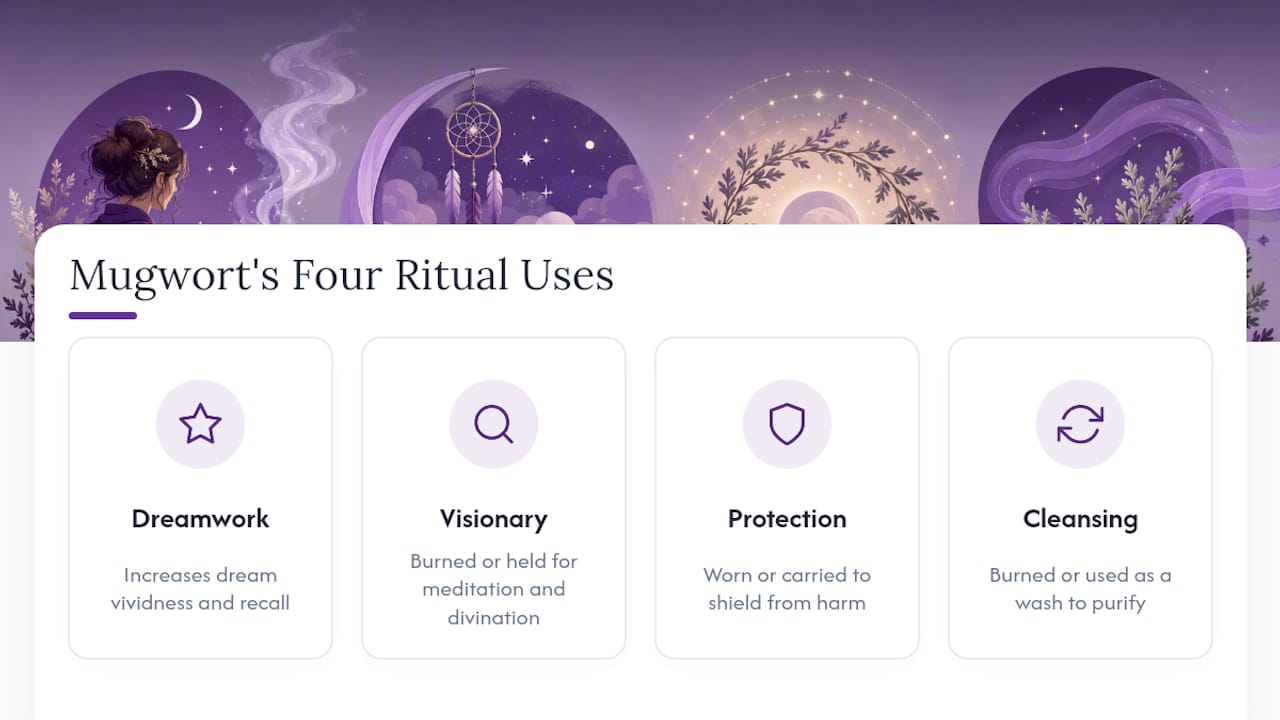
Oneirogenic, or dream-enhancing, action sits at the center of mugwort’s modern reputation. Herbalist and dreamwork sources describe mugwort as a herb that increases dream vividness and recall, whether taken as tea, tucked into a dream pillow, or simply kept near the bed. If your goal is remembering more of what you dream, or dreaming in sharper color and detail, this is the property that matters most.
Visionary and intuitive amplification extends beyond sleep into waking practice. Many practitioners burn mugwort or hold a sprig during meditation, divination, or scrying sessions, treating it as a tool that quiets mental static and opens space for intuitive impressions. This is subtler than the dream effect and depends heavily on your own receptivity and practice consistency.
Psychic protection is where mugwort crosses over into defensive magic. Folk tradition ties this back to the Roman travel-charm use: mugwort worn or carried was thought to shield the bearer from harm, and that same logic gets applied today to protecting a space, a ritual tool, or a person during vulnerable spiritual work.
Cleansing and purification rounds out the list, most commonly through smoke or a mugwort wash. Practitioner sources describe burning mugwort as incense to support trance states, smudging spaces for general purification, and using mugwort-steeped water to cleanse ritual tools and mirrors without the smoke residue that heavier resins leave behind. Some traditions also weave the dried herb into besoms, brooms used to sweep negative energy from a space rather than dust from a floor.
Here’s where expectation management matters. A dream pillow filled with dried mugwort delivers a mild, ongoing olfactory exposure all night, subtle and cumulative. A cup of mugwort tea or a tincture dose delivers a more concentrated internal exposure with a faster, stronger effect, and that’s exactly why the safety section below applies real weight to ingested forms. Crystal and herb-correspondence references commonly list mugwort’s lunar and Third Eye associations alongside its prophetic-dreaming reputation, which is useful shorthand, but it’s not a substitute for understanding which preparation method you’re actually using and what that implies for potency.
How Do You Use Mugwort in Ritual Practice?
Every method below scales from gentle to more concentrated. Start at the mild end, especially your first few times.
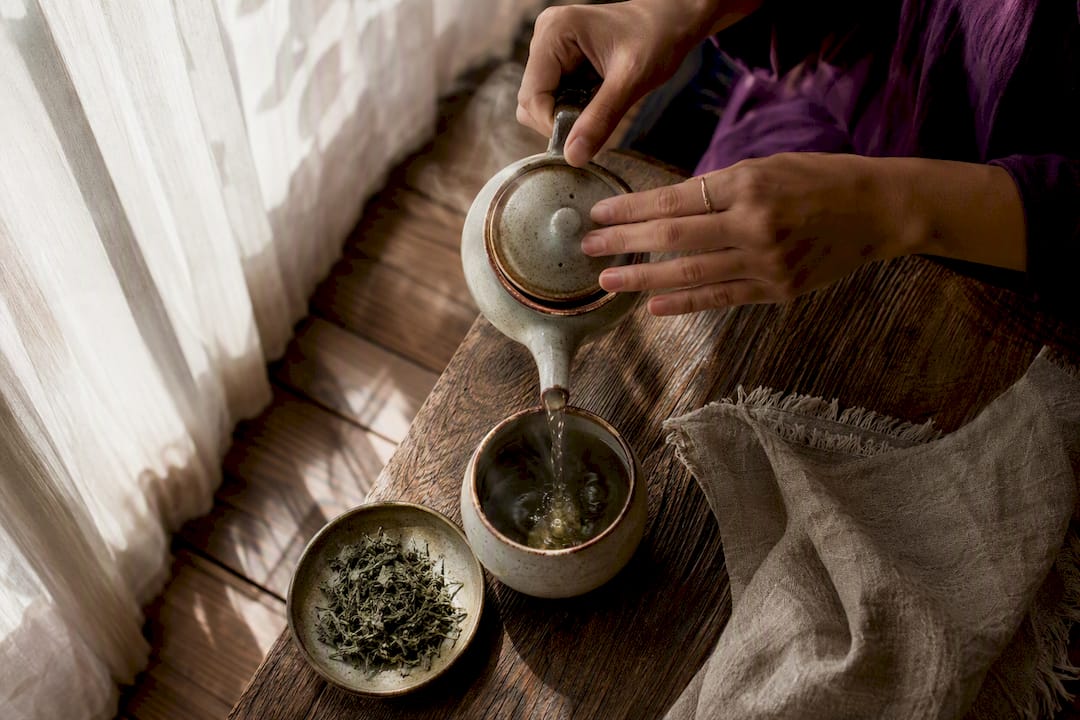
1. Mild mugwort dream tea. Steep 1 to 2 teaspoons of dried mugwort leaf in hot water for 5 to 10 minutes, then drink it 30 to 60 minutes before bed. This is the most-cited starting protocol among herbalists working with mugwort for dreamwork, and it’s a reasonable place to begin if you have no known sensitivity and you aren’t pregnant. Keep a dream journal on your nightstand and jot down anything you remember the moment you wake, since recall fades within minutes.
2. Dream pillow or sachet. Fill a small cotton pouch with dried mugwort leaf, alone or blended with lavender for a calming note, and tuck it inside your pillowcase or set it on your nightstand. This is the gentlest delivery method because there’s no ingestion and no smoke, just slow ambient exposure through scent. It’s also the method commonwealth herbalists most often recommend for anyone testing sensitivity before trying tea or tincture.
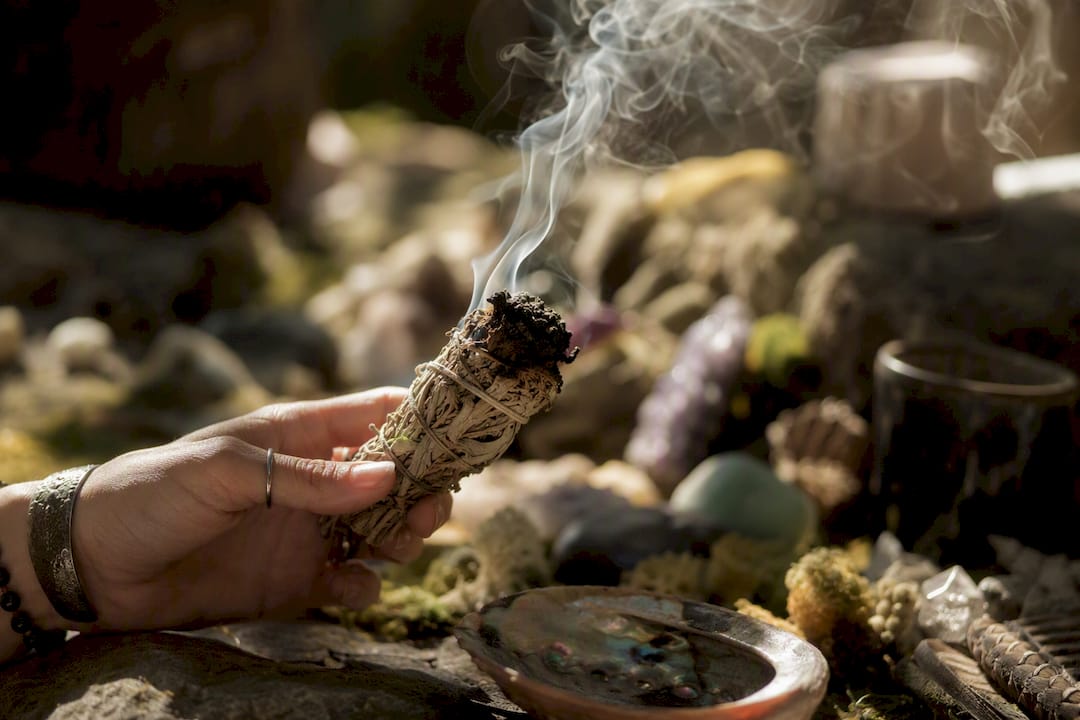
3. Smudging and smoke cleansing. Bundle dried mugwort into a small wand or use loose leaf over a charcoal disc, light it, let it smolder rather than flame, and waft the smoke through a room or around an object you want to cleanse. Crack a window first. Smoke cleansing works well for clearing a space before ritual or after an argument or illness has left heavy energy behind, but it isn’t appropriate for anyone with asthma or smoke sensitivity. Our guide to smoke cleansing rituals covers ventilation and technique in more depth.
4. Mugwort wash for tools and mirrors. Steep fresh or dried mugwort in hot water, let it cool, strain it, and use the liquid to wipe down scrying mirrors, tarot decks, crystals, or altar tools. This avoids smoke entirely, which makes it the better choice for delicate items or anyone sharing space with someone who can’t tolerate smudge smoke.
5. Mugwort bath. Steep a generous handful of dried mugwort in a muslin bag under running bath water, or brew a strong infusion and add it to your bath. This works well before divination or dreamwork as a way to signal to your nervous system that ritual time has begun. Keep the water comfortably warm, not scalding, since heat intensifies any skin sensitivity.
6. Tincture basics. A mugwort tincture, typically dried leaf extracted in high-proof alcohol over four to six weeks, delivers a concentrated dose in just a few drops. This is the strongest ingested form covered here and deserves the most caution: start with a single drop diluted in water rather than a full dropper.
7. Moxa and moxibustion context. Moxibustion is a clinical practice using compressed Artemisia argyi (moxa) applied near acupuncture points, and Cleveland Clinic describes it as a treatment with its own specific protocols and safety considerations under a trained practitioner. It is not the same thing as burning loose dried mugwort for a home ritual, and conflating the two risks either underestimating moxibustion’s clinical seriousness or overestimating what casual smudging does.
Timing shapes results more than most people expect. Bedtime protocols align with the herb’s dream-enhancing reputation, while new and full moon phases are the traditional windows for cleansing and protection work, tying back to mugwort’s old “moonwort” association. Before any session, set a specific intention rather than a vague one: “I want to remember tonight’s dreams” works better than “I want good dreams.” Pair the herb with a technique, not just the plant alone. Dream journaling immediately on waking, and basic reality-check habits used in lucid dream training, make a measurable difference in what you retain; our guide to vivid versus lucid dreaming walks through both.
Mugwort also blends well with other herbs depending on your goal:
- Lavender softens the bitterness of mugwort tea and adds a calming note to dream pillows.
- Jasmine pairs with mugwort in intuition and love-divination work, often as a companion aromatic rather than a blend in the sachet itself.
- Mullein combines with mugwort in some smoke blends for a milder, less acrid burn.
- White sage appears in mugwort blends for general cleansing, though many practitioners now favor mugwort on its own given sustainability concerns around wild sage harvesting.
Whatever method you choose, ventilate any smoke work, start low on anything you swallow, and give your body a night or two to tell you how it responds before increasing the dose.
Who Should Avoid Mugwort, and What Are the Risks?
The contraindications here aren’t minor footnotes. Pregnant and lactating individuals should not use mugwort in any ingested form, because of its traditional association with uterine stimulation, a use documented consistently enough across herbal literature that it isn’t a fringe caution. Anyone with a known allergy to ragweed, chrysanthemums, daisies, or other Asteraceae-family plants should also avoid mugwort, since cross-reactivity is common within that plant family.
Medication interactions deserve attention too. Mugwort may interact with sedatives, sleep medications, and certain other pharmaceuticals, so anyone currently taking prescription sleep aids or sedative medication should talk to a healthcare provider before adding mugwort tea or tincture to a nightly routine.
Reported side effects, even among people with no known contraindication, include:
- Mild stomach upset, especially at higher tea or tincture doses.
- Lighter or more fragmented sleep in some users, which runs counter to the intended effect and seems tied to individual sensitivity.
- Skin irritation from topical or bath use in a small subset of people.
- Possible uterine stimulation at high doses, which is the mechanism behind the pregnancy contraindication.
Before trying mugwort for the first time, run through a short screening checklist. Are you pregnant or breastfeeding? Do you have a known Asteraceae allergy? Are you on sedatives, blood thinners, or other medications with known herb interactions? If you answered yes to any of those, skip ingestion and either avoid mugwort altogether or stick to non-ingested exposure like a dream pillow, and talk to a healthcare provider first regardless.
For a sensitivity test, dab a small amount of diluted tincture or brewed tea on your inner forearm and wait 24 hours for skin reaction before internal use, then start any tea or tincture at the lowest end of the dosing range for the first two or three tries. Stop immediately if you notice stomach discomfort, unusual grogginess, or skin irritation.
Practitioner sources are consistent on one point: start with low, non-ingested exposure like a pillow sachet before moving to tea or tincture, so you can gauge your own sensitivity without any ingestion risk at all.
How Should You Source and Store Mugwort?
Quality mugwort starts with clear labeling. Look for the species name (Artemisia vulgaris) printed directly on the package, not a vague “mugwort blend,” and check whether the vendor discloses harvest method and timing.
A short sourcing checklist covers most of what matters:
- Confirm the species name on the label, especially if you specifically want A. vulgaris rather than A. argyi.
- Prefer organic or ethically wild-harvested sourcing over unlabeled bulk herb.
- Look for vendors who disclose harvest season, since mugwort cut before flowering tends to carry stronger aromatic oils.
- Ask about processing: air-dried herb generally retains more potency than herb dried under high heat.
Once you have quality mugwort, store it in an airtight glass jar in a cool, dark cupboard, away from direct sunlight and humidity. Properly stored dried mugwort holds its aroma and potency for around a year; if the scent has faded to almost nothing, it’s time to replace it. Ethical sourcing also means favoring suppliers who cultivate mugwort or harvest it from abundant, non-protected areas, since wild foraging on protected land or without landowner permission strips the plant from ecosystems that rely on it.
Pro Tip: Crush a small pinch between your fingers before buying in person. If the bitter, sage-like aroma is faint or musty instead of sharp, the batch is likely old or was dried improperly.
What Does the Evidence Say About Mugwort’s Effects?
The evidence here splits cleanly into two categories: what’s well documented and what’s still practitioner-level observation.
Botanical identification and safe preparation are solidly covered by extension-service and clinical resources. University extension guidance confirms the plant’s growth habits and identifying traits, and Cleveland Clinic’s overview of moxibustion draws a firm line between clinical moxa therapy and casual herb burning, a distinction worth remembering every time someone conflates the two online.
The dream-enhancement claim is where things get more nuanced. Practitioner-level reports of increased dream vividness and recall are remarkably consistent across dreamwork communities and herbal traditions, but the underlying mechanism is only partly understood. Some sources point to thujone and related aromatic compounds as a possible influence on sleep neurochemistry, though this remains a hypothesis rather than an established clinical finding. That gap between consistent anecdotal reporting and limited mechanistic proof is honest to acknowledge, and it doesn’t make the practitioner reports meaningless. It just means “mugwort helps people remember dreams” is a well-supported observation, while “mugwort chemically causes lucid dreaming” overstates what anyone has actually shown.
- Botanical ID and safe handling: well documented by extension sources.
- Moxibustion versus home burning: clearly distinguished by clinical health sources.
- Dream-enhancement mechanism: consistent anecdotal pattern, mechanism still hypothesized.
How Do You Use Mugwort Respectfully in Ritual?
Borrowing from centuries of layered tradition asks for some care. A few principles keep that respect intact rather than performative.
Name the tradition you’re drawing from instead of presenting mugwort as generic, uncredited “ancient wisdom.” If you’re using a besom-sweeping technique, that’s rooted in European folk magic; if you’re referencing moxibustion, that’s Traditional Chinese Medicine, and it deserves to be named as such rather than blurred into your own practice. Learn from voices within the community you’re borrowing from where you can, rather than only from secondhand retail copy or influencer content. Avoid claiming a lineage or credential you don’t have, and skip sacred symbols or ceremonial forms that belong to a specific closed practice.
Practically, that looks like setting a clear, personal intention before you use mugwort rather than mimicking a ceremony you’ve only seen online, and choosing education over spectacle when you share what you’re doing. If a particular ritual form is described as closed or initiatory within its tradition, defer to that and find an open equivalent instead.
Is Mugwort Legal to Buy, Grow, or Use?
Mugwort is legal to buy, sell, grow, and use for spiritual or culinary purposes across the United States, and it isn’t a controlled substance under federal or state law. You’ll find it sold openly as tea, dried herb, tincture, and smudge bundles through herbal retailers and online shops, with no special licensing required for personal use.
The legal wrinkles show up in a couple of narrower places. Some states and counties classify mugwort as an invasive or noxious weed because it spreads aggressively through rhizomes and can crowd out native plants, which mainly affects agricultural and land-management regulation rather than personal spiritual use. If you’re foraging rather than buying, check local rules before harvesting from public land, parks, or protected natural areas, since permission requirements vary by jurisdiction and mugwort’s invasive-weed status in some regions means removal is sometimes encouraged rather than restricted.
Selling mugwort as a supplement or wellness product in the United States falls under general herbal product labeling norms, which means retailers can’t make specific medical claims (like “cures insomnia”) without running into FDA regulatory issues, but general spiritual and traditional-use framing is standard across the herbal retail space. None of this affects your ability to buy, grow, or use mugwort personally for dreamwork, protection, or cleansing.
How Kejiwa Alchemy Works With Mugwort
Curating ritual botanicals for spiritual seekers has taught us that consistency matters as much as quality. A batch of mugwort that smells sharp and bitter one month and faint the next undermines the ritual it’s meant to support, which is why we track harvest sourcing and freshness across every smudging blend, sachet, and spagyric tincture we offer. We source with species accuracy in mind and disclose what’s in every blend rather than leaving customers to guess.
If you’re building a custom ritual blend or exploring wholesale options for a practice or shop, reach out through our site. We also maintain a growing library of ritual botanical guides for readers who want the fuller context behind each herb we work with.
Where to Find Ritual-Grade Mugwort and Complementary Tools
Sourcing mugwort you can actually trust means knowing the species on the label and how it was harvested, and that’s exactly the transparency Kejiwa Alchemy builds into every product line. We offer dried mugwort suited for sachets and smudge work, alongside smudging herb bundles that pair mugwort with complementary botanicals for cleansing rituals.

If tea or tincture is more your speed, our spagyric herbal tinctures are crafted in small batches with clear labeling on species and concentration, so you’re never guessing what’s in the bottle before you take a single drop. For non-ingested dreamwork and cleansing, our botanical aromatic mists and oils offer a gentler entry point, and our Ormus mineral collection rounds out a broader ritual practice for readers building an intuitive or dreamwork routine beyond mugwort alone.
Before purchasing anything meant to be swallowed, revisit the safety section above, especially if you’re pregnant, allergic to Asteraceae plants, or taking sedative medication. Once you’ve confirmed mugwort is a good fit for you, browse our current smudging herbs and tincture collections to find the starting protocol that matches your practice.
Sources
- How to Use Mugwort for Vivid and Lucid Dreams | DreamHerbs.c
- Mugwort Dreamwork: Complete Guide & Practices
- Using Mugwort in Magical Workings
- Mugwort | UAEX
- Moxibustion | Cleveland Clinic Health Essentials
These sources were chosen for their combined coverage of safety, historical depth, and hands-on practitioner protocols.