


The most widely used examples of sacred geometry in wellness are the Flower of Life, Seed of Life, Metatron’s Cube, Sri Yantra, Merkaba, Vesica Piscis, Platonic solids, and the Fibonacci/golden spiral. Each one carries a distinct energetic quality:
- Flower of Life — coherence, networked wholeness; used as a meditation gaze point or grid template
- Seed of Life — new beginnings, chakra alignment; the go-to template for chakra-aligned crystal grids
- Metatron’s Cube — containment, clearing, protection; used for energetic boundary work
- Sri Yantra — focused awareness, harmonic balance; a classic meditation anchor
- Merkaba — light-body activation, energetic centering; used in breath and visualization practices
- Vesica Piscis — union, transition, creative flow; appears in altar design and breathwork
- Platonic solids — elemental correspondence (earth, water, fire, air, ether); used in grounding and elemental balancing
- Fibonacci/golden spiral — natural coherence, growth patterning; embedded in yoga, spatial design, and visual anchoring
TL;DR: These patterns are supportive tools for nervous-system regulation and focused attention. They are not medical treatments and work best alongside, not instead of, conventional care.
Table of Contents
- What is sacred geometry, and why does it matter for wellness?
- The core sacred-geometry symbols and what they mean for your practice
- How sacred geometry is applied in practical wellness contexts
- Three ready-to-use mini-protocols you can try today
- How shapes relate to your chakras and elemental correspondences
- What practitioners and research say about sacred geometry’s effects
- Key Takeaways
- A practitioner’s perspective on weaving geometry into daily life
- How Kejiwastore supports your geometric wellness practice
- Useful sources for deeper reading
What is sacred geometry, and why does it matter for wellness?
Sacred geometry studies the geometric patterns, ratios, and shapes that recur across nature, the human body, and ancient spiritual traditions. The core premise is that these forms are not decorative accidents. They are expressions of an underlying order: the same spiral that governs a nautilus shell also appears in a galaxy’s arms, a sunflower’s seed arrangement, and the double helix of DNA (which completes one full turn every 34 angstroms, with a width of 21 angstroms, both Fibonacci numbers).
Cross-culturally, the tradition runs deep. Ancient Egyptians encoded it in pyramid proportions. Greek philosophers, particularly Plato, systematized it through the five elemental solids. Hindu and Buddhist practitioners built entire meditation systems around yantras and mandalas. Gothic cathedral builders used geometric ratios to create spaces that felt, to the body, like something more than stone. What connects all of these is a shared intuition: that certain shapes carry a quality of order that the nervous system recognizes and responds to.
In wellness, that recognition is the whole point. You are not being asked to believe in magic. You are being invited to notice that symmetrical, repeating patterns tend to quiet mental noise, anchor attention, and create a felt sense of coherence. That is where the practical value lives.
The core sacred-geometry symbols and what they mean for your practice
Each symbol below has a distinct visual signature and a corresponding wellness application. Use this table as a quick reference when choosing a pattern for a meditation, grid, room layout, or piece of jewelry.
| Symbol | Visual Cue | Common Wellness Use |
|---|---|---|
| Flower of Life | Overlapping circles in hexagonal array | Meditation gaze, grid template, space coherence |
| Seed of Life | Seven overlapping circles | Chakra crystal grid, new-intention setting |
| Metatron’s Cube | Star-like figure containing all Platonic solids | Clearing/containment grids, energetic protection |
| Sri Yantra | Nine interlocking triangles around a central point | Deep meditation anchor, harmonic focus |
| Merkaba | Two interlocking tetrahedra (star tetrahedron) | Breath/light-field visualization, centering |
| Vesica Piscis | Two overlapping circles sharing a radius | Altar design, transition rituals, breathwork |
| Platonic Solids | Five geometric forms (cube, tetrahedron, etc.) | Elemental and chakra correspondence work |
| Fibonacci Spiral | Logarithmic spiral based on the golden ratio | Yoga flow, spatial design, visual anchoring |
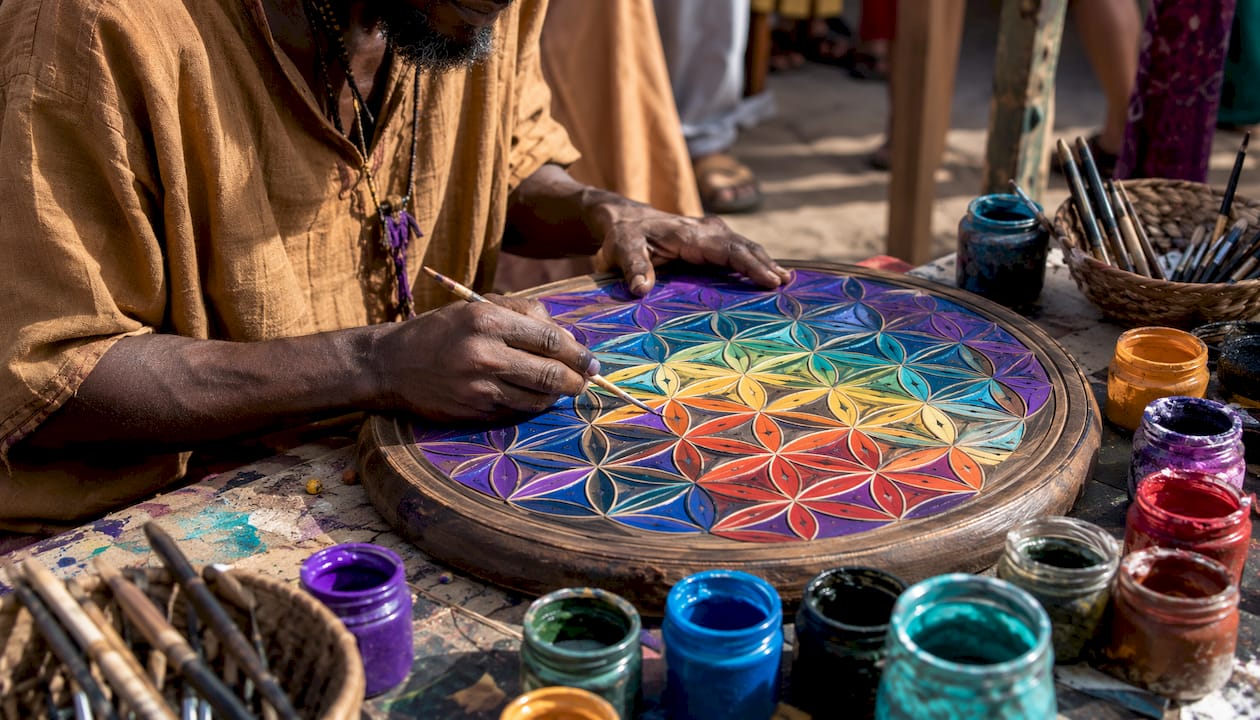
Flower of Life
Composed of multiple evenly spaced, overlapping circles in a hexagonal pattern, the Flower of Life is one of the oldest symbols in recorded human history, appearing in the Temple of Osiris at Abydos and in sacred sites across India, Turkey, and China. In wellness, it functions as a coherence anchor: gazing at it gives the visual system a stable, repeating pattern that tends to slow breath and quiet mental chatter. Practitioners at Flowergrid Holistic Wellness use it as the structural foundation for combined modalities including sound therapy, breathwork, and coaching.
Seed of Life
The Seed of Life is seven overlapping circles arranged symmetrically, and it sits at the heart of the Flower of Life pattern. Its seven points map naturally to the seven main chakras, making it the most intuitive template for chakra-focused crystal grids. Think of it as the Flower of Life’s quieter, more personal sibling: smaller in scope, more intimate in application.
Metatron’s Cube
This complex figure contains all five Platonic solids within its geometry. Practitioners use it as a visual grid template for clearing and stabilizing energetic fields, particularly when a client feels scattered, overwhelmed, or energetically porous. Its completeness (all elements present) is what makes it useful for containment work.
Sri Yantra
The Sri Yantra consists of nine interlocking triangles surrounding a central bindu point, enclosed in concentric circles and a square frame. Its precise construction requires solving a system of equations that was not formally resolved until the 20th century. As a meditation object, it trains focused, sustained attention. Gazing at the central point while allowing peripheral awareness of the surrounding triangles creates a quality of concentration that many practitioners describe as both sharp and spacious.
Merkaba
The Merkaba is a star tetrahedron: two interlocking tetrahedra, one pointing up and one pointing down, representing the integration of earth and sky, matter and spirit. It is most commonly used in breath-synchronized visualization practices, where the geometry becomes a felt sense of the body’s energetic field rather than just a visual object.
Vesica Piscis
Two circles of equal size, each passing through the other’s center, create the Vesica Piscis. The almond-shaped intersection is one of the most ancient symbols of transition and creative emergence. In wellness, it appears in altar arrangements that mark beginnings or endings, and in breathwork where the inhale and exhale are visualized as two overlapping spheres.
Platonic Solids
Plato associated each of the five regular solids with a classical element: the cube (hexahedron) with Earth, the tetrahedron with Fire, the octahedron with Air, the icosahedron with Water, and the dodecahedron with Ether. Practitioners use these correspondences to select shapes for elemental balancing work. The hexahedron/cube, for instance, is commonly used for grounding when clients feel scattered or unrooted.
Fibonacci Spiral and Golden Ratio
The golden ratio (φ ≈ 1.618) and its associated spiral appear in sunflower seed arrangements, pinecone spirals, nautilus shells, and the proportions of the human body. In wellness, this pattern shows up in yoga sequencing (moving from smaller to larger ranges of motion in a spiral progression), in spatial design (placing focal points at golden-ratio intersections), and as a visual anchor for practices that emphasize natural growth and organic unfolding.
How sacred geometry is applied in practical wellness contexts
Sacred geometric patterns in wellness are not abstract philosophy. They show up in specific, repeatable practices that you can integrate into work you may already be doing.
Crystal grids
A crystal grid uses geometric templates to arrange stones in a pattern that amplifies a shared intention. The Seed of Life and Flower of Life are the most common templates. You place a central stone (often clear quartz or selenite), then arrange supporting stones at each geometric node. Activation involves connecting the stones with a wand or your finger, tracing the pattern’s lines while holding your intention. For a deeper tutorial on building and charging a grid, the crystal grid guide at Kejiwastore walks through each step.
Meditation and mandalas
Mandalas are sacred geometry made visible as meditation objects. The Sanskrit word maṇḍala means simply “circle,” but in practice it maps the relationship between the individual and the cosmos. Gazing at a mandala or a specific symbol like the Flower of Life gives the attention a gentle task, which is particularly useful for people who find empty-mind meditation difficult. The pattern holds the mind without forcing it.
Visual breath and gaze practices
Gaze-based practices use a symbol as a soft focal point while the breath slows and deepens. Practitioner accounts report improved heart-rate variability and slower breathing when clients use symmetrical patterns like the Flower of Life as a gaze anchor. The predictable symmetry gives the nervous system something stable to orient toward, which tends to downshift activation.
Jewelry and wearable cues
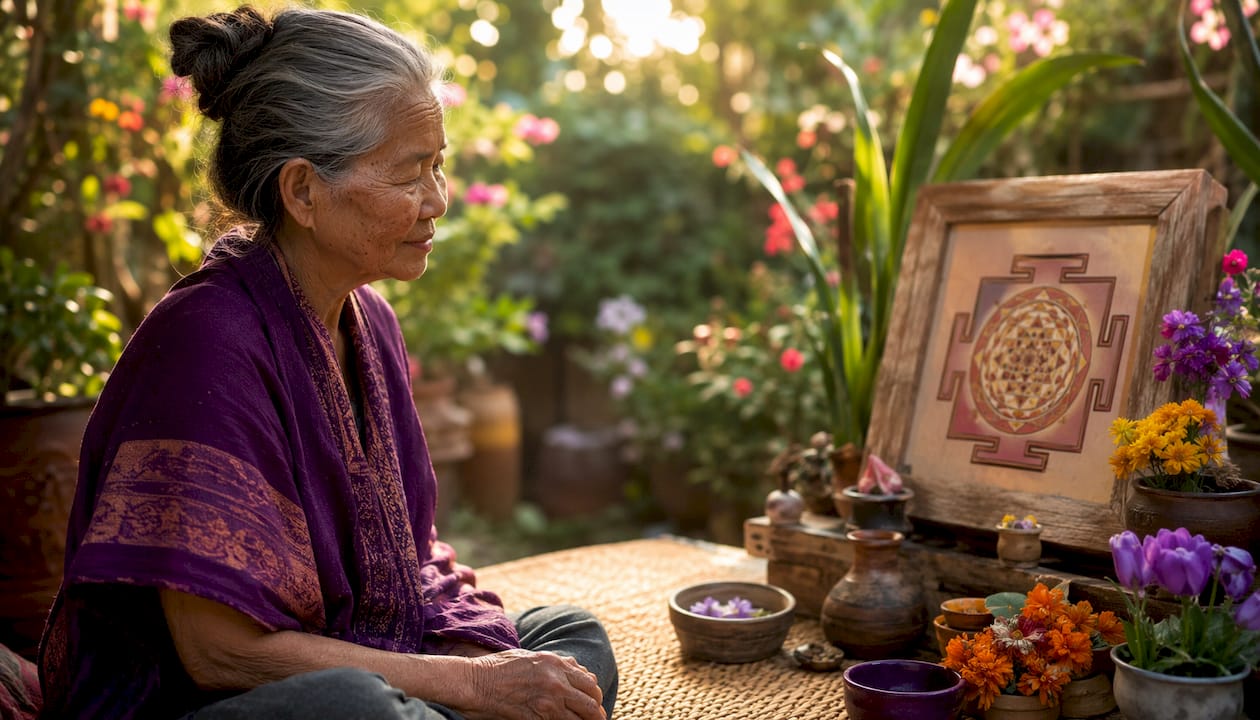
Wearing a pendant with the Flower of Life, Seed of Life, or Sri Yantra functions as a micro-ritual anchor throughout the day. Each time you notice it, you have an opportunity to take one conscious breath. Common recommendations include pendants, printed mandalas on desks, phone wallpapers, and small altar cards as daily ritual anchors.
Yoga and postural analogues
Certain yoga poses embody geometric forms: Warrior I and II create triangles; seated forward folds mirror the Vesica Piscis; tree pose echoes the vertical axis of the Tree of Life. Teaching students to feel the geometry of a pose, rather than just its muscular action, tends to deepen proprioceptive awareness and steadiness.
Room layout and altars
Feng shui and Vastu Shastra both use geometric principles to optimize the flow of energy through a space. Rectangles and squares support steady Chi flow; placing a central altar at the geometric center of a room mirrors the sacred-geometry principle of the bindu point. You do not need to redesign your home. Placing a Flower of Life print or a small crystal grid at the energetic center of your workspace is enough to shift the felt quality of the space.
Pro Tip: Use geometry as a background skeleton rather than a loud centerpiece. Subtle integration, whether in a textured mat, a grid tucked beneath a candle, or a pendant worn close to the skin, tends to be more effective than an oversized focal symbol, especially for sensitive clients who can become visually overstimulated.
Three ready-to-use mini-protocols you can try today
These three practices require minimal supplies and can be completed in five minutes or less. Start with one, repeat it for a week, and notice what shifts.
Protocol 1: Seed of Life chakra crystal grid
- Gather materials: Seven stones corresponding to the seven chakras (red jasper for root, carnelian for sacral, citrine for solar plexus, rose quartz for heart, blue lace agate for throat, lapis lazuli for third eye, amethyst for crown) plus one clear quartz center stone. A printed Seed of Life template helps with placement.
- Place the center stone on the central circle of the template, setting an intention aloud or silently.
- Place the seven chakra stones at each of the seven outer circles, moving clockwise from the root stone at the bottom.
- Activate the grid by touching the center stone, then tracing a line from stone to stone with your fingertip or a quartz wand, connecting each node while holding your intention. One full circuit is enough.
- Sit with the grid for three to five minutes, breathing slowly. You can use the Chakra Activation Guided Workbook from Kejiwastore to deepen the session with guided prompts for each energy center.
Protocol 2: Five-minute Flower of Life gaze meditation
- Position: Sit comfortably with a printed or digital Flower of Life image at eye level, roughly 18–24 inches away. Dim the room slightly if possible.
- Breath: Inhale for a count of four, hold for two, exhale for six. Repeat three times before you begin gazing.
- Gaze: Soften your focus on the center of the image. Allow the pattern to fill your peripheral vision without trying to trace individual circles. If your mind wanders, the pattern itself will draw your attention back.
- Visualization (optional): With each exhale, imagine the pattern’s coherence radiating outward from the image into your body, settling into your chest and belly.
- Close: After five minutes, close your eyes, place one hand on your heart, and take three slow breaths before returning to activity.
Protocol 3: Merkaba breath and light-field practice
- Posture: Sit cross-legged or in a chair with your spine upright. Rest your hands on your knees, palms up.
- Visualize the geometry: Picture a tetrahedron pointing upward from your base to above your head, and a second tetrahedron pointing downward from above your head to below your feet. Together they form a star tetrahedron surrounding your body.
- Breath pattern: Inhale slowly for a count of six, visualizing the upward tetrahedron filling with light. Exhale for a count of six, visualizing the downward tetrahedron filling with light. Alternate for eight breath cycles.
- Safety note: If you feel lightheaded or dissociated, stop the visualization, place both feet flat on the floor, and take three normal breaths. Drink water and eat something small before continuing any energetic practice. Grounding after clearing work is not optional.
How shapes relate to your chakras and elemental correspondences
The Platonic solids give practitioners a concrete vocabulary for elemental and chakra-focused work. Each solid carries a perceived energetic quality that corresponds to a classical element, and each element maps to specific chakras and physical or emotional themes.
| Chakra | Suggested Symbol | Element | Simple Use-Case |
|---|---|---|---|
| Root (1st) | Hexahedron (Cube) | Earth | Grounding grid for scattered or anxious states |
| Sacral (2nd) | Icosahedron | Water | Fluid movement, creative flow practices |
| Solar Plexus (3rd) | Tetrahedron | Fire | Confidence and will-activation meditations |
| Heart (4th) | Flower of Life / Vesica Piscis | Air | Heart-opening breathwork, compassion grids |
| Throat (5th) | Octahedron | Air/Ether | Clarity and expression practices |
| Third Eye | Sri Yantra | Ether | Deep focus meditation, intuition work |
| Crown | Merkaba / Dodecahedron | Ether/Cosmos | Light-body visualization, expanded awareness |
The rationale is straightforward: geometry carries a perceived energetic quality that resonates with the body’s own patterned systems. A cube feels stable and bounded, which is why the hexahedron is the go-to shape for grounding work when a client feels unrooted. The Sri Yantra’s concentrated triangles pointing inward toward a single point mirror the quality of focused, inward attention that third-eye practices cultivate.
Practical example: For a root-chakra session, place a cube-shaped stone (pyrite naturally forms near-perfect cubes) at the base of a Seed of Life grid, surround it with red jasper at the outer nodes, and sit in contact with the earth (bare feet on grass or a grounding mat) for ten minutes. Pair with slow, diaphragmatic breathing.
Safety note: When doing energetic clearing work, always close with a grounding practice: movement, food, hydration, or a few minutes with the hexahedron/cube as a visual anchor. Skipping the grounding step after clearing work can leave some people feeling spacey or unmoored.
What practitioners and research say about sacred geometry’s effects
Practitioners broadly agree that sacred geometry supports nervous-system regulation and focused attention. It is not a medical treatment, and responsible practitioners say so clearly. What it does offer is a structured, repeatable way to anchor attention, create a felt sense of coherence, and support the conditions in which the body’s own regulatory systems can do their work.
Flowergrid Holistic Wellness Centre uses the Flower of Life as the structural foundation for multimodal wellness sessions that combine sound therapy, breathwork, and coaching. Their practitioner notes describe geometry as a coherence scaffold: it does not do the healing, but it creates the conditions in which healing is more accessible. That framing is both honest and useful.
The nervous-system framing is where the most grounded evidence lives. Symmetrical patterns provide predictable visual input, which tends to reduce the brain’s threat-detection load and support a shift toward parasympathetic tone. This is not mystical. It is how the visual system interacts with the autonomic nervous system. Sacred geometry gives that interaction a beautiful, intentional container.
Multiple practitioner pages explicitly state that geometry is a supportive practice meant to sit alongside therapy, medication, or medical evaluation, not replace it. If you are working with a client who has a diagnosed condition, geometry belongs in the “complementary support” column, with their primary care provider’s awareness.
Pro Tip: If you are a practitioner, document your scope clearly in client agreements: sacred-geometry practices support wellbeing and self-regulation; they are not diagnosis, treatment, or cure. This protects both you and your clients and keeps the work grounded in integrity.
Key Takeaways
Sacred geometry supports nervous-system regulation and focused attention through structured, repeatable practices, but it works best as a complement to, not a replacement for, conventional care.
| Point | Details |
|---|---|
| Start with one symbol | Pick the Flower of Life or Seed of Life and use it consistently for one week before adding more. |
| Combine with breath and grounding | Geometry works best when paired with slow breathing, physical grounding, or movement. |
| Expect subtle regulation, not cures | The primary benefit is a felt sense of coherence and calmer attention, not dramatic healing events. |
| Consult professionals when needed | For diagnosed conditions, use geometry as complementary support alongside qualified medical or therapeutic care. |
| Kejiwastore supports your practice | Kejiwastore’s crystal collections, aromatics, and Chakra Activation Workbook pair directly with the protocols above. |
A practitioner’s perspective on weaving geometry into daily life
The most common mistake people make with sacred geometry is treating it as a performance. They set up an elaborate altar, light seven candles, and then feel deflated when nothing dramatic happens. The geometry that actually changes your nervous system is the kind you barely notice: a Flower of Life print on your desk that your eyes drift to between tasks, a Seed of Life pendant you touch before a difficult conversation, a crystal grid you walk past every morning and remember, for one breath, what you are working toward.
Geometry is most potent when it becomes a background frequency rather than a foreground event. In practice, that means integrating it subtly: a textured mat with a geometric pattern, a small grid tucked beneath a candle on your altar, a phone wallpaper you chose intentionally. For clients, I always ask before introducing any geometric tool. Consent matters. Some people find complex patterns overstimulating, and a simpler form like the Vesica Piscis or a single circle may serve them better than the full Sri Yantra. The geometry is in service of the person, never the other way around.
What I find most honest to say is this: sacred geometry does not heal you. It creates conditions in which your own system can remember its coherence. That is not a small thing. Coherence is what you are always moving toward, in every breath, every session, every ritual. The shapes just help you find the thread.
How Kejiwastore supports your geometric wellness practice
If you are ready to move from reading about these patterns to actually working with them, the tools matter. Kejiwastore’s small-batch offerings are made specifically for practitioners and wellness seekers who want sensory support that matches the intentionality of their practice.

The botanical aromatics collection at Kejiwastore includes handcrafted aromatherapy mists you can use to open a grid session, anchor a meditation space, or mark the beginning and end of a practice. The Jasmine Passion Alche-Mist, for instance, pairs naturally with heart-chakra and Vesica Piscis work. For deeper botanical support during meditation or breathwork, the spagyric herbal tinctures offer plant-based allies crafted through traditional alchemical processes that honor the same principles of natural order that sacred geometry reflects. You might also explore pairing your geometry practice with CBD-based relaxation tools for an added layer of nervous-system support before or after a session.
These products support wellbeing practices and are not medical treatments. They are companions for the work, not substitutes for professional care.
Browse the full crystal vortex collection for grid materials, or start with the Chakra Activation Guided Workbook to bring structure to your Seed of Life practice.
Useful sources for deeper reading
These sources informed this article and are worth exploring directly if you want to go further.
- Flowergrid Holistic Wellness: How to Use Sacred Geometry for Healing — Practical multimodal applications; explains how geometry functions as a coherence scaffold across combined wellness modalities.
- Flowergrid: Sacred Geometry and Your Nervous System — Practitioner accounts of gaze-based practices and their effects on breath and heart-rate variability; the most grounded nervous-system framing available from a practitioner source.
- Shams-Tabriz: Sacred Geometry Symbols, Meanings, and Origins — Comprehensive symbol reference with practitioner-level notes on Metatron’s Cube, clearing work, and daily integration.
- Chakra Serenity: Seed of Life Chakra Focus — Specific guidance on using the Seed of Life as a chakra-grid template; useful for the seven-stone protocol.
- Art2Fct: The Sacred Geometry of Energy Healing — Platonic solid correspondences and grounding protocols; includes the safety note on closing clearing sessions with grounding.
- Giansanti Codex: Sacred Geometry — The most thorough historical and philosophical overview available online; covers Egyptian, Greek, Islamic, Hindu, and Gothic traditions with primary-source depth.
- Wikipedia: Sacred Geometry — A useful neutral overview of cross-cultural applications, including feng shui, Vastu Shastra, and Buddhist mandala traditions; good for verifying historical claims.
- Healing Light: Understanding and Using Sacred Geometry in Healing — Accessible practitioner introduction covering natural examples (nautilus, snowflake, honeycomb) and basic application categories; good starting point for new practitioners.
This article is general educational information, not medical or therapeutic advice. For any health condition, consult a qualified healthcare professional before adding new practices to your care.