


Yes, you can combine crystals and aromatherapy safely and effectively when you match intention, materials, and safety practices. The pairing works through two channels: the measurable physiological effects of essential oils on your nervous system, and the ritual psychology that crystals anchor. Together, they create a multisensory practice that supports relaxation, focus, and emotional grounding.
Before you begin, take three immediate steps:
- Define your intention. Sleep support, stress relief, and heart-opening each call for different crystals and oils. Starting without a clear goal scatters the practice.
- Check your crystal’s material. Selenite, halite, and some calcites dissolve in water and degrade in oil. Clear quartz, amethyst, and black obsidian are far more durable choices for direct contact work.
- Dilute properly. For topical roller blends, a 1–3% dilution in a carrier oil (jojoba, fractionated coconut, or sweet almond) is the standard adult range. Never apply undiluted essential oils to skin, and never ingest DIY crystal-infused oils. For any medical concern, consult a licensed clinician before substituting this practice for treatment.
Key Takeaways
Combining crystals and aromatherapy works best when you treat the essential oil as the active agent, the crystal as the ritual anchor, and your clear intention as the practice that holds both together.
| Point | Details |
|---|---|
| Match intention to materials | Define your goal first — sleep, grounding, or heart work — then choose your crystal and oil accordingly. |
| Prioritize material safety | Avoid selenite, halite, and soft calcites in oil or water; stick to clear quartz, amethyst, or obsidian for direct contact. |
| Dilute every topical blend | Use a 1–3% essential oil dilution in carrier oil for adult skin; patch test before full application. |
| Cleanse and store properly | Wipe crystals dry after each use; store oil blends in dark glass away from heat and sunlight. |
| Kejiwastore for ready-made ritual support | Kejiwastore’s Botanical Aromatics, Jasmine Passion Alche-Mist, and Ormus Minerals are crafted for exactly this kind of intentional pairing practice. |
Table of Contents
- What do crystals and aromatherapy actually do together?
- What benefits can you realistically expect?
- Which crystals pair best with which essential oils?
- How do you actually use crystals and essential oils together?
- How do you cleanse and care for crystals used with oils?
- What safety risks should you know before you start?
- A Kejiwa Alchemy grounding ritual for restful sleep
- Why Kejiwa pairs crystals with botanicals — an honest perspective
- Kejiwastore’s curated aromatherapy and crystal offerings
- Sources
What do crystals and aromatherapy actually do together?
The phrase “aromatherapy crystals” covers two distinct things, and knowing the difference helps you use them well.
The first is stones used as scent-delivery tools: porous lava rock diffuser stones, unglazed ceramic pendants, and roller bottles that hold a crystal chip inside a carrier-oil blend. These work physically — the stone absorbs and slowly releases the essential oil’s volatile compounds, which you then inhale. The olfactory pathway is real and well-studied; scent molecules reach the limbic system quickly, influencing mood and stress response.
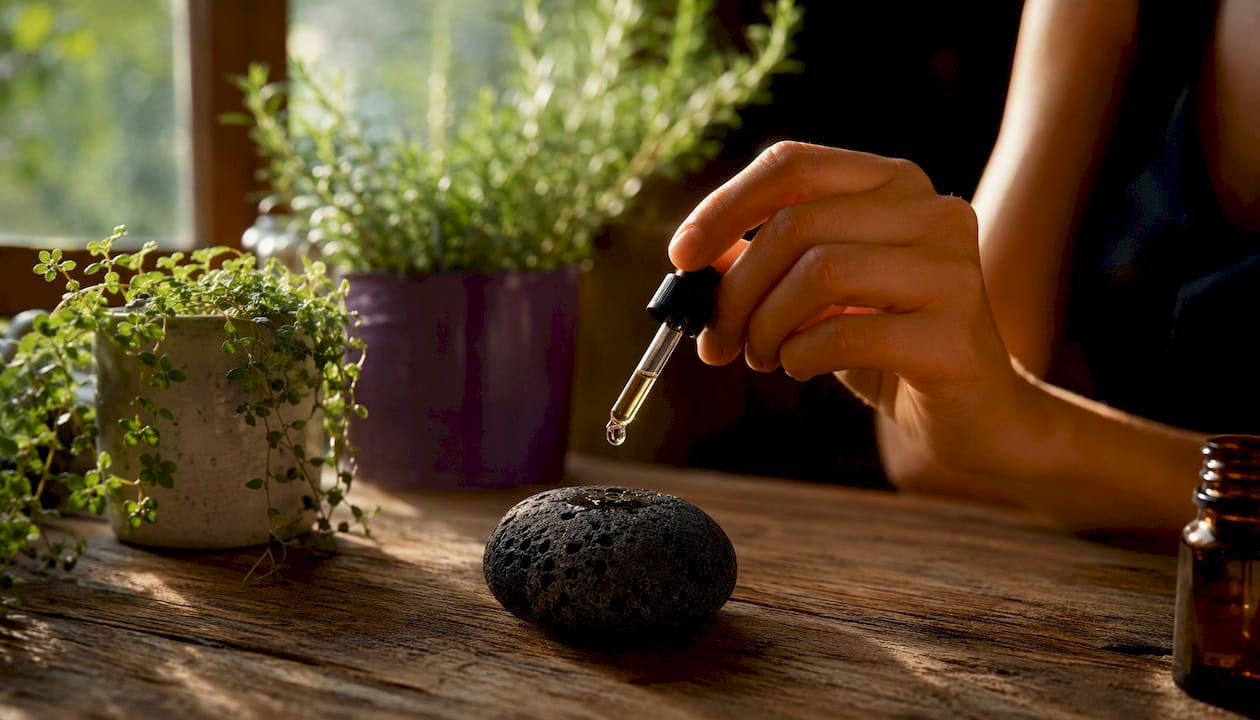
The second is crystals used as ritual anchors alongside aromatherapy. Here, the stone itself isn’t delivering scent. Instead, it holds your attention, marks your intention, and structures the practice. That psychological function is genuinely useful, even if the crystal has no pharmacological action of its own.
Common product formats include:
- Diffuser stones (lava rock, unglazed clay): absorb and release oils passively
- Roller bottles with crystal chips: a carrier-oil blend with a small tumbled stone inside the bottle
- Aromatherapy jewelry: pendants or bracelets with a porous insert for a drop of oil
- Crystal elixirs: water or oil infused with the energetic intention of a stone (the stone sits outside the liquid, not in it — important for reactive minerals)
- Spa crystals: commercial blends of essential oils, Epsom salts, and sea salts for bath or soak use, not topical application without dilution
Crystals most often paired with aromatherapy work include clear quartz (durable, amplifying), amethyst (calm and sleep support), rose quartz (heart and emotional work), citrine (energy and clarity), black obsidian (grounding and protection), and selenite (cleansing — but never in water or oil directly, as it dissolves).
What benefits can you realistically expect?
People who practice crystal energy healing alongside aromatherapy commonly report reduced anxiety, better sleep onset, sharper focus during meditation, emotional release, and a stronger sense of ritual grounding; for additional guidance on combining cannabinoids with sleep rituals, see CBD for Sleep: Creating a Nighttime Routine. Those outcomes are real — but the mechanism behind them matters for setting honest expectations.
Scientific reviews find no robust evidence that crystals carry intrinsic healing powers. The benefits people experience are most likely driven by placebo response, the calming structure of ritual, and the well-documented physiological effects of aromatherapy and mindfulness practices. Aromatherapy itself has a meaningful evidence base for stress and sleep support; crystals amplify the ritual container around it.
Controlled experiments suggest that people cannot reliably distinguish real crystals from convincing fakes in short exposures, which points to expectation and attention — not the mineral itself — as the active ingredient. That is not a reason to dismiss the practice. Ritual psychology is a legitimate wellness tool. Intention-setting, sensory anchoring, and consistent practice structure all produce real shifts in nervous system state.
The most honest framing: crystals work as ritual technology. The essential oils work pharmacologically. Used together with clear intention, the combination is greater than either alone — not because the crystal has special powers, but because the whole practice engages your attention, your breath, and your senses simultaneously.
Pro Tip: Frame your practice as “aromatherapy supported by ritual” rather than “crystal healing.” This keeps your expectations grounded, protects you from replacing medical care with wishful thinking, and — paradoxically — makes the ritual more effective because you’re fully present to what’s actually happening.
For a deeper look at how aromatherapy fits into intentional ritual, Kejiwastore’s guide on aromatherapy in ritual contexts is worth reading alongside this article.
Which crystals pair best with which essential oils?
The pairings below are drawn from practitioner traditions and common synergy guides. The “intention” column reflects the ritual use, not a medical claim.
| Crystal | Primary Intention | Suggested Oils | Material Notes |
|---|---|---|---|
| Clear quartz | Amplification, clarity | Frankincense, eucalyptus | Durable; safe for diffuser stones and rollers |
| Amethyst | Sleep, calm, intuition | Lavender, cedarwood | Durable; avoid prolonged sun exposure (fades color) |
| Rose quartz | Heart opening, self-love | Rose absolute, ylang ylang | Durable; safe for roller bottles |
| Citrine | Energy, confidence, abundance | Wild orange, bergamot | Note: much commercial “citrine” is heat-treated amethyst — both are durable |
| Black obsidian | Grounding, protection | Vetiver, black spruce | Durable volcanic glass; safe for direct use |
| Red jasper | Stability, root grounding | Patchouli, sandalwood | Durable; safe for diffuser stones |
| Moonstone | Intuition, feminine cycles | Clary sage, jasmine | Moderately durable; avoid prolonged soaking |
| Tiger’s eye | Focus, courage | Rosemary, ginger | Durable; safe for rollers and jewelry |
| Selenite | Cleansing, light, clarity | Diffuse separately; do not contact | Water-soluble; dissolves in oil or water — never immerse |
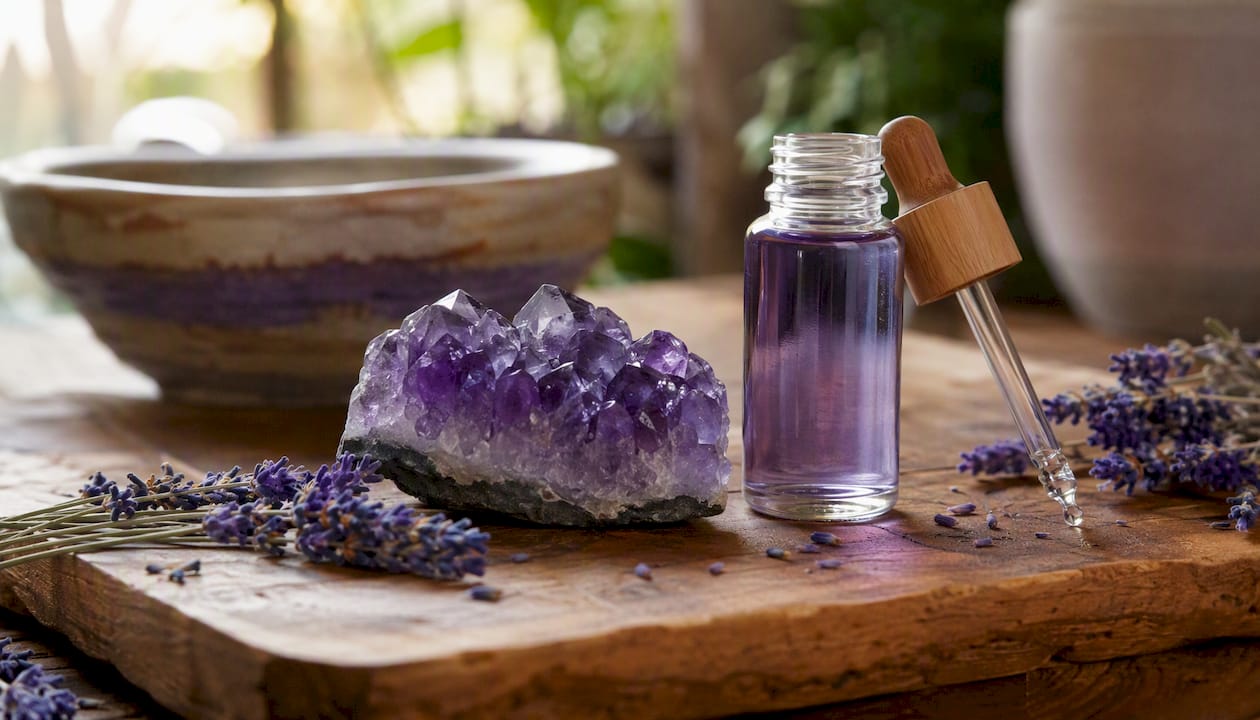
A few material rules that practitioners often skip over: selenite is water-soluble and should never be placed in oil or water blends. Some calcites and halite share this vulnerability. When you want the energetic quality of a reactive stone in your blend, use a crystal elixir method: place the cleansed stone in a sealed glass container next to (not inside) your oil, set your intention, and let it sit overnight. The stone influences the ritual without contacting the liquid.
Pro Tip: Before committing a new crystal to a roller bottle, test it: place a small chip in a teaspoon of carrier oil for 24 hours and check for color change, cloudiness, or residue. If the oil shifts, keep that stone outside the blend.
For readers who want a pre-curated crystal set rather than sourcing individual stones, Kejiwastore’s Crystal Vortex collection offers thoughtfully assembled options.
How do you actually use crystals and essential oils together?
There are four practical methods, each suited to a different context. Roller bottles, diffuser jewelry, and tumbled stones are the most common entry points, and each carries specific safety checkpoints.
1. Roller bottle blend
- Choose a 10 mL glass roller bottle.
- Add your crystal chip (only durable, non-reactive stones — clear quartz, amethyst, rose quartz, obsidian).
- Add a few drops of essential oil to a 10 mL bottle to achieve a safe dilution for topical use, typically recommended around 1 to 3 percent.
- Fill with carrier oil (jojoba is ideal — it resists rancidity and is skin-compatible).
- Cap, label with contents and date, and store away from heat and sunlight.
- Patch test on inner wrist before full application. Wait 24 hours.
2. Diffuser jewelry or pendant
- Add 1–2 drops of essential oil to the porous insert or lava bead.
- Let it absorb for 60 seconds before wearing.
- Hold your crystal in your non-dominant hand while you set your intention for the day.
- Wear the pendant; carry or pocket the crystal.
3. Room spray with crystal-adjacent charging
- Combine distilled water, a small amount of witch hazel (as emulsifier), and 15–20 drops of essential oil in a 2 oz glass spray bottle.
- Place a cleansed, water-safe crystal (clear quartz, amethyst) next to the bottle overnight before first use.
- Shake before each spray. Mist your space, your pillow, or your meditation area.
4. Tumbled stone inhalation practice
- Hold a cleansed tumbled stone in your palm.
- Place 1 drop of essential oil on a cotton pad or diffuser stone nearby — not directly on the crystal unless you’ve confirmed it’s oil-safe.
- Breathe slowly and deliberately for 5–10 minutes, using the stone as a tactile anchor.
On skin safety: The National Association for Holistic Aromatherapy recommends a 1–3% dilution for adult topical use. For children under 12, pregnant people, or those with sensitive skin, stay at or below 1% and avoid oils like clove, cinnamon bark, oregano, and most citrus oils on sun-exposed skin (phototoxicity risk). Always consult a healthcare provider before using essential oils during pregnancy.
Label every DIY blend with the date, oils used, and dilution. Most carrier-oil blends stay fresh for 6–12 months; jojoba extends that range. Store reactive crystals separately from oil blends to prevent degradation.
How do you cleanse and care for crystals used with oils?
Oils and skin residue accumulate on crystals quickly, especially in roller bottles and during hands-on ritual work. Regular cleansing keeps both the stone and your practice feeling clear.
Safe cleansing methods for oil-used crystals:
- Dry cloth wipe: After each use, wipe the stone with a soft, dry cloth to remove oil and skin residue. This is your first line of care.
- Moonlight: Place stones on a windowsill or outside during a full moon overnight. Safe for all crystal types, including water-sensitive ones.
- Sound: A singing bowl, tuning fork, or even a clear bell tone held near the stone for 30–60 seconds. No moisture, no chemical contact.
- Smoke: Pass the stone through sage, palo santo, or cedar smoke briefly. Avoid prolonged heat near delicate stones.
Cleanse a new crystal before first use, after heavy or emotionally charged sessions, and roughly monthly during regular practice. If a stone feels “heavy” or dull to you energetically, that’s a useful signal to cleanse regardless of schedule.
Storage guidance:
- Keep oil-used crystals in separate labeled glass or cloth pouches, not loose in a drawer with other stones.
- Store essential oil blends in dark glass bottles away from heat and direct sunlight — UV light degrades volatile compounds and shortens shelf life.
- Never store selenite, halite, or soft calcites in humid environments or near liquid containers.
Pro Tip: After a topical roller session, wipe your crystal with a dry cotton pad before putting it away. Thirty seconds of care after each use prevents oil buildup that can cloud the stone’s surface over weeks.
What safety risks should you know before you start?
Crystals and essential oils are gentle tools when used correctly. When used carelessly, both carry real risks.
Essential oil hazards
Several oils cause phototoxicity — skin reactions triggered by sun exposure after topical application. Cold-pressed bergamot, lime, lemon, and grapefruit are the main offenders. Use steam-distilled or furocoumarin-free (FCF) versions for roller blends you’ll wear outdoors. Clove bud, cinnamon bark, and oregano are dermally aggressive even at low dilutions; keep them in diffuser use only.
Pregnancy contraindications are significant. Clary sage, rosemary (high camphor), and several others are not recommended during pregnancy. Always confirm with a midwife or OB before using any essential oil topically while pregnant.
Crystal hazards
Some minerals contain heavy metals or toxic compounds. Malachite dust is toxic (safe as a polished stone, never as a powder or in water). Cinnabar contains mercury. Galena contains lead. These are not common aromatherapy crystals, but if you’re sourcing stones independently, research the mineral composition before any skin contact or liquid immersion.
Selenite and other water-soluble stones degrade in oil or water, potentially leaching into a blend. The risk is more about product integrity than acute toxicity for most common stones, but it’s still a reason to keep reactive crystals out of ingestible or topical preparations.
Pets
Many essential oils are toxic to cats and dogs. Tea tree, eucalyptus, clove, and cinnamon are among the most dangerous for cats; tea tree and pennyroyal are serious risks for dogs. Keep all blends stored in sealed containers out of reach, and diffuse in ventilated spaces your pets can leave freely. Some crystals — particularly those containing heavy metals — should also be kept away from animals who might chew or lick them.
When to stop and seek help: If you experience skin irritation, respiratory distress, or an allergic reaction after using any essential oil blend, discontinue immediately and consult a healthcare provider. Crystal and aromatherapy practices are complementary supports, not substitutes for medical care. For mental health crises, please contact a licensed mental health professional.
Crystal healing is categorized as a pseudoscientific practice in academic literature, with a long cultural history but no established clinical mechanisms. Use it as a ritual support, not a treatment.
A Kejiwa Alchemy grounding ritual for restful sleep
This ritual pairs amethyst with a lavender-cedarwood blend for sleep support. It takes about 15 minutes and is designed to transition your nervous system from activation to rest.
You will need:
- One cleansed amethyst point or tumbled stone (Kejiwastore’s amethyst double terminated point works well for bedside use)
- Kejiwastore’s Botanical Aromatics elixir spray or a DIY roller blend of lavender and cedarwood at 2% dilution in jojoba
- A quiet space, dimmed light, and 15 undisturbed minutes
Steps:
- Set your space (2 minutes). Dim the lights. Place your amethyst on your nightstand or hold it in your non-dominant hand. Take three slow, full breaths to signal your nervous system that the day is complete.
- Apply your aromatics (1 minute). Mist your pillow and the air around you with the botanical spray, or apply the roller blend to your wrists and the back of your neck. Inhale slowly and deliberately.
- Hold the stone and set your intention (3 minutes). Close your eyes. Hold the amethyst against your sternum or rest it on your forehead. Silently or aloud, state what you’re releasing from the day and what quality of rest you’re calling in.
- Breathe with the scent (5–7 minutes). Let the lavender and cedarwood work. Breathe in for four counts, hold for four, out for six. The extended exhale activates the parasympathetic nervous system.
- Place the stone and rest (2 minutes). Set the amethyst on your nightstand within arm’s reach. Let yourself drift.
At Kejiwa, we source our botanicals from organic and wild-harvested suppliers because the integrity of the plant material directly affects the quality of the aromatic experience. A lavender grown in full-sun, mineral-rich soil smells different — and works differently on the nervous system — than a conventionally farmed equivalent. That sourcing intention is built into every Kejiwa blend.
If amethyst isn’t available, clear quartz makes a strong substitute for sleep work. The ritual structure matters as much as the specific materials.
After the ritual, wipe your amethyst with a dry cloth and store it away from direct sunlight. Cap your roller or spray bottle and keep it in a cool, dark place.
For readers interested in a broader crystal and botanical pairing ritual, Kejiwastore’s mindful guide expands on this framework across multiple intentions.
Why Kejiwa pairs crystals with botanicals — an honest perspective
The conventional wellness industry often sells crystals as if the stone alone does the work. It doesn’t. What actually happens when you hold a piece of amethyst and breathe lavender is more interesting: your attention narrows, your breath slows, your sensory field fills with something intentional rather than ambient noise. The crystal gives your hands something to do. The scent gives your nervous system a direct signal. Together, they create a ritual container that your brain learns to associate with a particular state.
That’s not a small thing. Ritual psychology is one of the most underused tools in modern wellness. The problem is that most crystal content either overclaims the mineral’s powers or dismisses the practice entirely. Neither serves you.
At Kejiwa, we take a third position: the crystal is a ritual anchor, the botanical is the active agent, and your intention is the thread that connects them. We source our ingredients organically and from wild-harvested suppliers because we believe the quality of the material affects the quality of the experience — not through magic, but through chemistry, craft, and care. We’re also aware that gemstone mining carries real environmental and labor costs. That’s why we prioritize ethically sourced stones and support suppliers who operate transparently.
The practice works best when you stop asking the crystal to heal you and start asking it to help you pay attention. That shift alone changes everything.
Kejiwastore’s curated aromatherapy and crystal offerings
If you’d rather start with a ready-made blend than build from scratch, Kejiwastore’s small-batch products are designed specifically for this kind of ritual work.
The Botanical Aromatics collection is the best starting point for most readers: handcrafted elixir sprays and oils made with organic and wild-harvested botanicals, ready to pair with any crystal from your collection. For heart-centered work or sensual ritual, the Jasmine Passion Alche-Mist pairs beautifully with rose quartz — a single mist sets the aromatic field for an entire session. For readers drawn to deeper alchemical support, the Ormus Minerals collection offers advanced ritual elixirs that complement crystal and botanical practices at a cellular level.
All Kejiwastore products are made in small batches with transparent sourcing. Browse the full range, read the ingredient notes, and choose what resonates with your current intention. If you’re unsure where to start, the Botanical Aromatics collection covers the widest range of ritual needs.
Sources
- Guide to healing crystals - Healthline
- Healing Crystals May Trigger a Real Psychological Effect
- Crystal healing - Wikipedia
- How to use crystals for beginners - CrystalDatabase
This article is general information, not a substitute for advice from a qualified doctor. Consult a qualified healthcare professional about your own circumstances before acting on anything here.