


Mixing spagyric tinctures is a ritualized blending of spagyric extracts by intention and proportion, not casual dosing. The core rule: use simple whole-number ratios, lead with clear intention, and default to external application unless a product explicitly states otherwise. This practice is shaped by experience in small-batch craft, as reflected in the guidance below.
TL;DR:
- Use simple whole-number ratios such as 2:1:1 for general blends, adjusting to 1:1:3 for grounding or 2:2:1 for activation, based on the tinctures’ roles in the Tria Prima.
- Prepare your space by thoroughly cleaning tools and setting a clear, spoken intention for the blend before adding drops, focusing your energy throughout the process.
- Mix tinctures by adding drops in the order Salt, Mercury, then Sulfur, pausing to hold the intention, and log each ratio to replicate or analyze later.
- Most blends are for external use only, requiring patch testing and careful storage in dark bottles, with blends deepening and stabilizing over several months.
- Kejiwa offers pre-made spagyric tinctures crafted using traditional methods, providing a reliable foundation for blending or ceremonial use.
Table of Contents
- What Mixing Spagyric Tinctures Means
- How Do You Prepare Your Space Before Blending?
- The Mixing Method: Signatures, Roles, and Ratios
- Application, Ritual Uses, and Safety Rules
- Storage, Aging, and Potency Over Time
- Sample Blends to Try First
- How Kejiwa Alchemy Approaches Blending
- A Practitioner’s Note on Restraint
- Ready-Made Spagyric Tinctures From Kejiwa Alchemy
- Selected Resources for Deeper Practice
- Sources
- FAQ
What Mixing Spagyric Tinctures Means
Mixing tinctures, in this context, has nothing to do with combining herbal extracts for dosing or general remedies. Spagyric tinctures are alchemically prepared, and mixing them is a ritual act aimed at ceremony and energetic balance.
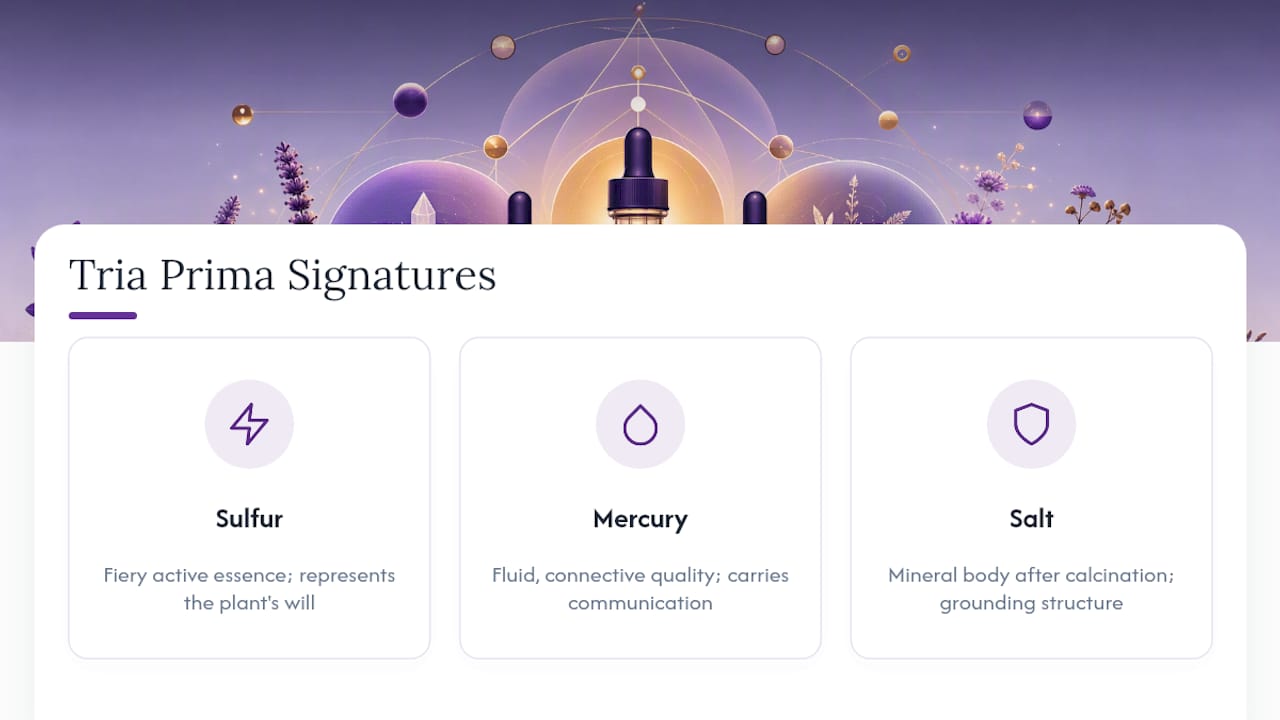
Classical spagyric procedure separates a plant into three principles known as the Tria Prima: Sulfur, Mercury, and Salt. Each is purified on its own, then recombined. That recombination step is what actually distinguishes a spagyric tincture from a standard herbal extract. Sulfur tends to represent the plant’s active, fiery essence and its will. Mercury carries the fluid, connective, communicative quality. Salt holds the mineral body, the grounded structure left after calcination.
When you blend two or more finished spagyric tinctures, you’re layering these signatures on top of each other. That’s why intention matters as much as measurement. Visualization, a spoken phrase, or a moment of centering before you uncap a bottle isn’t decoration. It’s part of what shapes the outcome you’re working toward, whether that’s grounding, protection, or activation.
How Do You Prepare Your Space Before Blending?
A cluttered counter produces a cluttered blend. Before you touch a single dropper, clear a dedicated surface and gather everything you’ll need in reach.
Tools worth having on hand:
- Amber or violet glass bottles (light degrades botanical compounds over time)
- Glass pipettes, one per tincture to avoid cross-contamination
- A small funnel for transferring larger volumes
- A notebook or blending journal
- Adhesive labels and a fine-point pen
Sanitation basics matter more than people expect. Wash and fully dry all glassware before use. Wipe pipette tips between tinctures. Treat every finished blend as intended for external use only, unless the original tincture’s label explicitly states it’s formulated for internal use.
Once your space is clean, set your intention:
- Write down, in one sentence, what this blend is for (grounding before ceremony, protection during travel, opening intuition).
- If it feels right, sketch a simple sigil or symbol representing that intent and keep it under the workspace.
- Take three slow breaths, hands resting on your closed eyes or heart, and hold that single sentence in mind.
- Carry that same intention silently or aloud as you add each drop, rather than treating it as a one-time preamble.
Pro Tip: Say your intention out loud once per bottle you open, not just once at the start. The repetition keeps your focus anchored as the blend comes together.
The Mixing Method: Signatures, Roles, and Ratios
Every tincture you own can be loosely sorted into a Tria Prima role based on its dominant quality. A fiery, activating herb like rosemary or ginger often reads as Sulfur. A connective, calming plant like lavender or chamomile tends to sit in Mercury. A deeply rooted, earthy tincture like mullein or burdock frequently plays the Salt role.
Practitioner tradition favors simple whole-number ratios over complicated math, and spagyric blending commonly uses these proportions to build synergy toward a specific aim:
- Balanced blend: 2:1:1 (Sulfur:Mercury:Salt) for general energetic alignment
- Grounding blend: 1:1:3, weighted toward Salt, for stabilizing after ceremony
- Activation blend: 2:2:1, weighted toward Sulfur and Mercury, for intuitive or ritual work
Operative alchemy teachers describe starting with these exact three ratios as repeatable experiments you can adjust once you feel how each proportion lands.
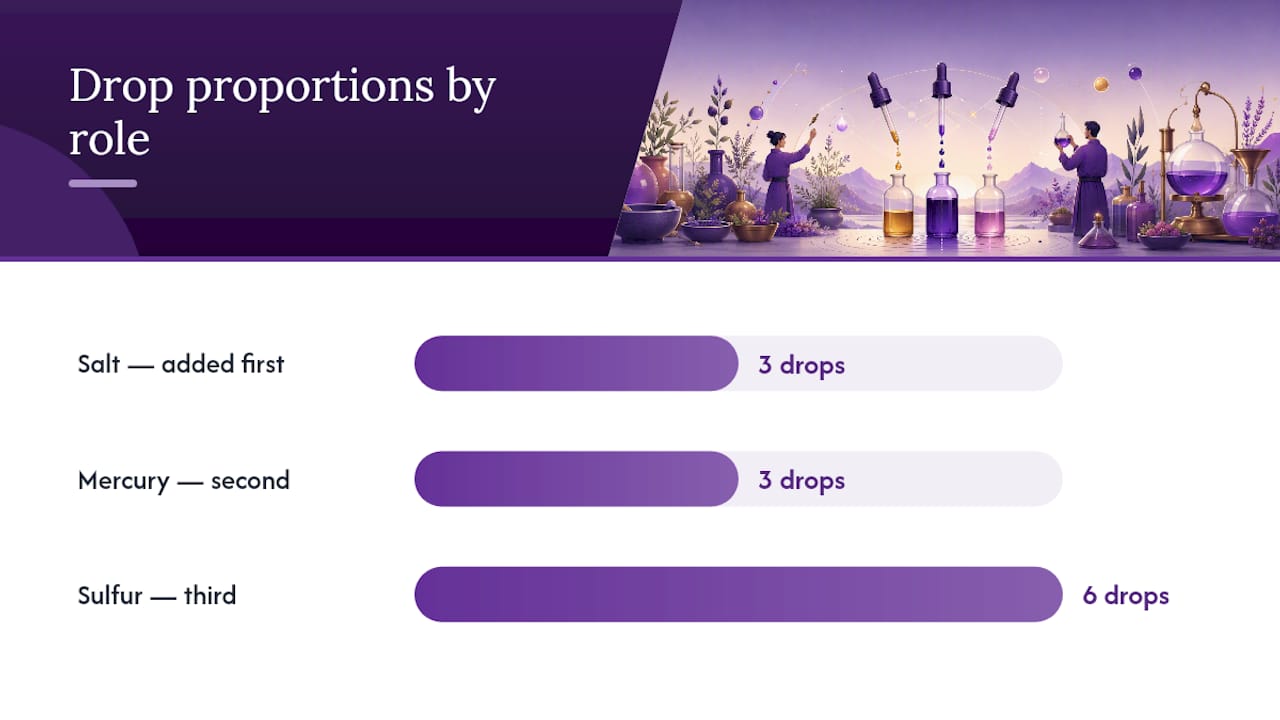
To mix, add drops in the order Salt, then Mercury, then Sulfur, pausing briefly after each addition to hold your intention. Count and log every drop. A blend built from 6 drops Sulfur, 3 drops Mercury, 3 drops Salt is easy to recreate later if it works, and easy to diagnose if it doesn’t.
Application, Ritual Uses, and Safety Rules
Most spagyric blends are designed for external use: anointing pulse points, adding a few drops to a ritual mist, dressing a candle, or placing on an altar cloth before ceremony. Practitioners generally verify intended use for each product before applying it to skin.
Because spagyric tinctures carry a refined, concentrated profile, a handful of safety rules keep the practice sound:
- Patch-test any new blend on a small area of skin (inner forearm works well) and wait 24 hours before broader use
- Never apply near the eyes or mucous membranes
- Do not ingest a blend unless the original tincture’s label explicitly permits internal use
- Store finished blends away from children and pets
- Air out the space before and after use if you’re sensitive to alcohol vapor
Label every bottle with the date mixed, the intention behind it, and the exact ratio used. A simple blending journal, even just a page per formula, turns guesswork into a repeatable practice. Pairing a blend with a botanical aromatic mist for the room can round out the ritual without adding another tincture to the mix.
Storage, Aging, and Potency Over Time
Store finished blends in dark amber or violet glass, kept in a cool, dry spot away from direct light and temperature swings. A closet shelf or a wooden box works better than a bathroom cabinet, where humidity fluctuates.
Spagyric tinctures often deepen with age rather than simply degrading, since the purified mineral salts reintegrated during preparation give the extract a more stable chemical profile than a standard herbal tincture. Many practitioners report blends feeling more integrated after several months of rest.
Watch for cloudiness, sediment that won’t settle, or an off smell as cues to retest a small patch before continuing use. Label each batch with its mix date and ratio so you can track which formulas age well and which don’t.
Sample Blends to Try First
Start small. These three formulas use the ratios covered above and give you a low-risk way to feel how spagyric blending actually works.
- Grounding anointing oil. Mix a Salt-dominant tincture (such as mullein or burdock) with Mercury and Sulfur tinctures at a 1:1:3 ratio. Apply to wrists and the base of the throat before meditation, whispering your grounding intention with the first drop.
- Activation mist base. Combine Sulfur and Mercury tinctures (rosemary and lavender, for example) with a small Salt portion at 2:2:1. Add to a spray bottle with water for a ritual room mist. Visualize clarity expanding outward as you mist the space, and pair it with a grounding essential oil blend if the energy feels too diffuse.
- Protection altar drops. Use a 2:1:1 balanced ratio, applying a few drops to a stone or altar cloth. Speak a short protective phrase as each drop lands.
Always patch-test first, and log the exact ratio and result in your journal before scaling up.
How Kejiwa Alchemy Approaches Blending
Every spagyric tincture is crafted in small batches, using organic and wild-harvested botanicals with intentional attention. That craftsmanship is the foundation practitioners lean on when they start experimenting with their own ratios.
The product line maps directly onto the blending needs covered here:
- Spagyric Herbal Tinctures for the Sulfur, Mercury, and Salt building blocks of a custom blend
- Botanical Aromatics for ritual mists that pair with finished tinctures
- Ormus Minerals for practitioners layering monoatomic gold into ceremony alongside their blends
Related blogs break down why alcohol belongs in most tinctures, useful reading if you’re curious about solvent stability before you start mixing.
A Practitioner’s Note on Restraint
I keep coming back to the same lesson: simplicity beats complexity almost every time. A clean 2:1:1 ratio, held with real intention, outperforms a seven-tincture blend mixed on autopilot. Speak or visualize your intent with every single drop, not just the first one. That habit alone changes how a blend feels in practice.
— Kejiwa
Ready-Made Spagyric Tinctures From Kejiwa Alchemy
If you’d rather start blending with tinctures already crafted with intention, small batch spagyric tinctures take the guesswork out of sourcing. Plants are organic or wild-harvested and prepared through traditional spagyric processes rather than shortcut extraction, so the Sulfur, Mercury, and Salt roles carry the depth this practice depends on.

Browse the Spagyric Herbal Tinctures collection to find Sulfur, Mercury, and Salt correspondences ready for your next blend, and check each product page for usage intentions. If you’re working on a specific ceremonial aim and want guidance on ratios, reach out to the shop directly. Custom blend questions are exactly what a small-batch practice is built to answer.
Selected Resources for Deeper Practice
For readers who want the technical grounding behind this guide, Seven Dreams Ceremony walks through classical spagyric procedure step by step, Mountain Rose Herbs explains how spagyric extraction differs chemically from herbal tincturing, and Pharmakeia covers Tria Prima categorization in practitioner detail.
Sources
- Spagyric Philosophy & Practice – Seven Dreams Ceremony
- The differences between herbalist tinctures & spagyrics tinctures – Mountain Rose Herbs
- Understanding Spagyrics: A Look into Alchemical Herbal Preparations – Pharmakeia
FAQ
Is It Safe to Ingest a Mixed Spagyric Tincture Blend?
Only if every individual tincture in the blend is explicitly labeled for internal use. Most spagyric blends discussed here are formulated and intended for external, ceremonial application, so check each product’s label before assuming otherwise.
What Ratio Should I Start With When Mixing Tinctures?
A balanced 2:1:1 ratio of Sulfur to Mercury to Salt is the standard starting point practitioners use for general energetic alignment. Adjust toward 1:1:3 for grounding or 2:2:1 for activation once you know how the balanced version feels.
Do I Need to Patch-Test Every New Blend?
Yes. Apply a small amount to your inner forearm and wait 24 hours before using a new blend more broadly, and always avoid the eyes and mucous membranes.
How Long Do Mixed Spagyric Tinctures Last?
Stored in dark glass in a cool, dry spot, spagyric blends can last well beyond a year and often feel more integrated after several months of rest, thanks to the purified mineral salts reintegrated during preparation. Watch for cloudiness or an off smell as signs to retest before continuing use.
Does Kejiwa Alchemy Sell Pre-Made Spagyric Tinctures for Blending?
Yes, Kejiwa Alchemy’s Spagyric Herbal Tinctures collection offers small-batch tinctures made from organic and wild-harvested botanicals. Current pricing and availability are listed directly on the product pages.