


Scent affects spiritual awareness by traveling a direct neural path from the nose into the brain’s emotional and memory centers, bypassing the more analytical routes that other senses take. That’s why a single breath of frankincense or sandalwood can pull you out of your head and into presence faster than counting breaths alone. One controlled study of experienced meditators found that synchronized scent delivery significantly raised mindfulness scores compared to unscented sessions. Scent doesn’t just accompany ritual. It anchors it.
Try this now, in under two minutes:
- Apply one traditional scent, such as sandalwood oil on your wrist or a frankincense mist near your seat.
- Take three slow, conscious inhales, letting each one fill your chest before you exhale.
- Notice what shifted, in your breath, your posture, or your thoughts, and name it silently.
If you want a quick reference before diving deeper, here’s the traditional shorthand for the scents this guide covers:
- Frankincense — grounding, prayerful focus
- Sandalwood — calm, meditative depth
- Jasmine — heart-opening, devotional warmth
- Palo santo — clearing, boundary setting
- Lavender — nervous system ease, gentle entry into stillness
- Myrrh — introspection, release
- Oud (agarwood) — reverence, deep presence
Pro Tip: Use the same scent every time you sit down to meditate for at least a week. Repetition is what turns a pleasant smell into a reliable trigger for your brain to enter a focused state.
Key Takeaways
Scent shapes spiritual awareness by triggering the brain’s emotional memory centers directly, making it one of the fastest, most reliable anchors for meditative focus and ritual presence.
| Point | Details |
|---|---|
| Scent bypasses analytical filtering | Smell reaches the amygdala and hippocampus almost directly, producing faster emotional shifts than sight or sound. |
| Controlled studies back the effect | A 54-person study found scent-paired meditation significantly improved mindfulness scores over unscented sessions. |
| Consistency builds the anchor | Using the same scent for the same practice repeatedly trains faster entry into focused states than switching scents often. |
| Difficult scent reactions need care | Sudden distress from a scent calls for grounding, breathwork, and professional support if it persists. |
| Sourcing matters for sacred scents | Palo santo and oud face overharvesting concerns, so choose suppliers who disclose origin and harvest method. |
| Kejiwastore offers a responsibly sourced starting point | Kejiwastore’s Botanical Aromatics collection provides small-batch mists and oils formulated for meditation and ritual use. |
Table of Contents
- The Neuroscience Behind Scent and Meditation
- How Ancient Traditions Used Scent to Reach the Sacred
- Seven Sacred Scents and What They Support
- A Step-By-Step Practice for Using Scent in Meditation
- When Scent Triggers Difficult Memories Instead of Peace
- Quick Scent Rituals for Specific Intentions
- How Kejiwa Alchemy Crafts Sacred Aromatics
- Choosing and Blending Scents for a Practice That’s Actually Yours
- Building a Scent Altar That Supports Daily Practice
- Ready-Made Aromatics for a Practice You Can Trust
- Frequently Asked Questions
- Sources
The Neuroscience Behind Scent and Meditation
Smell is the only sense with a direct line to the brain’s emotional core. When you inhale a molecule of frankincense resin or sandalwood oil, it travels to the olfactory bulb, then almost immediately to the amygdala and hippocampus, the structures responsible for emotion and memory, before looping through the hypothalamus, which governs your stress response. Sight and sound both get routed through the thalamus first, a kind of switchboard that filters and delays. Scent skips that step. A practitioner essay on scent and the sacred brain describes this as scent’s ability to “return the body to a state it already knows,” rather than teaching it something new.
That wiring is why a whiff of myrrh in a quiet room can feel like more than a pleasant smell. It can feel like a memory, or a mood, arriving before you’ve consciously registered the scent at all.
“Synchronized scent delivery significantly improved Mindful Attention Awareness Scale scores compared with non-scented meditation.” That was the finding in a study of 54 experienced meditators, with results reaching statistical significance (p < 0.01).
Data snapshot: The same research found scent-paired meditation outperformed unscented sessions on standardized mindfulness measures, while a separate, much smaller study of Zen practitioners (13 participants) reported a measurable drop in theta brainwave amplitude after inhaling specific essential oil blends, alongside shifts in alpha activity often associated with relaxed, absorbed states.
Read that second study with some caution. Thirteen participants in a single setting doesn’t prove scent reliably changes brainwave patterns for everyone, everywhere. But it does align with what contemplatives have reported for centuries: a shift toward theta and alpha states often coincides with the kind of loose, spacious attention that meditation teachers call absorption. The practical takeaway isn’t that scent guarantees a mystical state. It’s that scent gives your nervous system a consistent cue to soften into one.
How Ancient Traditions Used Scent to Reach the Sacred
Long before neuroscience had language for the limbic system, cultures across the world had already figured out that scent changes consciousness. They just called it something else: purification, offering, communion.
- Christianity: Frankincense and myrrh marked anointing rites and prayer, with incense smoke serving as a visible symbol of prayers rising toward the divine.
- Hindu and Buddhist practice: Sandalwood paste and jasmine garlands accompanied meditation and temple offerings, their scent believed to focus the mind and honor deities.
- Indigenous smudging traditions: Burning sacred plants cleared space and marked boundaries between the ordinary and the ceremonial, a practice still followed with care and protocol today.
- Jewish, Muslim, and Zoroastrian rites: Rose attars, oud, and other aromatics carried ceremonial weight in worship, according to reporting on scent traditions across faiths.
Scholarship on perfume in biblical and liturgical texts traces how fragrance functioned as a language of its own, a way to signal purification and communicate reverence without a single word spoken.
Scent has long been described as an “inner attraction” to prayer and stillness, a sense that points the practitioner inward even when the intellect resists, according to a reflection on the spiritual meaning of smell.
If you borrow from a tradition outside your own, a quick note of respect matters. Learn where a practice originated, understand what it meant to the people who developed it, and use it with that context in mind rather than as a decorative flourish.
Seven Sacred Scents and What They Support
Each of these aromatics carries a long ritual history, and each tends to support a slightly different kind of spiritual work.
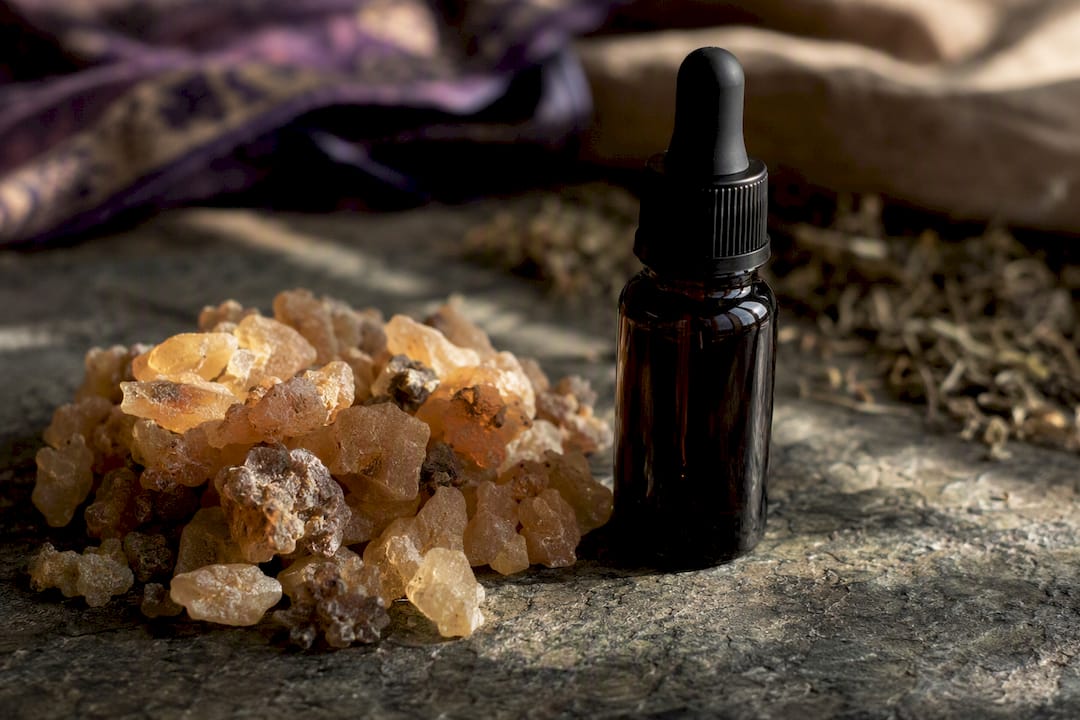
- Frankincense: Burned as resin for millennia, it supports grounding and prayerful focus. Its warm, slightly citrus smoke has anchored Christian, Jewish, and ancient Egyptian rites alike.
- Sandalwood: Used as paste, oil, or incense in Hindu and Buddhist practice, sandalwood’s creamy, woody scent supports meditative depth and calm.
- Palo Santo: This South American wood, burned as smoke, is associated with clearing stagnant energy and marking the start of a ritual.
- Jasmine: Typically found as absolute oil or floral water, jasmine’s rich sweetness supports heart-opening and devotional states.
- Myrrh: Often paired with frankincense in resin form, myrrh leans toward introspection, release, and processing grief or transition.
- Oud (Agarwood): Prized across Middle Eastern and South Asian traditions as oil or chips, oud’s deep, resinous scent supports reverence and a sense of depth or weight in practice.
- Lavender: Widely available as essential oil, lavender calms the nervous system and eases the transition into stillness, making it a gentle entry point for beginners.
Sourcing matters as much as scent choice. Wild agarwood trees have been overharvested for oud production, and palo santo faces similar pressure in parts of South America. Look for suppliers who name their harvest region and method, not just “wild-harvested” as a marketing word.
Pro Tip: Test resin or oil quality by smelling it undiluted before buying. Genuine frankincense resin smells bright and slightly sharp, not flat or waxy. Cloudy or artificially sweet oils are usually a sign of dilution or synthetic additives.
A Step-By-Step Practice for Using Scent in Meditation
Scent works best when it’s paired with breath and repeated with consistency, not swapped out every session for novelty.
The 3 to 5 minute sensory anchor:
- Apply your chosen scent to your wrist, a cloth, or the air near you.
- Close your eyes and take five slow breaths, inhaling the scent fully on each one.
- Silently name one word for what you notice, calm, heavy, open, and let that word settle.
The 15 minute scented ritual:
- Light resin or diffuse oil at least five minutes before sitting, so the space is already scented when you arrive.
- Set an intention aloud or silently, tying it to the scent you’ve chosen.
- Meditate for 10 minutes, returning to the scent anytime your mind wanders.
- Close with three deep breaths and a moment of gratitude before extinguishing any flame or smoke source.
A few safety basics matter more than people expect; for practical guidance on aromatherapy safety and benefits, see Aromatherapie: ontdek de voordelen van essentiële oliën - Roots Health Store.
- Dilute essential oils properly before skin contact; most need a carrier oil at 1 to 3 percent concentration.
- Ventilate any room where you’re burning resin or herbs, and never leave smoke sources unattended.
- Pregnant readers and anyone with asthma or other respiratory conditions should check with a doctor before regular smoke or concentrated oil exposure.
Consistency beats perfection. Guidance from meditation teachers on fragrance and mindfulness points to the same conclusion: repeated pairing of one scent with one practice trains your brain to drop into focus faster over time. For structured ritual formats, Kejiwastore’s guide to aromatherapy in ritual walks through building a full sequence, and the botanical smoke cleansing guide covers smoke safety in more depth.
Pro Tip: Pick one scent for one specific practice, like sandalwood only for morning meditation, and don’t use it anywhere else. That exclusivity strengthens the association.
When Scent Triggers Difficult Memories Instead of Peace
The same wiring that makes scent a powerful anchor also makes it a powerful trigger. Because smell connects almost directly to the amygdala and hippocampus, a scent tied to a painful memory can surface that memory, and its emotional charge, before you’ve had a moment to brace for it.
If a scent brings up sudden distress during practice, a few steps can help:
- Remove the scent source immediately and move to fresh air if possible.
- Ground yourself with slow box breathing: inhale for four counts, hold for four, exhale for four.
- Write down what came up once you feel steady, without judging the content.
- Reach out to a trauma-informed therapist if the reaction is intense or recurring.
Persistent flashbacks or overwhelming distress tied to a scent are a signal to work with a qualified professional, not to push through alone.
Pro Tip: If you want to gently work with a difficult scent, try controlled re-exposure in tiny amounts, one brief inhale at a time, always with an exit plan and never alone if the association is severe.
Quick Scent Rituals for Specific Intentions
Pick the ritual that matches what you need today rather than forcing one scent to do every job.
- Grounding: Apply diluted sandalwood oil to your wrists, breathe for one minute, and plant your feet firmly before rising. Best in the morning or during autumn’s slower energy.
- Heart-opening: Mist jasmine near your chest, place a hand over your heart, and breathe for two minutes before a gratitude practice.
- Clarity: Light a small piece of frankincense resin, watch the smoke rise for one minute, and set a single intention aloud.
- Clearing: Pass palo santo smoke around your space in a slow circle, then open a window briefly to let stale energy out.
Evening rituals tend to favor myrrh or lavender, since both scents lean toward release and calm rather than activation. Remember that palo santo and oud both carry sourcing concerns, so use them sparingly and choose suppliers who disclose harvest practices.
How Kejiwa Alchemy Crafts Sacred Aromatics
Kejiwastore’s approach to scent starts with sourcing, not formulation. Botanicals are wild-harvested or organically grown, then handled in small batches so each aromatic mist reflects the plant rather than a mass-produced approximation of it.
- Organic and wild-harvested botanicals sourced with attention to origin
- Small-batch crafting that prioritizes potency over shelf volume
- Intentional formulation aimed at supporting meditation, ritual, and energetic balance
Small-batch craft means every mist carries the character of its specific harvest, not a standardized formula repeated at scale.
A simple DIY mist you can make tonight: Combine two ounces of distilled water with 10 to 12 drops of sandalwood or lavender essential oil in a glass spray bottle, shake well, and mist your meditation space or pillow before sleep or practice.
Pro Tip: Always shake botanical mists before each use; natural oils separate from water without synthetic emulsifiers, and a quick shake keeps the scent balanced.
For a ready-made version built on the same sourcing principles, Kejiwastore’s Botanical Aromatics collection offers pre-blended mists and oils.
Choosing and Blending Scents for a Practice That’s Actually Yours
Start with intention, not inventory. Ask what you need most right now, grounding, release, focus, or warmth, and let that answer point you to one or two scents rather than five.
Single scents work well for beginners because they’re easier to associate with a specific state. Frankincense alone, used only during morning meditation, builds a cleaner mental link than a rotating cast of five different oils. Once that anchor feels solid, blending becomes a way to layer intentions rather than a way to make things smell nicer.
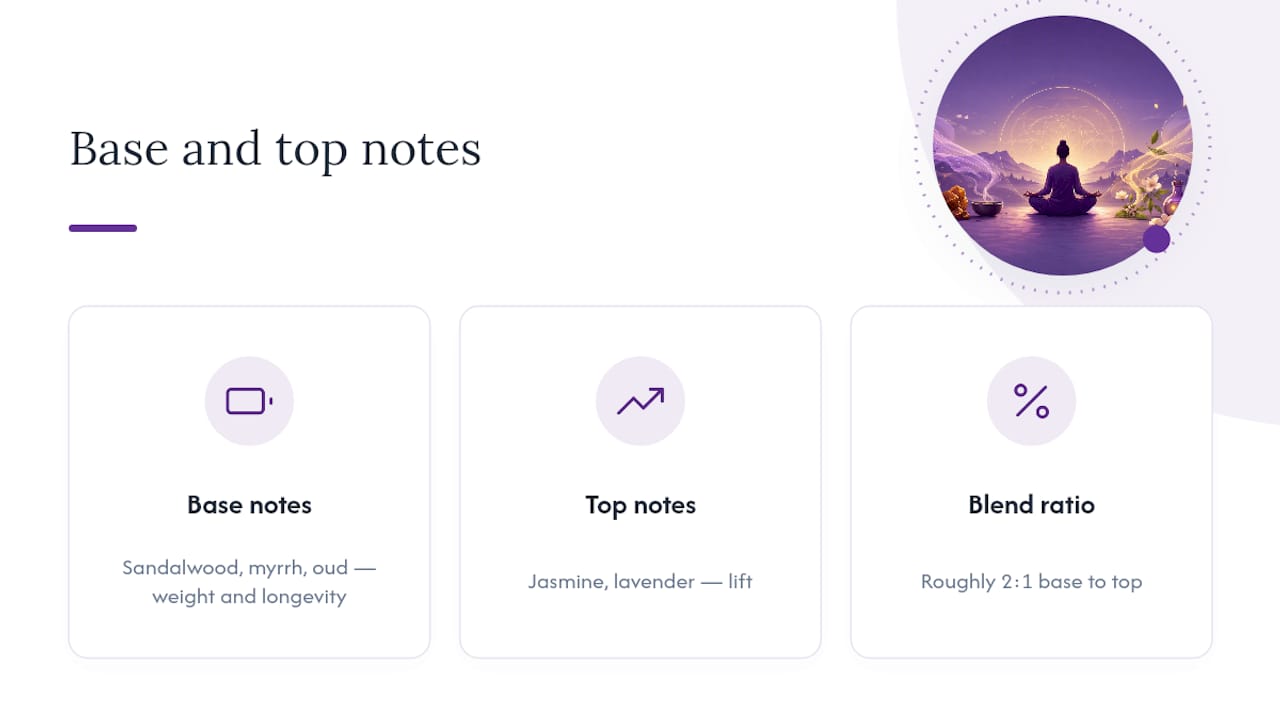
A basic blending principle borrowed from perfumery: pair a base note (sandalwood, myrrh, oud) with a lighter top note (jasmine, lavender) in roughly a 2 to 1 ratio, base to top. The base gives the blend weight and longevity; the top note gives it lift. Test any blend on a cloth or in a small diffuser before committing to it as a regular practice scent, since reactions to blended aromatics can differ from single oils.
Scholarship on contemporary essential oil culture points out that people often treat certain aromatics as universally sacred, borrowing meanings from traditions they haven’t fully studied, according to cultural analysis of essential oil use. That doesn’t mean blending is wrong. It means the most resonant blend is usually the one built from your own experience with a scent, not just its reputation.
Kejiwastore’s guide to pairing crystals and aromatherapy offers one practical framework for layering scent with other ritual materials if you want to expand beyond scent alone.
Building a Scent Altar That Supports Daily Practice
A scent altar doesn’t need to be elaborate. It needs to be consistent, a fixed spot where your nervous system learns that sitting here means something is about to shift.
Start with a small, dedicated surface, a shelf, a low table, a windowsill, and keep it separate from everyday clutter. Place your primary scent tools there: a resin burner or diffuser, your chosen oils, a lighter or matches if you’re working with smoke. Adding a bowl of sand or ash catches embers safely if you’re burning resin or herbs regularly.
Keep the altar simple enough to maintain. A cluttered altar becomes one more thing to tidy before you can sit down to practice, which undercuts the entire point. Clean the surface weekly, refill or replace oils as they run low, and resist the urge to add every crystal or object you own. Two or three meaningful pieces, alongside your scent tools, usually work better than a dozen.
Seasonal rotation keeps the altar alive rather than static. Lean toward warming scents like frankincense or myrrh in winter, and lighter florals like jasmine as the year turns toward spring. Kejiwastore’s guide to smudging herbs offers additional detail on selecting altar-appropriate herbs if smoke is part of your setup.
A Personal Shift Worth Naming
Before scent became part of practice, meditation often meant twenty minutes of restless negotiation with a wandering mind. After pairing frankincense with the same seat each morning, dropping into stillness started taking closer to two minutes instead of twenty. Try one scent for seven days and notice what changes in how quickly your mind settles.
Ready-Made Aromatics for a Practice You Can Trust
Building a scented practice from scratch takes time most seekers don’t have between work, family, and everything else pulling at attention. Kejiwastore’s ready-made line solves that gap without asking you to become an amateur perfumer first.

The Botanical Aromatics collection offers pre-blended mists and oils formulated for meditation and ritual use, so you can mist a space or anoint your wrists without measuring drops yourself. The Jasmine Passion mist supports heart-opening work specifically, a good starting point if devotional or emotional practices are your focus. For readers building a fuller practice, spagyric herbal tinctures offer a botanical support that pairs well with scent-based ritual, and Ormus minerals round out a practice focused on energetic balance.
Whatever you choose, dilute concentrated oils before skin contact, keep any space you’re scenting well ventilated, and check with a doctor before regular use if you’re pregnant or manage a respiratory condition. Browse the Botanical Aromatics collection to find a scent that matches the intention you’re working with right now.
Frequently Asked Questions
Does scent actually change spiritual awareness, or does it just feel that way? Scent produces measurable effects. A controlled study of experienced meditators found scent-paired sessions significantly improved mindfulness scores compared to unscented ones, though the feeling of shift and the measurable shift work together, not separately.
Which scent should a beginner start with? Lavender or sandalwood work well for most beginners since both calm the nervous system without overwhelming the senses. Pick one, use it only during meditation, and let the association build over a week or two.
Can I use synthetic fragrance oils instead of essential oils? Traditional and research-backed spiritual practices rely on natural aromatics, resin, essential oil, and dried botanicals, rather than synthetic fragrance blends, which don’t carry the same documented associations with meditative states.
Is it disrespectful to use scents from traditions I don’t belong to? Respectful use means learning a scent’s origin and traditional role before adopting it, rather than treating it as a generic wellness product. Sourcing transparency and basic cultural awareness go a long way toward using a practice thoughtfully.
How long before a scent becomes a reliable meditation anchor? Most practitioners notice a stronger association within one to two weeks of consistent daily pairing, though this varies by individual and by how often the scent is used outside of practice.
Sources
- MDPI study on Zen meditation and aromatherapy
- Spiritual sense of smell: Recognizing the divine perfume — Unity
- Karen A. Cerulo — cultural analysis of essential oil use and spirituality (DOI)