


You only need a candle, paper and pen, a bowl of water, and a quiet corner of your home to perform a real full moon ritual tonight. The simplest version follows three moves: write down what you’re releasing, let it go (burn, bury, or tear), then cleanse your space. Do it the night of peak fullness or anytime within a 72-hour window around it, and you’ve done the whole thing right.
TL;DR:
- Burning or burying your release paper should be done outdoors or over a fireproof dish with water nearby for safety reasons.
- Use a clear quartz, moonstone, or selenite crystal, cleaned under running water before first use, to enhance lunar energy.
- Charge moon water and intention pages overnight in moonlight on a windowsill or outdoor space, labeling them with date and moon sign if known.
- Keep your full moon kit simple, starting with a candle, paper, pen, and water, then gradually add crystals or botanicals if the ritual becomes a regular practice.
- Consistency in performing the ritual each month, even if brief, is more effective than complex setups or infrequent elaborate ceremonies.
Table of Contents
- What Are the Core Full Moon Ritual Essentials?
- How Do You Perform a Simple Full Moon Ritual Step by Step?
- What Do Candles, Crystals, and Moon Water Actually Do in a Ritual?
- Setting Up a Sacred Space Without Overcomplicating It
- How to Charge Crystals and Moon Water, Plus What Happens After
- Building Your Kit: Minimalist, Midlevel, or Ceremonial
- Why Consistency Matters More Than Complexity
- Botanical Support for Your Full Moon Practice
- Sources
What Are the Core Full Moon Ritual Essentials?
Gather these in the next ten minutes and you’re ready. You don’t need an altar, a coven, or a cabinet of crystals. You need four things and a little quiet.
Must-haves:
- A candle (any color works for a beginner, white or silver is traditional)
- Paper and a pen
- A bowl of water, plain tap is fine
- A fireproof dish or metal bowl if you plan to burn anything, or a safe outdoor spot to bury paper instead
Helpful extras that deepen the practice without complicating it:
- One small crystal, like clear quartz or moonstone
- A journal for longer reflection after the ritual
- A lighter or matches, plus a damp towel nearby for fire safety
- Sea salt, if you want to add a purifying element to your water bowl
For ambiance, not necessity:
- A drop of essential oil or a lit stick of incense
- Soft instrumental music or total silence, whichever settles your nervous system faster
If you don’t have a fireproof bowl, skip burning entirely and tear your paper into pieces instead. If open flame isn’t an option in your space, a battery-operated candle still marks the moment symbolically. One quick ethics note before you light anything: if you’re burning herbs, source them responsibly. Wild sage and palo santo are over-harvested in some regions, and ethically sourced alternatives like rosemary and lavender do the same energetic job without the sustainability problem.
How Do You Perform a Simple Full Moon Ritual Step by Step?
This whole sequence takes 20 to 30 minutes, and most beginner full moon rituals run in the 20 to 45 minute range with zero prior experience required. Here’s exactly what to do.
-
Prepare your space. Silence your phone, dim overhead lighting, and set a timer for 30 minutes so you’re not checking the clock. Take five slow breaths, in for four counts, out for six. This isn’t decoration. It shifts your body out of the scattered, task-switching state most of us carry around all day.
-
Light your candle. Set an intention before you strike the match. Something as plain as “I’m making space for what’s next” is enough.
-
Write. This is the core of the ritual, and the part people rush. Full moons are traditionally tied to completion, release, and gratitude, so give yourself two separate prompts. First: “What am I ready to release?” Write until you run out of things to say, not until you hit an arbitrary length. Second: “What am I grateful this cycle brought me?” Even one line counts.
-
Take ritual action on what you wrote. If you’re releasing something, this is where you burn or bury the release page. Burning works best in a fireproof bowl, outdoors or over a sink, with water within reach in case a spark jumps. If burning isn’t practical in your space, tear the paper into small pieces and either bury them in a plant pot or dispose of them with a firm mental “this is done.” Keep your gratitude page. Some people store it in a small box, others tuck it into a journal to reread at the next full moon.
-
Cleanse. Pick one method based on what you have access to. Smoke cleansing with a responsibly sourced herb bundle works if you have ventilation. A singing bowl or even a few claps in each corner of the room works if smoke isn’t an option. A quick salt bath, a handful of sea salt in warm bathwater for ten minutes, works if you’d rather cleanse your body directly.
-
Close with gratitude. Say thank you out loud, even if it feels a little silly the first time. Blow out your candle. If you charged a crystal or a jar of water during the ritual, label it with today’s date so you remember when it was made.
That’s the entire ritual. No incantations to memorize, no specific hour you have to catch.
What Do Candles, Crystals, and Moon Water Actually Do in a Ritual?
Every tool in a full moon kit has a job. Understanding the job makes the ritual feel less like performance and more like practice.
Candles mark the start and give your eyes something steady to focus on while your mind settles. White or silver candles are the traditional beginner pick because they’re associated with clarity, but color is a personal choice, not a rule. If you live somewhere with strict fire codes or you’re ritual-planning with kids in the house, a flameless LED candle gives you the same visual anchor with none of the risk.
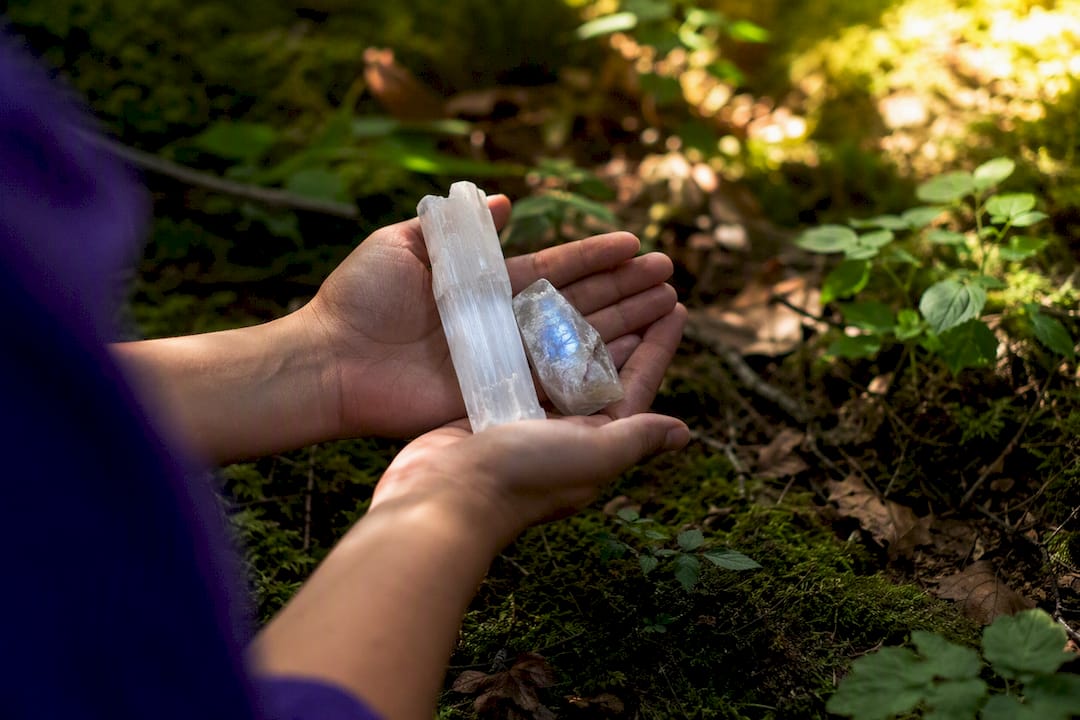
Crystals are optional but popular because they’re tactile. Beginners tend to reach for selenite, clear quartz, or moonstone since all three are inexpensive and widely recommended in beginner guides for their association with clarity and lunar energy. Clean a new crystal under cool running water before its first use, then let it air dry.
Herbs and smudging clear stagnant energy from a room, similar to opening a window after a stuffy day. If you’re in an apartment or sensitive to smoke, skip the burning and use a rosemary or lavender sachet instead, or simply open a window for a few minutes while you set your intention.
Your journal or loose paper is the actual working surface of the ritual. Whether you keep the page or destroy it isn’t a spiritual test, it’s a practical choice: keep gratitude, release the rest.
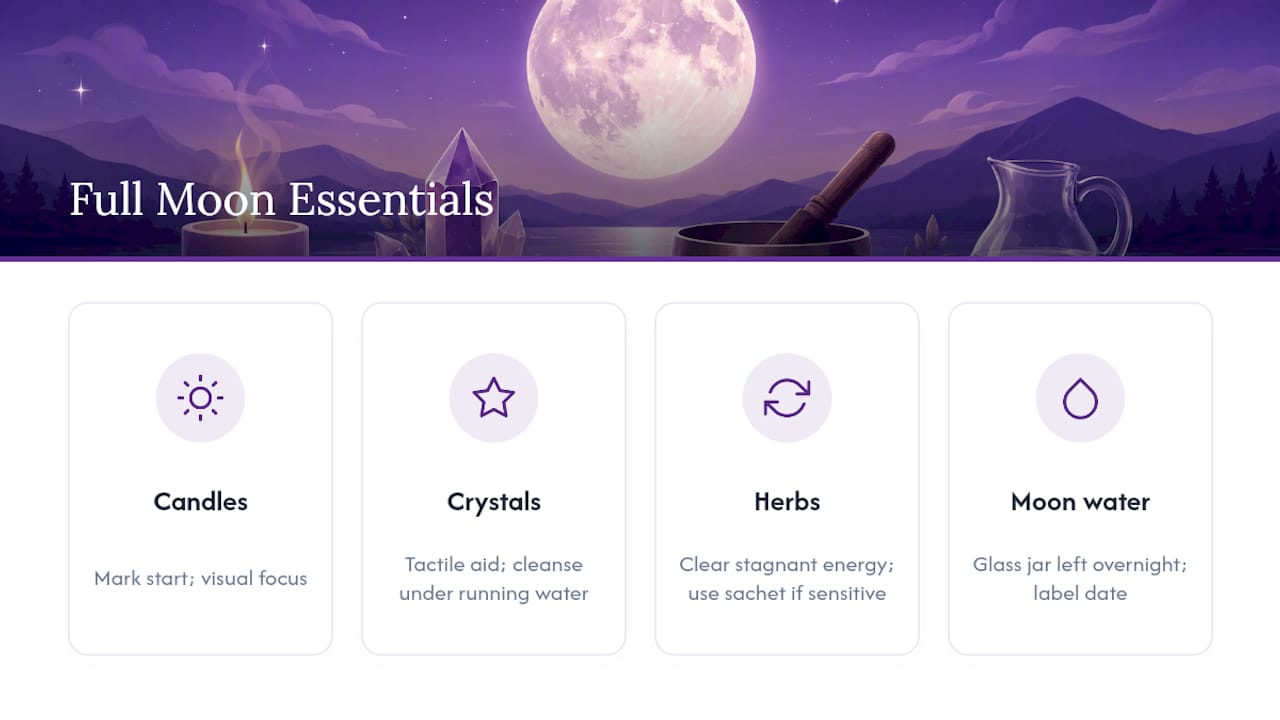
Moon water is water left out under the full moon overnight to “charge,” then used the next day. Use a glass jar, not plastic, and label it with the date and the moon’s zodiac sign if you know it. Moon water is generally safer for external use, splashed on your face, added to a bath, or used to water plants, unless you started with distilled water in a sealed, food-safe container.
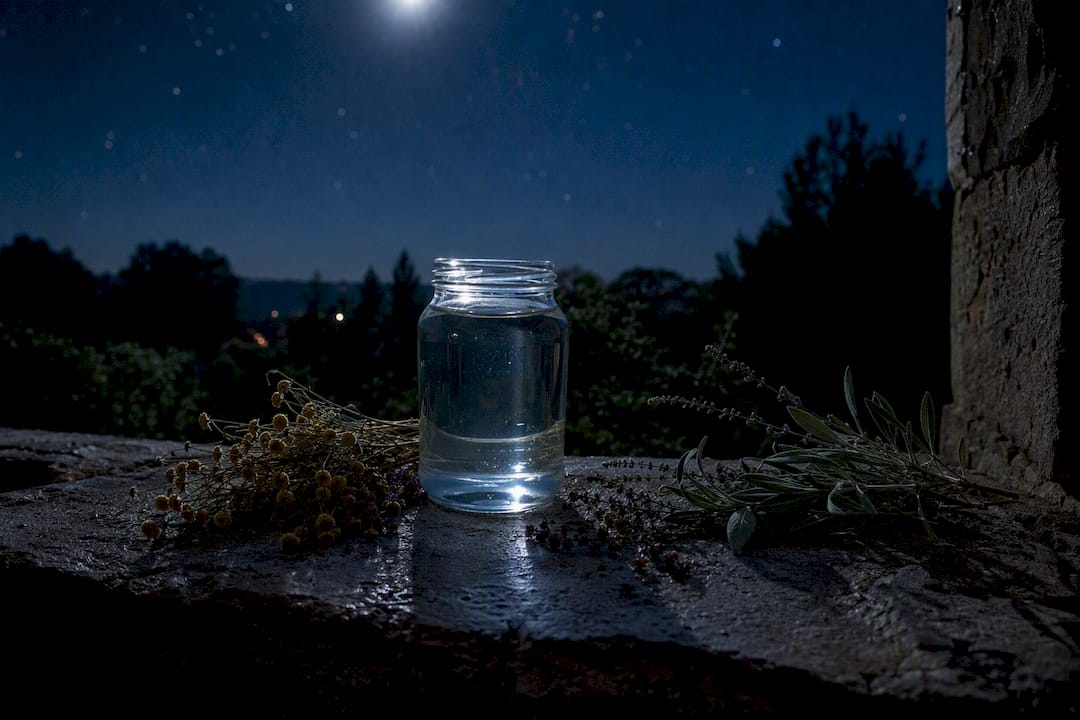
Pro Tip: Charge your moon water and your intention-writing at the same time. Set the jar on your windowsill right after you finish your release page, so both are absorbing the same night’s energy before you go to bed.
Setting Up a Sacred Space Without Overcomplicating It
You don’t need a permanent altar. You need a spot, even a corner of a bedroom or a cleared kitchen table, that’s free of clutter and phone notifications for thirty minutes.
Decide indoor or outdoor first. Outdoor space under open sky is ideal if you have a balcony or backyard, but a windowsill where moonlight actually reaches works just as well. Creating a distraction-free space and having your writing materials ready ahead of time matters more than the size or beauty of the space itself.
If fire is part of your plan, run through this checklist first:
- Crack a window or work near ventilation before burning anything
- Keep your fireproof dish on a heatproof surface, not directly on wood or fabric
- Have water or a damp cloth within arm’s reach
- Never leave a lit candle or burning herb bundle unattended, even for a minute
On sourcing: wild-harvested white sage and palo santo have real sustainability and cultural-respect concerns tied to over-harvesting. Rosemary and lavender, grown widely and easy to source ethically, work as smoke-cleansing substitutes without that baggage. Renters and apartment dwellers who can’t use smoke at all can rely on sound (a bell, a clap, a few bars of music) to clear a room’s energy instead.
How to Charge Crystals and Moon Water, Plus What Happens After
Charging is simple: place your crystal or your sealed water jar somewhere moonlight will reach it, a windowsill, balcony ledge, or backyard table, and leave it overnight. Charging tools and moon water overnight is standard practice and needs no additional steps beyond labeling the item with the date once morning comes.
Aftercare is where a lot of beginners quit too early, but it’s the part that makes the ritual stick. The next morning, reread your gratitude page. Ask yourself one question: did anything shift, even slightly, in your mood or clarity? You’re not looking for fireworks. A full moon ritual’s effects tend to show up as a subtle mental exhale, not a dramatic before-and-after.
Repeat the ritual every full moon if release and reflection are useful rhythms for you, roughly once every 29.5 days. If you skip a month, nothing is lost. The moon comes back.
Building Your Kit: Minimalist, Midlevel, or Ceremonial
Most people start minimalist and add pieces as the practice earns its place in their routine.
- Minimalist: candle, paper and pen, bowl of water. Total cost under $10 if you’re sourcing from what’s already in your kitchen drawer.
- Midlevel: add one or two crystals, a dedicated journal, and an aromatherapy mist or essential oil for scent-based grounding.
- Ceremonial: add ethically sourced smudging herbs, a tarot or oracle deck for post-ritual reflection, a dedicated altar cloth, and higher-quality botanical tinctures for aftercare support.
Invest in better-quality crystals or botanicals once you notice you’re doing the ritual consistently, not before. Buying a $60 crystal set before your third full moon is a common beginner overspend. Store your kit in a shoebox or small drawer near your ritual space so setup next month takes minutes, not a search through the whole house.
Why Consistency Matters More Than Complexity
Most people overbuild their first full moon kit because they assume more tools mean more power. It’s backwards. Intention and focused attention are the actual engine of a ritual; the candle, the crystal, the incense just give your attention something to hold onto while you do the real work of noticing what you’re ready to release.
At Kejiwa Alchemy, we build small-batch botanicals specifically for people who want that anchor without the overwhelm, something plant-based and intentional that supports the moment rather than dominating it. Consistency beats elaborate setup every single time. A five-minute ritual you actually do each month outperforms a two-hour ceremony you attempt twice a year and then abandon. If you want to go deeper on the botanical side, our guide to lunar ritual bathing walks through pairing a moon bath with your release practice.
Pro Tip: Pick one small plant-based ritual element, a mist, an oil, a tincture, and use the same one every full moon for three cycles before adding anything new. Repetition is what builds the association between the scent and the state of mind you’re trying to reach.
— Kejiwa
Botanical Support for Your Full Moon Practice
If you’ve gathered your candle and your bowl of water and you’re wondering what comes next, Kejiwa Alchemy’s small-batch aromatherapy mists, spagyric tinctures, and smudging herbs are built for exactly this moment, ritual support without a subscription or a steep learning curve.

A few ways our ritual-minded customers actually use these: a few spritzes of a botanical aromatherapy mist at the start of your writing step, to signal to your nervous system that it’s time to settle in. A dropper of spagyric herbal tincture added to your evening routine on ritual nights, for readers who want botanical support that extends past the ritual itself and into the days that follow. Ethically sourced smudging herbs for those who want the clearing step without foraging their own sage.
Everything is handcrafted in small batches from organic and wild-harvested ingredients, so what you’re using has the same intentional sourcing this guide recommends. If tonight’s ritual is your first, start with one mist or one tincture rather than a full ceremonial kit. Browse the botanical aromatics collection and pick the scent that matches what you’re releasing this cycle.
Sources
- Full moon — Time and Date
- Full Moon Ritual and Self-Care - Farmers’ Almanac
- A Complete Ritual Guide to Full Moon Manifestation | The Moon School
- Full Moon Ritual: Step-by-Step Guide for Beginners - WitchcraftForBeginners
- Full Moon Rituals: Your Step-by-Step Guide | The Pagan Grimoire