


Energy healing modalities fall into three primary categories based on how they are delivered: hands-on techniques that use physical touch or pressure, no-touch methods that work through hovering hands and intention, and self-administered practices you can explore on your own. The National Center for Complementary and Integrative Health (NCCIH) further classifies energy medicine into veritable forms (measurable energy such as laser or magnetic therapy) and putative forms (subtle, unmeasurable energy like Reiki or Therapeutic Touch). Understanding this distinction helps you set realistic expectations before you choose a path.
Here is a quick orientation across all three delivery styles:
Hands-on modalities (involve physical touch or pressure at specific body points):
- Reiki
- Acupuncture
- Reflexology
- Polarity Therapy (PT)
No-touch modalities (work through hovering hands or pure intention):
- Therapeutic Touch (TT)
- Healing Touch
- Quantum Touch (QT)
- Pranic Healing
Self-administered practices (movement, breath, tapping, or meditation you direct yourself):
- Qigong
- Emotional Freedom Technique (EFT)
- Yoga-based energy work
- Self-applied reflexology
Each category draws on the concept of a vital life force, called qi in Chinese medicine, prana in Sanskrit traditions, or simply “life energy” in Western frameworks. The goal across all of them is the same: clear blockages, restore flow, and support the body’s natural capacity to heal.

Common hands-on energy healing techniques
Hands-on techniques combine bodywork and energy principles to relieve pain, improve energy flow, and support relaxation. They are the most widely recognized forms of energy therapy in the United States, and several are offered in hospital integrative medicine programs alongside conventional care.
-
Reiki. Developed in Japan in the 1920s, Reiki is built on the belief that a practitioner can channel universal life-force energy through their hands into a recipient’s body. The practitioner holds their hands lightly on or just above specific points, allowing energy to flow and support the body’s own healing response. Sessions typically last for an extended period, allowing time for a complete treatment, and the recipient remains fully clothed. Reiki is also practiced at a distance, which places it at the intersection of hands-on and no-touch traditions.
-
Acupuncture. Rooted in Traditional Chinese Medicine (TCM), acupuncture involves inserting very thin steel needles into acupressure points on the body, commonly on the head, neck, face, and back. The goal is to stimulate these points and rebalance the flow of qi along pathways called meridians. Among all energy-based approaches, acupuncture has the most substantial body of clinical research, particularly for pain management and nausea.
-
Reflexology. The known history of reflexology traces back to ancient Egypt, around 2,500 B.C., with hieroglyphic scenes depicting foot treatment. A practitioner applies targeted pressure to specific points on the hands, feet, and ears, which correspond through nerve pathways to muscles, glands, and internal organs. The intent is to push energy through 12 pathways in the body, relieving pain and reducing stress.
-
Polarity Therapy (PT). Developed in 1947 by Dr. Randolph Stone, an Austrian-American osteopath and naturopath, Polarity Therapy integrates Eastern and Western healing frameworks. A practitioner applies manual pressure to “opposite” points on the body (for example, the left side of the head and the right side of the abdomen) to release blockages. Sessions also incorporate daily yoga and mindful eating as part of a broader lifestyle approach.
Pro Tip: If you are new to hands-on energy work, Reiki is often the most accessible entry point. Sessions are gentle, require no undressing, and are widely available through integrative health centers across the U.S.
No-touch energy healing techniques you should know
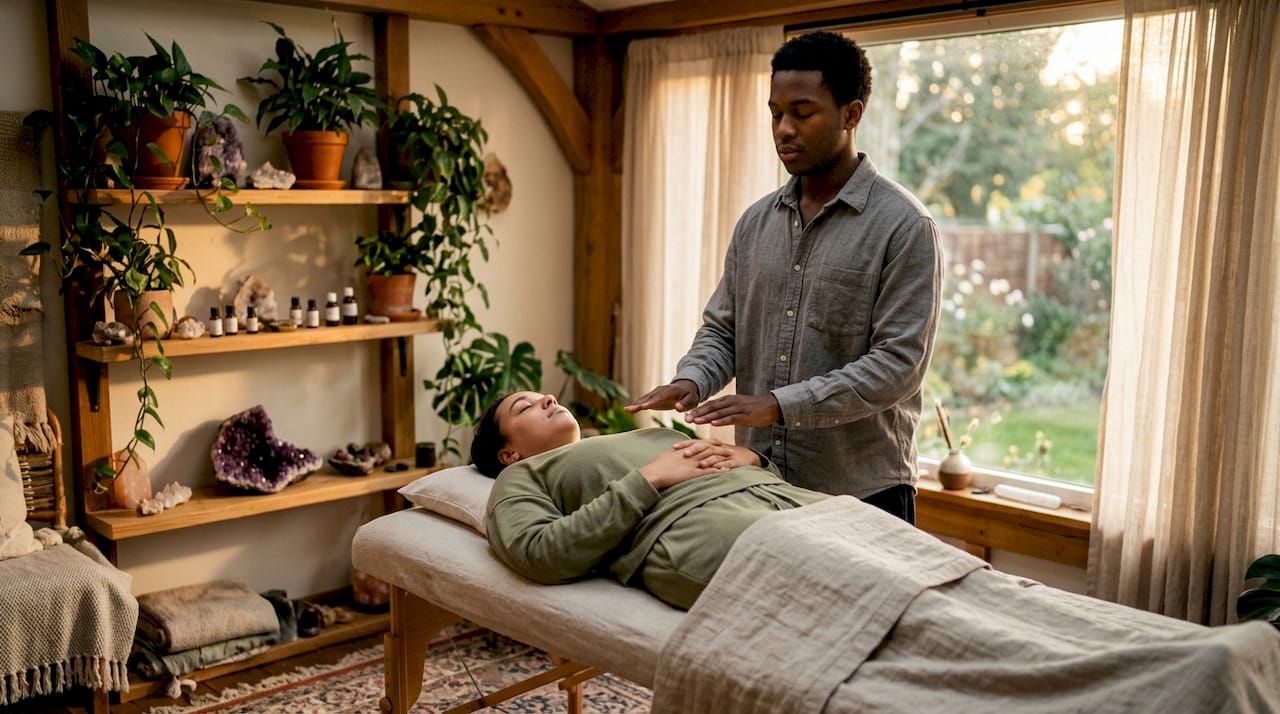
No-touch modalities work through practitioner intention and energy field manipulation without physical contact. The practitioner scans, clears, or channels energy by hovering their hands a few inches from the body, or in some cases, from an entirely different location. For people who are sensitive to touch, recovering from injury, or simply drawn to subtler methods, these approaches can feel more appropriate.
-
Therapeutic Touch (TT). Developed by Dolores Krieger, a nursing professor, and Dora Kunz, a psychic healer, TT is a modern adaptation of the ancient “laying on of hands” practice. A practitioner centers themselves into a focused state of consciousness, then passes their hands 2–6 inches from the body to scan for energy imbalances. They “clear” congested areas and rebalance the biofield. Formal training programs exist through nursing and integrative health organizations.
-
Healing Touch. Created by Janet Mentgen, an energetically sensitive nurse with over 40 years of clinical experience, Healing Touch follows a structured sequence. Practitioners ground themselves, set an intention to stimulate the recipient’s self-healing, and then place their hands above or lightly on the body for up to 60 minutes. Healing Touch International offers a formal certification pathway, making it one of the more credentialed no-touch modalities available in the U.S.
-
Quantum Touch (QT). Quantum Touch originates from the healing work of Bob Rasmussen in the late 1970s. Practitioners use light touching, specific breathing techniques, and body awareness meditations to influence the life force of a recipient. The underlying belief is that the body is inherently intelligent and capable of self-correction when its energy field is supported. QT sits at the boundary between touch and no-touch, since the contact is feather-light rather than therapeutic pressure.
-
Pranic Healing. “Prana” is a Sanskrit word meaning “life force,” referring to the invisible energy field surrounding the body. A Pranic Healing practitioner scans the aura for blockages, then removes them by scattering fresh energy over the recipient without ever making physical contact. This approach draws on the concept that the physical body has an energetic counterpart, and that healing the energy body supports recovery in the physical one.
Self-administered energy healing practices
One of the most empowering aspects of energy healing practices is that several of them require no practitioner at all. You can learn them, practice them daily, and adapt them to your own schedule and needs. This accessibility is part of why self-administered modalities have grown so steadily in American wellness culture.
-
Qigong. A form of Traditional Chinese Medicine with roots stretching back thousands of years, Qigong uses a combination of physical postures, breathing techniques, and conscious mental focus to improve the flow of qi through the body’s meridians. Regular practice is associated with lower blood pressure, reduced pain, and improved sleep. In external Qigong, a trained practitioner can also project their qi toward another person, bridging the self-administered and practitioner-led categories.
-
Emotional Freedom Technique (EFT). EFT is a form of exposure therapy that combines cognitive reframing with physical tapping on 12 acupressure points on the body. A therapist or the individual themselves taps on these points while focusing on a negative emotion and simultaneously repeating positive affirmations. The process aims to balance the energy field and reduce the emotional charge around a specific memory or fear. You can learn the tapping sequence and practice it independently, which makes EFT one of the most portable self-care tools in the energy therapy space.
-
Yoga-based energy work. Yoga’s pranayama (breath control) and asana (posture) practices are designed to move prana through the body’s energy channels, called nadis. While yoga is often categorized separately from energy healing, its foundational philosophy is identical: clear the channels, balance the flow, and support overall vitality. Many energy healers incorporate yoga as a daily maintenance practice between sessions. For a deeper look at how plant-based tools can support this kind of energetic work, energetic herbalism offers a complementary framework worth exploring.
-
Self-applied reflexology. While professional reflexology sessions involve a trained practitioner, the basic principles can be applied at home. Pressing on specific points on your own feet or hands can stimulate the corresponding nerve pathways and provide stress relief. Foot rollers and reflexology charts are widely available, making this one of the most accessible entry points into hands-on energy work.
Pro Tip: EFT is particularly well-suited for practitioners who work with others’ emotional energy all day. Tapping through a short sequence before and after client sessions can help you reset your own biofield and avoid carrying residual energy home.
What science says and what you need to consider
The scientific picture around energy healing is honest and worth understanding clearly. The NCCIH distinguishes veritable energy medicine (measurable, physically validated) from putative energy medicine (subtle fields that current instruments cannot reliably detect). The lack of standardized instruments for measuring subtle energy fields remains the primary barrier to mainstream acceptance.
Scientific consensus positions energy healing as a complementary approach. Reiki and related therapies lack clear validation for treating disease, and most existing research has been limited in quality and consistency. That said, the safety profile for most putative modalities is favorable. The main safety concern identified by the NCCIH is not the practice itself but the indirect harm of delaying or replacing evidence-based medical care.
Credentialing varies widely across modalities. Therapeutic Touch and Healing Touch have formal training programs and certification pathways, while Reiki has no standardized licensing in the United States. This means the quality of a Reiki session depends heavily on the individual practitioner’s training lineage and experience. For professional practitioners, investigating the heritage behind a modality (for example, Traditional Japanese Reiki versus Western Reiki adaptations) is worth the time.
Energy healing’s persistence across cultures and centuries reflects something real about human need. The concepts of qi, prana, and vital force appear independently across Chinese, Indian, and Western traditions, suggesting a shared intuition about life energy that predates modern medicine. Whether or not that energy is measurable, the desire for care that addresses emotional and spiritual dimensions alongside physical symptoms is a legitimate and deeply human one. For those managing stress alongside their wellness practice, some people also explore CBD for stress management as a complementary tool.
How each modality is typically used in practice
Understanding the delivery format of each modality helps you know what to expect from a session and whether it fits your current situation.
| Modality | Session format | Common use cases |
|---|---|---|
| Reiki | Hands-on or distant; extended sessions | Stress, anxiety, post-surgery recovery |
| Acupuncture | Needle insertion; typical session length | Chronic pain, nausea, headaches |
| Reflexology | Foot/hand pressure; typical session length | Stress relief, circulation, fatigue |
| Polarity Therapy | Bodywork + lifestyle; typical session length | Chronic tension, emotional imbalance |
| Therapeutic Touch | No-touch scan and clearing; 20–30 min | Anxiety, wound healing support |
| Healing Touch | Structured hand sequence; up to 60 min | Pre/post-surgical care, pain management |
| Quantum Touch | Light touch + breathwork; 30–60 min | Pain, structural alignment support |
| Pranic Healing | No-touch aura work; typical session duration | Fatigue, emotional clearing |
| Qigong | Movement + breath; daily practice | Blood pressure, sleep, chronic pain |
| EFT | Tapping sequence; brief session duration | Anxiety, phobias, trauma processing |
Most of these modalities are used alongside conventional medical care rather than instead of it. Acupuncture, for instance, is offered in many U.S. hospital systems as a pain management adjunct. Reiki is available in some oncology and palliative care settings. The framing that serves people best is “and” rather than “or.” Energy work supports the body’s natural processes; it does not replace a physician’s care. If you are drawn to the vibrational dimensions of these practices, that context deepens the experience considerably.
How the underlying philosophies of these modalities compare
Every energy healing modality rests on a foundational belief about the nature of life force and how it moves through the body. The philosophies differ in meaningful ways, and understanding them helps you choose a practice that resonates with your own worldview.
Chinese medicine frameworks (Reiki, Acupuncture, Qigong, Reflexology) share the concept of qi flowing through meridians. Blockages in these channels produce symptoms; restoring flow restores health. Acupuncture and Qigong are the most structurally mapped of these traditions, with detailed meridian charts that have been refined over thousands of years.
Sanskrit and Ayurvedic frameworks (Pranic Healing, Yoga-based work) center on prana and the concept of an energy body (pranamaya kosha) that interpenetrates the physical body. Pranic Healing specifically works on the aura as a distinct energetic structure, treating it before changes manifest physically.
Western integrative frameworks (Therapeutic Touch, Healing Touch, Polarity Therapy) blend Eastern energy concepts with Western anatomy and nursing science. Polarity Therapy, for example, draws on Ayurvedic principles, Chinese medicine, and osteopathic bodywork simultaneously. Therapeutic Touch was developed within academic nursing and frames the biofield in terms compatible with Western clinical language.
Consciousness-based frameworks (Quantum Touch, EFT) emphasize the role of the practitioner’s or recipient’s own awareness in the healing process. EFT explicitly combines cognitive behavioral principles with energy meridian theory, making it the most psychologically integrated of all the modalities listed here. Quantum Touch holds that the body’s intelligence does the actual healing; the practitioner simply creates the conditions for it.
What unites all of these, despite their different vocabularies, is the conviction that physical health cannot be fully separated from emotional and spiritual wellbeing. That integrative view is precisely what draws so many people to these practices, and why they have persisted across cultures and centuries despite mainstream medicine’s skepticism. For practitioners who work in this space and want to support their own energetic architecture between sessions, energy protection practices are worth building into your routine.
Support your energy work with Kejiwastore
The modalities you explore deserve support at every level, including the physical and biochemical. Kejiwastore’s handcrafted Ormus minerals are made in small batches from carefully sourced ingredients, designed to support cellular coherence, nervous system regulation, and energetic balance. Whether you are a practitioner holding space for others or someone just beginning to explore energy medicine, these alchemical preparations are crafted to complement the work you are already doing. Kejiwastore also offers spagyric herbal tinctures and botanical aromatics rooted in the same tradition of intentional, plant-based wellness.
Key Takeaways
Energy healing modalities divide into hands-on, no-touch, and self-administered categories, each drawing on distinct cultural philosophies about life force, biofield, and the body’s innate capacity to heal.
| Point | Details |
|---|---|
| Three delivery categories | Hands-on, no-touch, and self-administered practices each offer distinct entry points into energy medicine. |
| NCCIH classification | Veritable energy medicine is measurable; putative forms like Reiki and Therapeutic Touch work with subtle, unmeasurable fields. |
| Safety profile | Most putative modalities carry low direct risk; the main concern is delaying evidence-based medical care. |
| Credentialing varies widely | Healing Touch and Therapeutic Touch have formal programs; Reiki has no standardized U.S. licensing. |
| Philosophy shapes practice | Chinese, Ayurvedic, Western integrative, and consciousness-based frameworks each define life force differently, influencing how sessions are structured and what outcomes to expect. |