


Amethyst is traditionally used to calm mental noise and open the Third Eye and Crown chakras, the two energy centers linked to inner perception and higher awareness. Hold a piece like Kejiwa Alchemy’s Amethyst Double Terminated Point against your forehead for five quiet minutes and notice what surfaces. The stone itself, a form of quartz rated 7 on the GIA hardness scale, does not manufacture insight. It clears space for the insight you already have.
TL;DR:
- Amethyst helps quiet mental noise by reducing static rather than amplifying signals, which enhances existing intuitive impressions.
- For best results, meditate three to five times weekly with a focus on the Third Eye or Crown, using it during specific questions or dreamwork routines.
- Combining amethyst with crystals like clear quartz or labradorite can improve focus and protect against overwhelm during intuitive practices.
- Genuine amethyst displays color zoning, feels cool initially, and resists scratching, unlike glass or dyed imitations that are uniform and softer.
- Crystals are inert tools; they do not produce psychic effects but may support mental clarity through ritual conditioning and expectation.
Table of Contents
- Why Amethyst Is Linked to Intuition
- How to Use Amethyst for Intuition: A Step-By-Step Practice
- Crystal Pairings That Support Amethyst’s Intuitive Work
- Who Should Be Cautious With Amethyst
- Caring For and Choosing an Amethyst Stone
- What Amethyst Actually Is: History and Material Facts
- What Science Actually Says About Crystals and Intuition
- Myths About Amethyst and Intuition Worth Retiring
- Real vs. Fake Amethyst: How to Tell the Difference
- Limitations to Keep in Mind
- How Kejiwa Works With Amethyst
- Bring Amethyst Into Your Own Practice
- Sources
Why Amethyst Is Linked to Intuition
The connection isn’t random. Amethyst has occupied a specific spot in chakra theory for generations, and that placement shapes how practitioners actually use it.
Third Eye and Crown correspondence. In most modern chakra systems, amethyst’s violet hue maps to the Third Eye (perception, insight, pattern recognition) and the Crown (connection to something larger than the daily grind of decision making). Chakra Serenity’s meditation guide recommends resting the stone directly on the forehead or just above the crown of the head during seated practice, letting its weight anchor attention to that region rather than the usual mental scroll of to-do lists and replayed conversations.
That anchoring effect matters more than any mystical amplification. Amethyst’s real value for intuition seems to come from quieting the noise, not boosting a hidden signal. Think of your intuitive impressions as a quiet radio station buried under static: worry, fatigue, the mental clutter of a normal day. Amethyst doesn’t turn up the station. It turns down the static, which is often enough to hear what was already playing.
Here’s what that looks like in practice:
- Calming quality: Crystal practitioner sources describe amethyst as one of the more soothing stones in daily rotation, useful for settling a racing mind before intuitive work even starts.
- Placement matters: near the head for daytime focus, on the crown or forehead for deeper meditative states.
- Material grounding: amethyst belongs to the quartz family (SiO2), scores 7 on the Mohs hardness scale, and a standard tumbled stone typically runs $8 to $20 in the U.S. market.
- Traditional framing, not clinical proof: practitioners treat amethyst as a support for receptivity, not a guarantee of psychic accuracy.
How to Use Amethyst for Intuition: A Step-By-Step Practice
You don’t need an elaborate setup. You need a quiet ten minutes and a stone you trust.
The 5 to 10 minute Third Eye meditation:
- Sit upright somewhere you won’t be interrupted. Dim the lights if you can.
- Hold your amethyst piece or place it flat against your forehead, between the brows.
- Close your eyes and breathe slowly for a full minute before doing anything else.
- Silently ask a single, specific question. Not “what should I do with my life,” but something concrete: a decision, a relationship, a next step.
- Sit with the silence. Don’t chase an answer. Notice images, words, or bodily sensations that arise without forcing them.
- After 5 to 10 minutes, open your eyes and write down whatever surfaced, even if it seems unrelated.
The dreamwork routine (10 to 20 minutes, before sleep):
Place the amethyst on your nightstand or under your pillow. Spend the first few minutes journaling one open question you’d like clarity on. Then simply go to sleep. On waking, write down any dream fragments immediately, before checking your phone or talking to anyone. Patterns tend to show up over a week, not in a single night.
For daily micropractice, carry a small tumbled amethyst in your pocket and pause twice a day to ask: what did I just notice and dismiss? That dismissed thought is frequently the intuitive hit worth tracking.
Meditation with amethyst works best practiced three to five times weekly rather than daily marathon sessions. Start with short sits. If you feel foggy or overstimulated, stop, put the stone down, and place both feet flat on the floor until the feeling passes.
Pro Tip: Keep a small notebook next to your meditation cushion. The value of amethyst work isn’t the ten minutes you spend with your eyes closed. It’s the pattern you can only see after writing down thirty separate sessions.
Crystal Pairings That Support Amethyst’s Intuitive Work
Amethyst rarely works alone in a practitioner’s kit. Certain crystal combinations show up again and again because they round out what amethyst does on its own.
- Clear quartz amplifies clarity and is often placed alongside amethyst to sharpen focus during longer sessions.
- Rose quartz softens the emotional edges of intuitive work, useful if what surfaces during meditation feels heavy or unresolved.
- Labradorite is prized for protection and discernment, a useful counterweight when you’re opening yourself to more input than usual.
- Angelite, a gentler calming stone, pairs well for grounding after an intense dreamwork session. Kejiwa’s Angelite Tumbled Crystal works well set beside an amethyst point on a small altar.
A simple altar layout: amethyst at center, clear quartz to its right, rose quartz or labradorite to its left, with a small dish for anything you burn or diffuse. Charge the set under a full moon overnight if you keep a lunar rhythm. Combining crystal work with aromatics or a clean smudge deepens the ritual for many practitioners; Kejiwa’s guide to crystals and aromatherapy walks through safe pairings in more depth.
Who Should Be Cautious With Amethyst
Sensitive practitioners sometimes report headaches, unusually vivid dreams, or a general sense of overwhelm after intense or prolonged crystal meditation. These are signals to scale back, not push through.
- Shorten sessions to five minutes or skip a day if you feel foggy or overstimulated.
- Ground yourself with feet flat on the floor, plain water, and a few minutes away from any stone.
- Treat amethyst as a complementary practice. Practitioner guidance consistently notes it is not a substitute for professional medical or mental health care.
Caring For and Choosing an Amethyst Stone
Amethyst is durable at 7 on the Mohs scale, but a soft cloth and mild soap are still the safer cleaning choice over harsh chemicals, which can dull the surface over time. For energetic cleansing, moonlight overnight or a light smudge works for most practitioners; running water is a common tradition but skip it on pieces with metal settings or fractures.
- Tumbled stones ($8 to $20) suit pocket carrying and daily micropractice.
- Points, like Kejiwa’s Amethyst Double Terminated Point, direct energy outward from both ends and work well for forehead placement during meditation.
- Clusters anchor a room or altar rather than travel with you.
What Amethyst Actually Is: History and Material Facts
Separate the tradition from the mineral, and you get a clearer picture of what you’re actually working with.
The name traces back to the Greek word amethystos, meaning “not intoxicated.” Ancient wearers believed the stone warded off the effects of wine, and that association with sobriety gradually extended into a broader symbolic link to mental clarity and clear judgment.
Amethyst is quartz, chemically silicon dioxide, with a Mohs hardness of 7. That single fact explains why it survives daily handling, pocket carrying, and years of altar use without significant wear.
The GIA confirms these material facts plainly: quartz family, hardness 7, with tumbled retail prices in the $8 to $20 range for standard U.S. market stones. What the GIA does not confirm, and what no mineralogical body confirms, is any measurable effect on intuition itself. That distinction is the honest one to hold: the historical use is real, well documented, and centuries deep. The intuitive benefit is a matter of tradition and personal experience, not laboratory proof.
What Science Actually Says About Crystals and Intuition
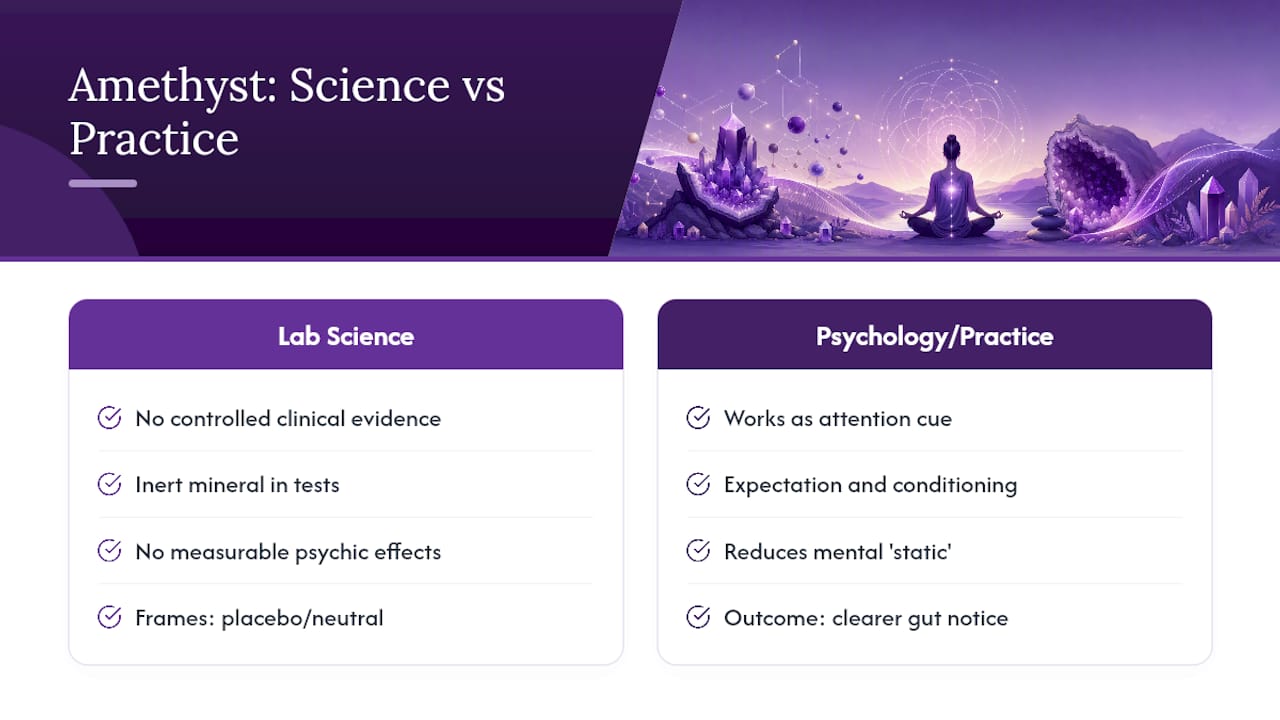
No controlled clinical research demonstrates that amethyst produces measurable psychic or intuitive effects beyond what any calming object or ritual object might offer. That’s a fair, direct statement, and it’s worth sitting with rather than dancing around.
What psychological perspectives do support is more interesting than a flat dismissal. The mechanism most consistent with how amethyst seems to help is attention and expectation. Holding a specific object during a quiet, structured meditation creates a repeatable cue your nervous system learns to associate with slowing down. That’s not nothing. A stone that reliably signals “we are entering a calm, reflective state” can genuinely improve your access to subtle thoughts and gut reactions you’d otherwise steamroll through on a busy day.
This lines up with the practitioner framing that amethyst’s real function is reducing static rather than amplifying signal. Quieting racing thoughts through a ritual object is a documented psychological pattern, sometimes called a focusing object or anchor in mindfulness contexts, even when the object itself carries no measurable energetic property. Whether you call that placebo, ritual, or simple behavioral conditioning depends on your framework. The practical outcome for many meditators is the same either way: fewer distractions, more room to notice what your gut has been trying to tell you.
Hold both truths at once. The stone is inert mineral by every lab measure available. The ritual built around it can still change your mental state in ways worth taking seriously.
Myths About Amethyst and Intuition Worth Retiring
The biggest misconception is that amethyst grants psychic ability, as though holding one turns on a switch that was previously off. No practitioner guide worth trusting makes that claim, and neither should you. What amethyst supports is receptivity, the capacity to notice impressions that were already available to you but drowned out by noise.
A second myth: bigger or more expensive amethyst works better. A $200 cathedral geode does not out perform a $10 tumbled stone for meditation purposes. Size affects room presence and altar aesthetics, not the quality of your inner attention during a ten minute sit.
Third, some assume amethyst works instantly, that one session should produce a clear, dramatic download. Most practitioners report the opposite: patterns emerge over weeks of consistent short sessions, not from any single sitting.
Finally, there’s a belief that amethyst can replace discernment, that anything that surfaces during meditation must be trusted and acted on immediately. Intuitive impressions still deserve the same scrutiny you’d apply to any other input. The stone helps you hear the signal. It does not verify the signal is correct.
Real vs. Fake Amethyst: How to Tell the Difference
Glass and dyed quartz imitations circulate widely, and telling them apart matters if you’re paying for a piece meant for regular meditation use.
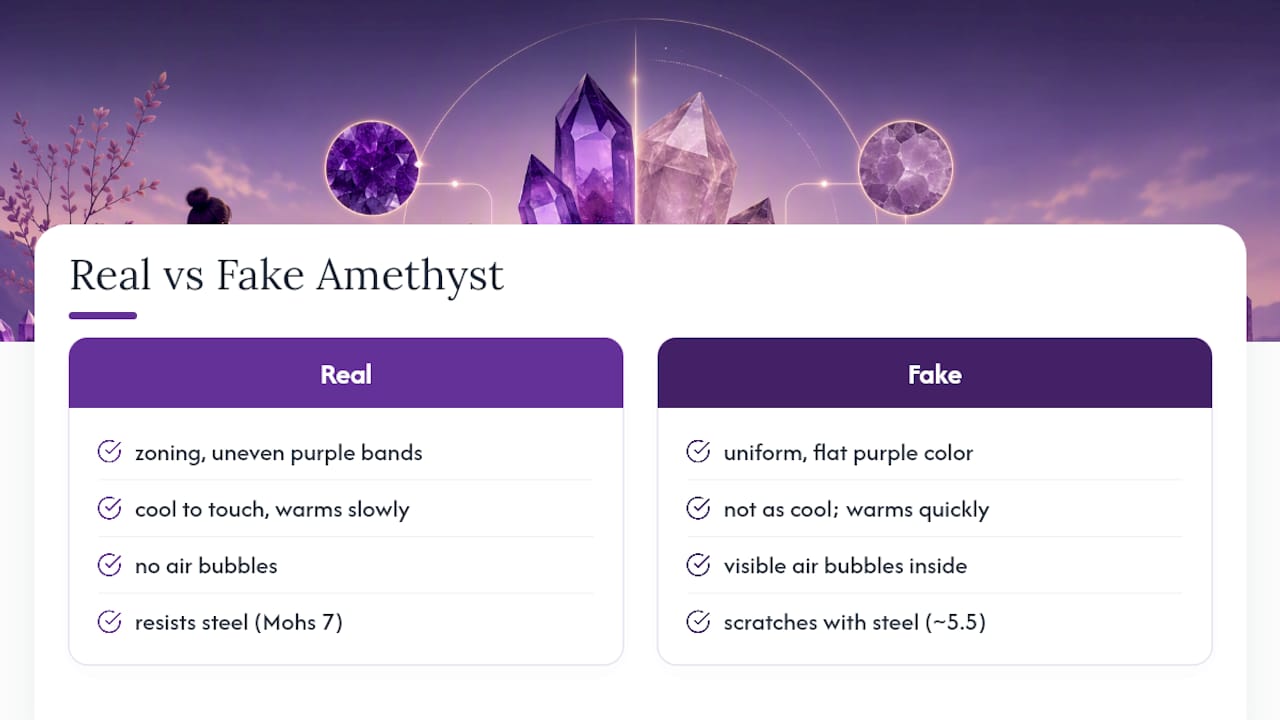
Genuine amethyst shows color zoning, uneven bands or patches of purple rather than one flat, uniform shade throughout the stone. Glass imitations tend to look suspiciously even, almost too perfect, with color that seems poured in rather than grown. Real amethyst also feels cool to the touch initially and warms slowly, a quartz characteristic that cheap glass often doesn’t replicate the same way.
Bubbles are a dead giveaway. Hold the piece to light: visible air bubbles trapped inside almost always mean glass, since natural quartz formation doesn’t produce that pattern. Scratch testing is more definitive but destructive, since genuine amethyst at Mohs 7 will resist a steel blade, while glass, softer at around 5.5, will scratch more easily.
Price is a rough but useful signal too. A large, deeply saturated, perfectly clear amethyst point sold for a few dollars is almost never authentic. Buying from a source that states sourcing practices directly, rather than an anonymous marketplace listing with no stone information, reduces your risk considerably.
Limitations to Keep in Mind
Amethyst for intuitive work has real limits worth naming plainly rather than glossing over.
It won’t manufacture insight where none exists, and it won’t override poor judgment or wishful thinking dressed up as intuition. Overreliance on any single practice, crystal or otherwise, can also become a way to avoid actually making a decision. If you find yourself meditating repeatedly on the same question without ever acting, that’s a limitation of the practice, not a sign you need a bigger stone. And for a small number of sensitive practitioners, frequent or prolonged sessions can trigger the overwhelm and vivid dreaming mentioned earlier, which is a good cue to scale back rather than push through.
How Kejiwa Works With Amethyst
We reach for the Amethyst Double Terminated Point most often for forehead placement during seated meditation. Both pointed ends are believed to let energy move through the stone rather than pooling, which can be useful for shorter, focused sits rather than long open-ended ones. Paired with an Angelite Tumbled Crystal held in the opposite hand, the combination tends to soften anything that feels too intense after dreamwork.
One practitioner tip we return to often: place the amethyst point before you sit down, not after you’re already settled. Fumbling with a stone once you’ve closed your eyes breaks the very stillness you’re trying to build.
— Kejiwa
Bring Amethyst Into Your Own Practice
Working with amethyst consistently starts with having a piece you actually trust to sit with, not one gathering dust because it never felt quite right. Kejiwastore hand selects pieces like the Amethyst Double Terminated Point specifically for forehead and altar placement, sourced and finished with the same care we put into our spagyric tinctures and Ormus preparations.
If dreamwork or evening meditation is where you’re headed, the Angelite Tumbled Crystal makes a gentle companion piece for grounding afterward. And if you’re building out a fuller ritual, one that pairs stonework with scent, our botanical aromatics collection and Ormus mineral line were built with exactly that kind of layered practice in mind. Browse the amethyst point, add an angelite piece to your cart, and give your next meditation a physical anchor worth returning to.