


Alcohol is the standard solvent in herbal tinctures because it extracts a broader range of plant compounds than water or glycerin alone, and it keeps the finished extract shelf-stable for years. Most tinctures typically contain alcohol concentrations ranging from about 25% up to high levels, depending on the herb and the constituents being pulled. Alcohol isn’t the only option, though. Glycerites and vinegar extracts exist for people who need to avoid it, even if they extract a narrower spectrum of compounds. If you’re pregnant, in recovery, managing liver disease, or taking medications metabolized by the liver, talk to a clinician before adding any alcohol-based extract to your routine.
TL;DR:
- Alcohol concentration in tinctures typically ranges from 25% to 60%, with higher percentages needed for roots, barks, and resins.
- Using alcohol below 24% to 26% risks microbial growth, so proper formulations maintain at least this minimum for safety.
- Glycerites and vinegar extracts are viable alcohol-free alternatives but offer narrower compound extraction and shorter shelf life.
- Proper storage in dark, airtight bottles extends alcohol tinctures’ shelf life to several years, whereas glycerites last around one to two years.
Table of Contents
- How Alcohol Works as a Solvent and Preservative in Tinctures
- What Alcohol Percentage Should a Tincture Have?
- Is Alcohol in Tinctures Safe for Everyone?
- How to Make an Alcohol Tincture at Home
- Can You Remove or Reduce Alcohol Before Taking a Tincture?
- Glycerites and Vinegar Tinctures: What You Gain and Lose
- How Long Do Tinctures Last, and How Should You Store Them?
- What Does the Research Say About Alcohol in Tinctures?
- How Kejiwastore Approaches Alcohol in Spagyric Tinctures
- Ready-Made Spagyric Tinctures Without the Guesswork
- Why the “Alcohol-Free Is Always Better” Assumption Falls Short
- Sources
How Alcohol Works as a Solvent and Preservative in Tinctures
In herbal preparation, the liquid used to pull constituents out of plant material is called a menstruum, and alcohol has earned its place as the default choice for one simple reason: it dissolves things water can’t touch. Food-grade ethanol, the kind found in vodka or grain alcohol meant for drinking, pulls volatile oils, resins, and alkaloids out of roots, bark, and resinous plants. Water, meanwhile, handles the sugars, tannins, and polysaccharides that alcohol leaves behind. Combine the two in a single menstruum, and you get a tincture that captures nearly the whole chemical profile of the plant, according to ScienceDirect’s overview of tincture pharmacology.
Never substitute isopropyl or methyl alcohol for ethanol in anything meant for internal use. Those are industrial solvents, not food-safe ones, and ingesting them can cause serious harm.
A properly made alcohol tincture offers a few practical advantages over other extraction methods:
- Shelf life measured in years rather than months, since alcohol above roughly 24% to 26% inhibits microbial growth
- Broader constituent capture across both fat-soluble and water-soluble compounds
- Faster onset for some people, since alcohol-based extracts are already partially predigested chemically
What Alcohol Percentage Should a Tincture Have?
There’s no single “correct” alcohol percentage. The right concentration depends entirely on what part of the plant you’re extracting and what you’re trying to pull out of it. American College of Healthcare Sciences notes that tinctures commonly fall between 25% and 60% alcohol, though some formulations push toward 90% for resinous or high-moisture plant material.
A few working rules make the decision easier:
- Lower alcohol (25% to 40%): better suited to flowers, leaves, and mucilage-rich herbs like marshmallow root or chamomile, where you’re not fighting resins
- Higher alcohol (60% to 90%): needed for roots, barks, and resins such as myrrh or propolis, where the target compounds resist water extraction
- Fresh herb adjustments: fresh plant material carries its own water, so start with a higher-proof alcohol (like 151 or 190 proof) to offset that dilution and avoid fermentation
Preservation minimum: alcohol content needs to stay above roughly 24% to 26% to reliably prevent microbial growth in a finished tincture, per ScienceDirect’s pharmacology reference.
If your everclear or grain alcohol is too strong for a given herb, dilute it with distilled water rather than guessing at ratios.
Is Alcohol in Tinctures Safe for Everyone?
Alcohol in tinctures is safe for most healthy adults at typical dosing, but several groups need to approach it with real caution. Pregnant and breastfeeding people are generally advised to avoid alcohol entirely, and tinctures are no exception since even small doses cross into breast milk. Children metabolize alcohol far less efficiently than adults, so pediatric use typically calls for alcohol-free alternatives. People with liver disease face added strain from any alcohol load, however small, because the liver is already the organ processing the tincture’s active compounds. And anyone in recovery from alcohol use disorder should treat tincture alcohol content the same way they’d treat a drink; the amount matters less than the exposure itself.
Medication interactions deserve equal attention. Alcohol affects liver enzymes involved in drug metabolism (the CYP450 pathway), which can intensify or blunt how certain medications behave. Combining tinctures with sedatives, anticoagulants, or other CYP-metabolized drugs is a conversation worth having with a pharmacist first.
Here’s how to think through your actual exposure:
- Check the label for alcohol percentage (Kejiwastore lists this on every spagyric tincture)
- Multiply the dose volume by the percentage; a 5 mL dose at 40% alcohol contains 2 mL of pure ethanol
- Compare that to a standard drink (roughly 14 mL of pure ethanol) to put it in perspective
- If you’re dosing multiple times daily, add up the total before deciding it’s negligible
A peer-reviewed animal study found that repeated dosing with a phytotherapic tincture containing alcohol produced measurable changes in cholesterol, triglycerides, kidney markers, and liver tissue after ten to thirty days. That’s not a reason to panic over an occasional dropperful, but it’s a solid argument for dose-awareness rather than assuming “it’s just a tincture” means unlimited use.
How to Make an Alcohol Tincture at Home
Home tincture-making follows a fairly forgiving process once you understand the two standard ratios. Dried herbs typically use a 1:5 ratio (one part herb to five parts menstruum by weight/volume), while fresh herbs use 1:2 since they already carry water weight. Scaling up simply means keeping that ratio constant as you increase batch size.
- Chop or grind your plant material to increase surface area for extraction
- Pack it into a clean glass jar and cover completely with your chosen alcohol percentage
- Seal with a tight, non-reactive lid (avoid metal lids that touch the liquid directly)
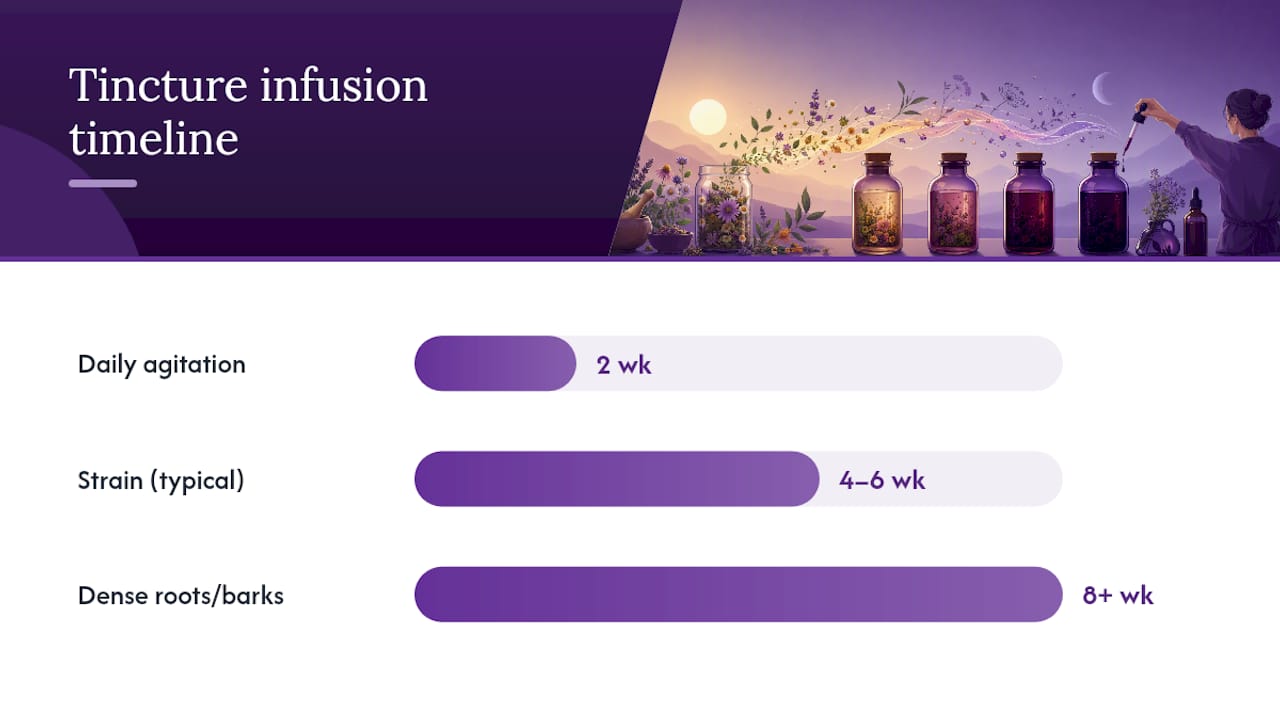
- Store in a cool, dark spot and shake daily for the first two weeks
- Strain after four to six weeks; dense roots and barks may need eight weeks or longer
Regular agitation matters more than most home herbalists realize, particularly for dense root material where compounds are slower to migrate into the menstruum. A jar left untouched on a shelf extracts unevenly compared to one shaken daily.
Pro Tip: Keep a small notebook or label taped to each jar with the start date, herb, and alcohol percentage. Six weeks from now, you won’t remember which jar is which.
One practical note: very high-proof grain alcohol (190 proof or higher) is restricted or unavailable in some states, so check local availability before planning a recipe around it.
Can You Remove or Reduce Alcohol Before Taking a Tincture?
You can meaningfully reduce the alcohol taste and sensation in a dose, though complete removal at home isn’t realistic. The most common method is dilution: stir your dropperful into a small cup of hot water or tea and let it sit for a minute or two. Some of the alcohol evaporates off, and the volume dilutes what remains, which works well for people who are alcohol-sensitive but not strictly avoiding it.
A few points worth knowing before you rely on this method:
- Hot water dilution reduces alcohol content somewhat but does not eliminate it
- Boiling or simmering evaporates more alcohol but also degrades some heat-sensitive constituents
- If you need alcohol-free with zero exceptions (pregnancy, recovery, certain medications), switch to a glycerite instead of trying to dilute your way there
Glycerites and Vinegar Tinctures: What You Gain and Lose
Glycerin and vinegar both work as alternative menstruums, and each comes with real trade-offs compared to alcohol. Glycerites use vegetable glycerin instead of ethanol, producing a noticeably sweeter tincture that’s easier to give to children or anyone avoiding alcohol altogether. The catch is that glycerin is a weaker solvent overall. It doesn’t extract resins or alkaloids nearly as well, and glycerites carry a shorter shelf life, typically one to two years compared to several years for alcohol-based extracts, according to Verywell Health’s overview of tincture composition.
Vinegar-based extracts (and oxymels, which blend vinegar with honey) rely on acidity rather than alcohol to pull constituents and preserve the mixture. They’re well suited to minerals and certain water-soluble compounds but fall short on resins and volatile oils.
- Choose glycerin for pediatric use, alcohol avoidance, or a milder-tasting daily tonic
- Choose vinegar or an oxymel for mineral-rich herbs, immune-support blends, or a food-based approach
- Choose alcohol when you need maximum constituent range and multi-year shelf stability
Pro Tip: If a recipe calls for alcohol but your household needs an alcohol-free option, don’t assume a 1:1 glycerin swap. Glycerites often need a longer maceration time to compensate for the weaker extraction.
How Long Do Tinctures Last, and How Should You Store Them?
Solvent choice drives shelf life more than almost any other factor. Alcohol-based tinctures at 40% or higher routinely last several years when stored properly. Glycerites last roughly one to two years, and vinegar extracts fall somewhere in between, per Verywell Health. Heat, light, and air exposure all shorten useful life regardless of solvent.
- Store in amber or cobalt glass to block UV light
- Keep in a cool, dark cabinet rather than near a stove or window
- Use tight-fitting lids to limit oxidation and evaporation
- Watch for cloudiness, mold, or an off smell as spoilage signs
Label every batch with the herb name, alcohol percentage, menstruum type, and date of both start and straining. That single habit prevents more confusion than any storage upgrade.
What Does the Research Say About Alcohol in Tinctures?
Pharmacopoeia-style references define tinctures as hydroalcoholic solutions prepared from botanical material, typically at herb:menstruum ratios like 1:5 or 1:10 in professional and clinical formulations, according to ScienceDirect’s pharmacology entry. That standardization exists for a reason: consistent ratios make dosing predictable across batches and manufacturers.
The safety picture is more nuanced than a simple “alcohol is fine” or “alcohol is dangerous” binary. The same animal study on phytotherapic tincture exposure that flagged liver and biochemical changes after repeated dosing didn’t find those effects after a single or occasional dose. Context and cumulative exposure matter more than the mere presence of alcohol.
Repeated dosing with an alcohol-containing tincture over ten to thirty days produced measurable changes in lipid and kidney markers alongside liver tissue changes in rats, a finding that argues for dose-awareness rather than treating tinctures as risk-free simply because they’re “herbal.”
For clinicians, that means asking about tincture use the same way you’d ask about any alcohol intake. For home users, it means respecting the dose on the label rather than assuming more drops mean faster results.
How Kejiwastore Approaches Alcohol in Spagyric Tinctures
Kejiwastore formulates its spagyric tinctures in small batches, selecting alcohol percentage based on the specific botanical and the constituents each formula is built to preserve, not a one-size-fits-all default. That percentage is documented directly on the product label, so you know exactly what you’re taking before you open the bottle. Every collection page carries dosage guidance, and Kejiwastore’s team is reachable for anyone with questions about sensitivity, sourcing, or how a given blend was prepared.
Ready-Made Spagyric Tinctures Without the Guesswork
If measuring ethanol percentages and tracking maceration dates isn’t how you want to spend your evenings, Kejiwastore’s Spagyric Herbal Tinctures collection offers small-batch formulas with the alcohol content clearly labeled on every bottle.
Each tincture in the collection is formulated with intention, pairing wild-harvested botanicals with an alcohol percentage chosen for that specific plant’s chemistry rather than a generic default. If you’re sensitive to alcohol, start by checking the percentage listed on the product page and choosing a lower-proof formula, or pair your tincture with hot water dilution as described earlier in this guide. If you’re drawn to a specific effect, whether grounding, clarity, or emotional release, browse by intention rather than by ingredient alone, since Kejiwastore’s spagyric process is built around energetic and botanical alignment together. For a deeper look at how these preparations are made and used in practice, the somatic guide to alchemy tinctures walks through real application. When you’re ready to try one, browse the current tincture collection and pick a formula that matches what you’re working toward.
Why the “Alcohol-Free Is Always Better” Assumption Falls Short
The wellness world has developed a reflexive suspicion of alcohol in anything labeled “natural,” and that instinct, while understandable, misses the actual chemistry. Alcohol isn’t a compromise ingredient tolerated for lack of a better option. It’s the reason a tincture can extract resins, alkaloids, and volatile oils that glycerin simply cannot touch, and the reason a properly made extract survives on a shelf for years instead of months. Treating every alcohol-based product as inherently riskier than its glycerite counterpart ignores that glycerites carry their own trade-off: weaker extraction and a shorter useful life.
The more useful question isn’t “alcohol or no alcohol.” It’s “does this specific herb, this specific person, and this specific health situation call for alcohol, and if so, how much?” A resin-heavy formula for an adult with no liver concerns and no medication interactions is a very different calculation than a calming blend meant for a child. Kejiwastore’s practice of listing alcohol percentage on every label exists precisely because that decision belongs to the person taking the tincture, not to a blanket rule about what sounds cleaner on a package.
— Kejiwa
Sources
For deeper detail on preparation ratios and shelf-stability comparisons, American College of Healthcare Sciences covers home preparation methods and legal notes on high-proof alcohol. ScienceDirect’s pharmacology overview explains pharmacopoeia-style ratio standards. The animal study on tincture alcohol exposure supports the dose-awareness points in the safety section, and Verywell Health contrasts alcohol tinctures with glycerin and vinegar alternatives.
This article is general information, not a substitute for advice from a qualified doctor. Consult a qualified healthcare professional about your own circumstances before acting on anything here.
- Herbal Medicine: How to Make Tinctures | American College of Healthcare Sciences
- Study reporting biochemical and histological effects in rats treated with phytotherapic tincture and alcohol (PMC)
- Tincture - an overview | ScienceDirect Topics
- Tincture Uses, Composition, and Health Benefits | Verywell Health