


The most reliable aura cleansing methods are white-light visualization, breathwork, salt baths or showers, and sound or smoke practices. Pick a quick two to five minute reset (visualization or breath) when you’re mid-day and depleted. Save a twenty to thirty minute deep cleanse (salt bath, smudging, singing bowl) for after high-exposure events or once a week for maintenance. Practical how-to steps for each follow below.
TL;DR:
- Visualizations and breathwork are quick, silent methods suitable for crowded or shared spaces, taking just a few minutes to reset energy.
- Salt baths and smudging offer deeper cleansing but require more time, ventilation, and ethical sourcing considerations, especially for smudging herbs.
- Sound healing and crystal clearing are external practices that can loosen stuck energy and require minimal time, often just a few minutes per session.
- Consistent daily micro-cleansing routines with simple tools outperform infrequent intense rituals, and layered methods deepen long-term effects.
- There is no scientific proof of an aura field, but relaxing practices like slow breathing, salt water, and mindfulness have measurable stress-reduction benefits.
Table of Contents
- Which quick aura cleansing techniques should you start with?
- What does a white-light visualization script actually look like?
- How do you smudge your aura safely and respectfully?
- Do salt baths really clear your energy field?
- Can sound healing clear stuck energy around your body?
- What breathing patterns clear your aura fastest?
- How do you aura-comb with selenite or clear quartz?
- Can standing outside for ten minutes really reset your energy?
- What’s a simple daily aura maintenance routine?
- How often should you cleanse your aura?
- How does Kejiwa Alchemy support safe, sourced aura rituals?
- Who should be cautious with aura cleansing practices?
- Should you combine several aura cleansing methods at once?
- How do you protect your energy after cleansing?
- Is there scientific evidence behind aura cleansing?
- Where do these cleansing traditions actually come from?
- Why consistency beats intensity in energy work
- Practical tools for your aura cleansing routine
- Sources
Which quick aura cleansing techniques should you start with?
Your starting point depends on time, sensitivity, and where you’re standing. A crowded subway platform calls for something silent and internal; a Sunday evening at home opens the door to a full ritual.
- Visualization and breathwork: free, silent, works anywhere, takes 2 to 10 minutes.
- Salt bath or shower rinse: needs a bathroom and sea salt, best for 10 to 30 minutes.
- Smudging or smoke cleansing: needs ventilation and fire safety awareness; avoid if you or someone nearby has asthma or smoke sensitivity.
- Sound healing: needs a singing bowl, bell, or just your own voice, 3 to 7 minutes.
- Crystal clearing: needs a selenite wand or clear quartz point on hand.
If you’re traveling or in a shared space, lean toward breathwork and energy protection over anything that produces smoke or noise. Save smudging for private, well-ventilated rooms.
What does a white-light visualization script actually look like?
Sit or stand with your feet flat, eyes closed. Breathe in for four counts, out for six, four times.
- Picture a white or gold light forming above your head.
- Let it pour down slowly, scanning your body top to bottom.
- Notice any spot that feels dense, dark, or heavy, and let the light linger there.
- Once it reaches your feet, imagine it sealing into a smooth shell around your whole body.
Beginners can shorten this to three minutes; advanced practitioners often extend it to ten, adding a second pass focused purely on repair.
Pro Tip: Picture the light having texture, not just color. A “thick honey” light tends to feel more repairing than a thin beam for people newer to visualization.
How do you smudge your aura safely and respectfully?
Light your chosen herb bundle, let it smolder, and fan the smoke from your feet upward, circling your head last. Smudging works by moving smoke through dense, stagnant energy rather than burning it away directly.
- White sage faces sourcing and overharvesting concerns, so consider palo santo, rosemary, or frankincense resin as respectful alternatives.
- Buy from suppliers who disclose ethical sourcing, not just “wild-harvested” as a marketing label.
- Keep pets and small children out of the room, crack a window, and extinguish the bundle fully in sand or a fireproof dish, never in an open trash bin.
One frequently cited smoke-cleansing insight is that the practice deserves a cultural-respect step: acknowledging the lineage a technique comes from before treating it as a generic wellness hack.
Do salt baths really clear your energy field?
Practitioner guidance recommends 1 to 2 cups of sea salt or Dead Sea salt for a 20 to 30 minute soak.
- Add the salt as the tub fills, plus a few drops of lavender or rosemary oil if you like.
- Soak and visualize gray or murky water pulling away from your skin.
- As you drain the tub, picture whatever you released swirling down with it.
Short on time or without a tub? A salt scrub in the shower, rubbed briefly over arms and torso before rinsing, gives a faster version of the same effect. Skip salt soaks entirely if you have open wounds, eczema flare-ups, or very sensitive skin.
Can sound healing clear stuck energy around your body?
Vibration loosens what stillness can’t. Singing bowls, bells, and even your own voice are commonly used to move stuck energy through the field rather than just around your ears.
- Strike a bowl or bell near your crown, then slowly walk the sound down and around your body.
- Chant a single low tone for 30 seconds, pause, repeat three times if you have no instrument at all.
- Run this whole sequence in 3 to 7 minutes for a quick reset.
- Pair it with slow breathing for a stronger combined effect.
- Book a guided sound bath session when you want a longer, fully immersive version.
What breathing patterns clear your aura fastest?
Breath is the most direct bridge between your body and whatever you’d call your energy field. Even a short pattern produces a noticeable calming shift within a couple of minutes.
- Quick reset one: inhale four counts, hold four, exhale six, repeat six times.
- Quick reset two: three sharp exhales through the nose, then one long slow exhale through the mouth.
- Deeper sequence: alternate nostril breathing for 10 to 15 minutes, switching nostrils every four breaths.
Stop immediately if you feel dizzy or lightheaded, and shorten any pattern that leaves you breathless rather than calm.
Pro Tip: Do the quick reset before a hard conversation, not after. Clearing your field beforehand keeps you from absorbing tension you didn’t create.
How do you aura-comb with selenite or clear quartz?
Hold a selenite wand or clear quartz point a few inches from your skin and sweep it slowly from head to feet, as though combing through static in the air. Crystal-clearing guidance treats selenite as effectively self-cleansing, which makes it a low-maintenance starting stone.
- Selenite and clear quartz: general clearing and amplification.
- Black tourmaline and smoky quartz: grounding and protection rather than clearing.
- Recharge crystals under moonlight or with sound after heavy use, and cleanse them properly between sessions rather than assuming they reset themselves.
Can standing outside for ten minutes really reset your energy?
Grounding works because it’s simple, not despite it. Standing barefoot on grass, leaning against a tree trunk, or taking a ten minute walk outside gives your nervous system, and by extension your energy field, somewhere to discharge.
- No grass nearby? Press both palms flat against a windowsill or wall and breathe slowly for two minutes.
- Running water works as a faster grounding option: rinse your hands under cold tap water while picturing tension draining away.
- Ocean or lake swims are best reserved for when you have more time, since the effect tends to build the longer you stay in.
What’s a simple daily aura maintenance routine?
Consistency beats intensity, especially when you adopt gezonder leven routines that help natural wellness stick with practical daily habits. Daily micro-cleansing sessions of 5 to 15 minutes tend to outperform occasional dramatic rituals, because they keep stagnant energy from building up in the first place.
- Morning (5 minutes): three rounds of four count breathing, then a 30 second white-light scan from head to toe.
- Midday emergency reset (2 minutes): one sharp exhale sequence plus a mental image of your field sealing shut, usable at a desk or in a car.
- Evening (3 to 5 minutes): a grounding cue, hands pressed to the floor or a wall, paired with one slow breath cycle before bed.
Short on time? Drop to just the breath pattern. Have more time and privacy? Add a salt shower or five minutes with a singing bowl on top of the base routine.
How often should you cleanse your aura?
Daily micro-cleanses handle routine wear; weekly deeper sessions handle everything else. Maintenance guidance generally recommends short daily practice with a more involved ritual, a salt bath or full smudging session, once a week.
- Add extra sessions after crowded events, hospital visits, arguments, or any day that leaves you unusually drained.
- Watch for heaviness, persistent fatigue that sleep doesn’t fix, irritability with no clear cause, or a sense of carrying someone else’s mood.
- If these signs persist for more than two weeks despite consistent home practice, that’s a signal to seek out a trained energy practitioner rather than pushing harder solo.
How does Kejiwa Alchemy support safe, sourced aura rituals?
The store’s aromatic and smudging lines include botanicals described as organic and wild-harvested, with an emphasis on transparency about origin rather than relying solely on a “wild-harvested” label.
- Confirm any smudging herb’s harvest region and growing practice before buying, especially for sage varieties facing overharvesting pressure.
- Treat cultural-respect guidance as a starting point, not an afterthought, particularly with herbs tied to Indigenous traditions.
- Botanical aromatic mists suit the quick, 2 to 5 minute resets described above.
- Ritual bath blends pair naturally with the salt bath protocol.
- Smudging herb bundles support the smoke-cleansing steps, when sourced and used respectfully.
Who should be cautious with aura cleansing practices?
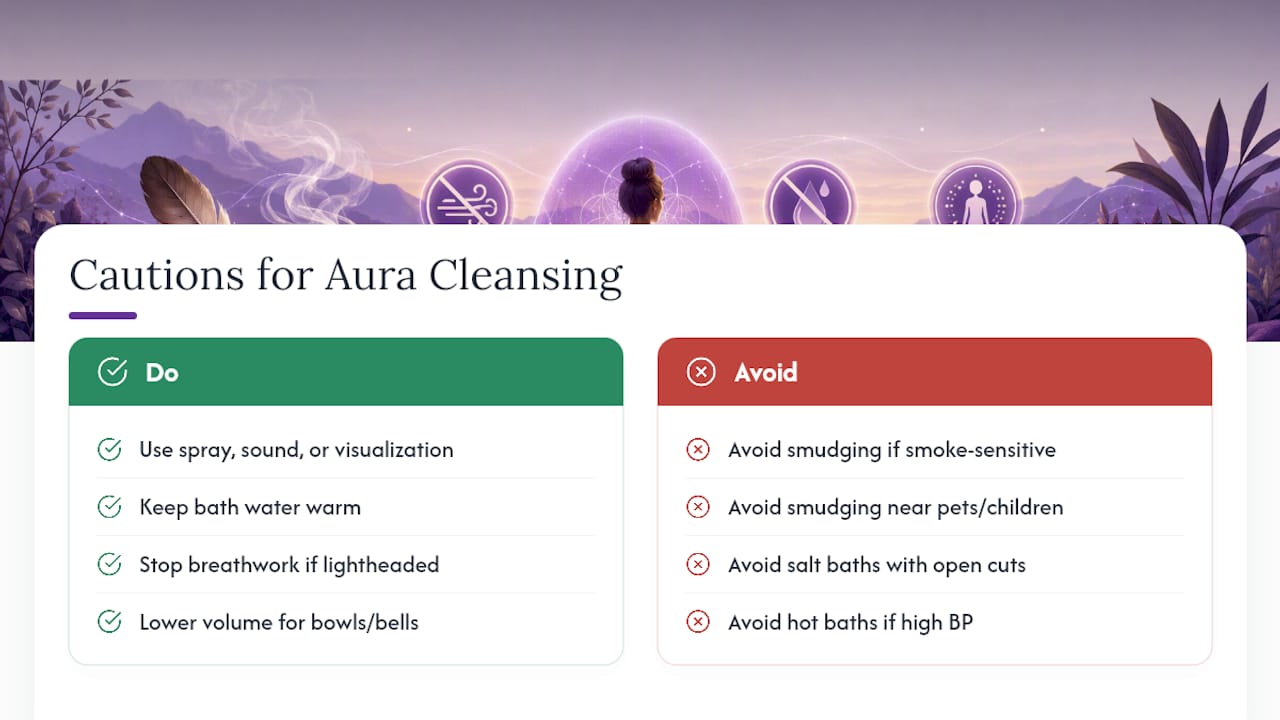
Most of these methods carry low physical risk, but a few deserve real caution. Smoke-based cleansing is the clearest case: anyone with asthma, COPD, or general smoke sensitivity should skip smudging entirely and reach for a spray mist, sound, or visualization instead. The same caution applies to pets and small children in the room, since their lungs are more reactive than an adult’s.
Salt baths carry their own limits. Skip them if you have open cuts, active eczema, psoriasis flares, or very high blood pressure, since hot water soaks can affect circulation regardless of the salt. Pregnant readers should keep bath water warm rather than hot and check with a doctor before starting any new intensive routine, the same caution that applies to any new physical practice during pregnancy.
Breathwork needs its own guardrail. Rapid or held-breath patterns can trigger dizziness, tingling, or panic in people with anxiety disorders, epilepsy, or cardiovascular conditions. Stop any breath exercise immediately if you feel lightheaded, and never practice intensive pranayama while driving or standing near stairs.
Sound healing is gentle for most people, but very loud or sustained tones can aggravate migraines or tinnitus. Keep bowls and bells at a moderate volume if you have either condition.
Finally, treat every method here as a wellness and self-care practice, not a substitute for medical or mental health treatment. Fatigue, persistent heaviness, or mood changes that don’t lift with rest and routine cleansing deserve a conversation with a doctor or therapist, not just another ritual.
Should you combine several aura cleansing methods at once?
Layering methods often works better than repeating one technique on a loop. Combining two or three complementary practices, visualization paired with breathwork, or a salt bath followed by selenite combing, tends to produce deeper and longer-lasting results than any single method used alone.
The logic makes sense once you break it down. Breathwork moves energy internally; a salt bath draws it out through water; sound and smoke both work externally on the field around you. Stacking an internal method with an external one covers more ground than doubling down on either alone.
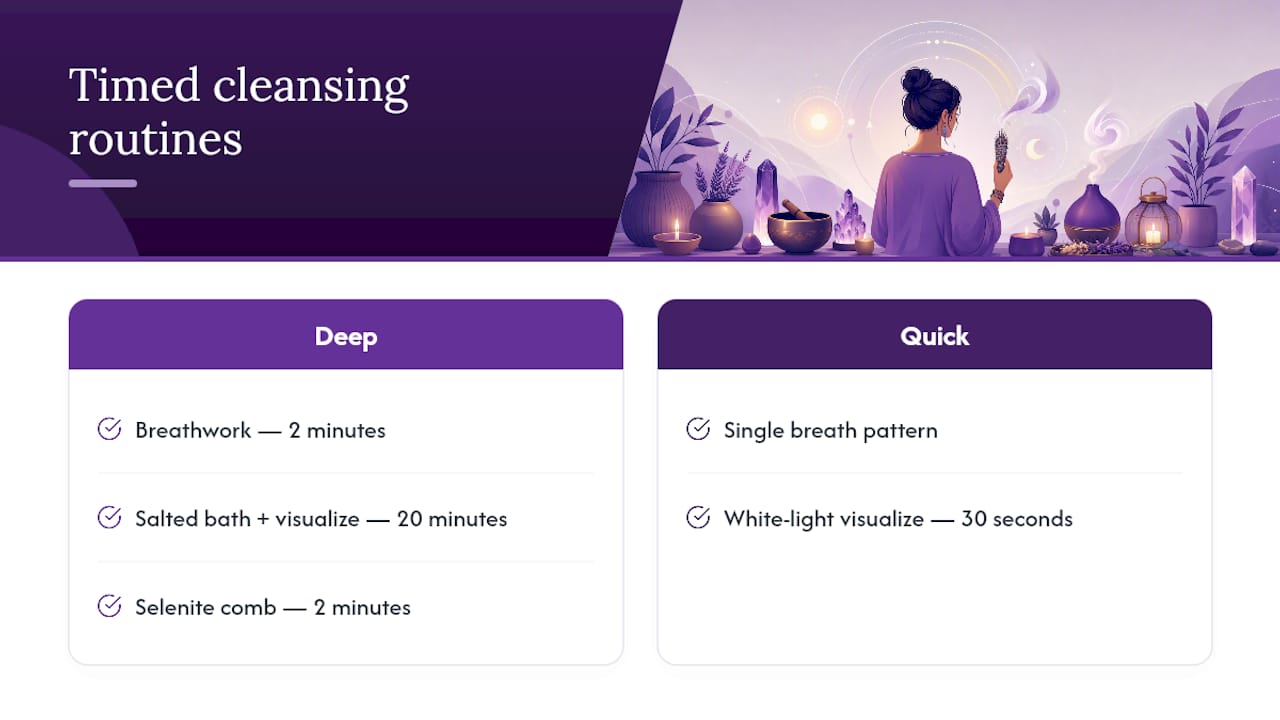
A practical stacking order for a deep session: breathe for two minutes to settle your nervous system, soak in a salted bath for twenty minutes while visualizing release, then finish with a two minute selenite comb once you’re dry. For a quick version, pair a single breath pattern with thirty seconds of white-light visualization, no bath or crystal required.
Avoid stacking too many smoke or sound elements in one sitting, since sensory overload can undercut the calm you’re trying to build. Two or three well-chosen methods beat five rushed ones, and a routine you’ll actually repeat beats an elaborate one you abandon after a week.
How do you protect your energy after cleansing?
Cleansing clears the field; protection keeps it clear. Skipping this step is why some people feel their reset “doesn’t last,” when really nothing sealed the field back up after the release.
The simplest protective step is the sealing visualization already built into the white-light script: picturing the light forming a smooth shell around your body as it finishes its pass. You can repeat this alone, without a full cleanse, any time you’re heading into a draining environment, crowded events, hospitals, difficult family visits.
Grounding stones like black tourmaline or smoky quartz work well as daily protection when carried in a pocket or worn as jewelry, distinct from selenite’s clearing role. A short breath pattern before entering a stressful space, the same four count inhale and six count exhale used for quick resets, gives your nervous system a buffer before you even walk in.
For ongoing sensitivity, a more structured energy-protection routine built around consistent grounding and boundary visualization tends to hold up better than protection you only remember to do occasionally.
Is there scientific evidence behind aura cleansing?
No controlled clinical research confirms that a measurable energy field called an “aura” exists or that these practices clear it in any physically verifiable way. The concept itself is documented mainly in paranormal and cultural literature) rather than peer-reviewed physics or medicine.
That doesn’t mean these practices do nothing. Breathwork’s calming effect on the nervous system is well established outside spiritual contexts, slow, controlled breathing measurably lowers heart rate and activates the parasympathetic system. Grounding practices like standing barefoot outside overlap heavily with basic mindfulness and nature-exposure research, both linked to stress reduction regardless of any energetic framework attached to them.
Skeptics reasonably point out that the felt results of a salt bath or a sound session may come from relaxation, ritual, and expectation rather than any literal field being cleaned. That’s a fair distinction to hold alongside the practice itself. Whether you frame these techniques through the language of energy or through the language of stress physiology, the actual actions, slow breath, warm salted water, quiet focused attention, produce a real, felt shift for most people who try them consistently.
Where do these cleansing traditions actually come from?
Every method covered here has roots that predate modern wellness culture by centuries, sometimes millennia. Smudging with sage, cedar, and other sacred plants traces to Indigenous traditions across the Americas, where smoke carried specific cultural and ceremonial meaning long before it became a shelf item in wellness shops.
Salt has carried a purifying reputation across an unusually wide range of cultures, from ritual baths in ancient Rome to salt-scattering practices in Japanese Shinto tradition. Sound healing similarly spans continents: Tibetan singing bowls, West African drumming, and Gregorian chant all use vibration and rhythm toward a shared goal of shifting mental and emotional states.
Breathwork’s clearest lineage runs through pranayama, a formal branch of yogic practice systematized in Indian texts thousands of years ago, long before “breathwork” became a standalone wellness term. Crystal use for healing and protection shows up across ancient Egyptian, Chinese, and Mesoamerican records, each culture assigning its own meanings to specific stones.
The idea of an “aura” itself, a visible or sensed energy field around a living being, appears across multiple spiritual and philosophical traditions, from Hindu and Buddhist concepts of subtle bodies to Western esoteric movements of the nineteenth century. Modern aura cleansing borrows from all of these lineages at once, which is exactly why the cultural-respect guidance around smudging matters: these aren’t interchangeable techniques invented yesterday, but practices carrying real histories worth acknowledging.
Why consistency beats intensity in energy work
I’ve come to trust the small, boring practice over the elaborate one. A four count breath at a red light does more for most people over a month than one dramatic ritual they only do twice. My own habit is nothing fancy: thirty seconds of visualization while the coffee brews. Build your own version around whatever moment already exists in your day, and let it be small enough that you’ll actually keep doing it.
— Kejiwa
Practical tools for your aura cleansing routine
A salt bath needs sea salt from your kitchen cabinet. A smudging session needs a bundle and a fireproof dish. But a few well-chosen tools make the daily micro-cleanses covered above easier to actually stick with, especially on days when a full bath or bundle isn’t realistic.
Kejiwastore’s botanical aromatic mists work well for the two to five minute resets: a few spritzes around your body doubles as a portable stand-in for smoke cleansing when ventilation or smoke sensitivity rules that out. Ritual bath blends pair with the weekly salt soak, and the spagyric tinctures support the grounding and nervous-system side of a regular practice. If you’re building a routine from scratch, start with one product that matches whichever method from this guide you’re most drawn to, and browse the full aromatics collection to find your starting point.
Sources
- How to Cleanse Your Aura: 7 Simple Energy Clearing Methods
- How to Cleanse Your Aura: A Practitioner’s Real Guide
- How to Cleanse Your Aura
- Aura Cleansing: Complete Guide to Clear Your Energy