


“White powder gold” is the informal name most sellers and spiritual communities use for ORMUS (also written Ormus) or monatomic gold, a category of products described as a fine white or off-white powder produced by chemically processing gold or mineral salts. The short verdict: no clinical human trials support the wellness and consciousness claims made for these products, and independent chemistry experts say the core “monatomic” premise is not chemically plausible under normal conditions. That said, three genuinely distinct materials travel under this label, and understanding which one you are looking at changes everything about how you evaluate it.
The three categories covered here are: ORMUS/monatomic gold products (the most common wellness use), colloidal or nanoparticle gold, and traditional metallic gold powders used in art and gilding. Each has a different chemistry, a different history, and a very different relationship to safety.
Key Takeaways
White powder gold is an informal label covering at least three chemically distinct materials, and no clinical human trials support the wellness or consciousness claims made for ORMUS-style products.
| Point | Details |
|---|---|
| Three distinct materials | “White powder gold” refers to ORMUS/monatomic products, colloidal gold, or traditional art gold powders — each with different chemistry and uses. |
| No clinical evidence | No peer-reviewed human trials support brain-boost, anti-aging, or consciousness claims for ORMUS or monatomic gold products. |
| Chemistry experts are skeptical | Independent fact-checkers confirm stable monatomic gold is not chemically plausible; most products likely contain ionic salts or mineral precipitates. |
| COA is non-negotiable | Always request an ICP-MS-based Certificate of Analysis from an accredited third-party lab before purchasing any white powder gold supplement. |
| Kejiwastore’s approach | Kejiwa offers small-batch Ormus minerals with COA documentation and transparent, modest claims — a responsible starting point for wellness seekers. |
Table of Contents
- What is white powder gold, really? The three materials behind the name
- How vendors say ORMUS is made, and what chemistry actually shows
- What vendors claim these products do, and what the science says
- Safety risks and how the FDA regulates these products in the United States
- How to evaluate a white powder gold product before you buy
- How traditional gold powders differ from ORMUS-style products
- Kejiwa’s perspective on white powder gold and responsible guidance
- Kejiwa’s Ormus minerals: small-batch, tested, and transparently made
- Sources
What is white powder gold, really? The three materials behind the name
People use “white powder gold” to mean at least three different things, and conflating them leads to real confusion on product pages and in community forums.
ORMUS / monatomic gold (“m-state” gold). Vendors describe this as a nonmetallic, white or off-white powder produced by shifting the pH of salt solutions or by dissolving metallic gold and re-precipitating it through proprietary chemical steps. Sellers claim the resulting material exists in a unique quantum state, is non-conductive, and carries energetic or consciousness-expanding properties. Community and vendor sources describe it as the basis for meditation support, mental clarity, and spiritual practice. You can read a representative vendor framing at this community overview. Kejiwa’s own practitioner content draws a clear line between Ormus-style products and colloidal gold, explaining practical differences and spiritual uses for readers who want a grounded comparison.
Colloidal or nanoparticle gold. This is metallic gold dispersed as nanoscale particles in a liquid. It is physically and chemically distinct from ORMUS claims. True colloidal gold appears red or purple in solution because of the surface plasmon resonance of gold nanoparticles, a measurable optical effect. It is detectable by spectroscopy and particle-size analysis, which means its composition can actually be verified in a lab.
Traditional metallic gold powder (kindei / shell gold / gilding powder). This is finely ground metallic gold used by artists and gilders for centuries. Gold powder in the art-conservation record is described as a colorant prepared by grinding gold with binders or through electrolytic methods. It is not a supplement. It is not white. Its intended use is decorative, and its production history has nothing to do with wellness claims.
The table below shows how these three materials compare across the dimensions that matter most when you are evaluating a product.
| Feature | ORMUS / Monatomic gold | Colloidal gold | Traditional gold powder (kindei/shell gold) |
|---|---|---|---|
| Appearance | White or off-white powder | Red/purple liquid | Metallic gold powder |
| Basic chemistry | Claimed: unique quantum state. Actual: likely ionic salts or mineral precipitates | Gold nanoparticles in suspension | Finely ground metallic gold (Au) |
| Lab detectability | Not confirmed by standard assays; no reproducible ICP-MS signature for “monatomic” state | Detectable by UV-Vis spectroscopy, TEM, ICP-MS | Detectable by XRF, ICP-MS, SEM |
| Primary use | Wellness supplement, meditation, spiritual practice | Wellness supplement, cosmetics | Art, gilding, decorative pigment |
How vendors say ORMUS is made, and what chemistry actually shows
The most common production method described involves dissolving sea salt or Dead Sea salt in water, raising the pH with lye (sodium hydroxide) to around 10.78, and collecting the white precipitate that forms. Vendors claim this precipitate contains m-state gold and other monatomic elements extracted from the salt. A second approach starts from metallic gold dissolved in acid (aqua regia) and then re-precipitated through pH manipulation, with sellers claiming this converts the gold into a nonmetallic monatomic form.
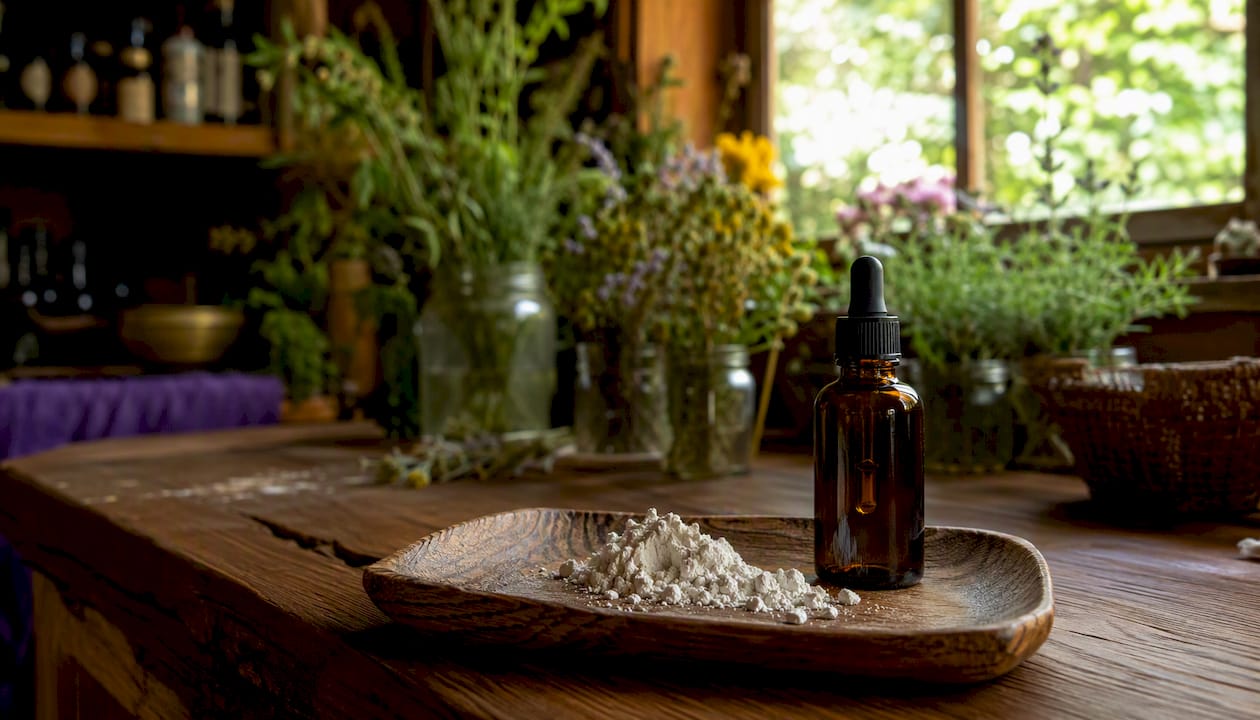
What those steps actually produce, chemically, is more mundane. Raising the pH of a salt solution precipitates magnesium hydroxide and calcium carbonate, both of which are white powders. These are ordinary mineral compounds, not exotic quantum-state materials. When metallic gold is dissolved in aqua regia and re-precipitated, the result is ionic gold salts or gold colloids, not a stable monatomic element. Chemists point out that a single gold atom in a stable, isolable form under normal temperature and pressure is not a chemically recognized state for gold.
Vendor processes also vary widely from batch to batch. Without standardized production protocols, the chemistry of what ends up in the jar is genuinely inconsistent. That inconsistency is not a minor detail; it means two products sold under the same label may contain entirely different compounds.
Pro Tip: Before purchasing any ORMUS or white powder gold product, ask the vendor for an ICP-MS (inductively coupled plasma mass spectrometry) report, a particle-size analysis if nanoparticles are claimed, and a Certificate of Analysis (COA) from an accredited third-party lab. If the vendor cannot provide these, treat the product’s composition as unverified.
What vendors claim these products do, and what the science says
The wellness and spiritual claims attached to white powder gold products are wide-ranging. Common ones include:
- Enhanced brain function, memory, and mental clarity
- Heightened states of consciousness and deeper meditation
- Immune system support and anti-aging effects
- Improved cellular coherence and biofield regulation
- Increased energetic conductivity or “superconductivity” in the body
Kejiwa’s own content documents reported physical benefits from Ormus minerals while being transparent that these reports are largely anecdotal and not equivalent to clinically validated evidence. That honesty matters, because the gap between community experience and clinical proof is significant.
The scientific critique operates on two levels. First, the chemistry: independent fact-checkers and chemistry experts at AAP have concluded that stable monatomic gold is not chemically plausible under normal conditions, and that many products marketed as monatomic gold likely contain ionic salts, colloids, or non-gold mineral precipitates rather than the claimed material. Second, the evidence base: no peer-reviewed clinical trials in humans have tested ORMUS or monatomic gold for any of the health or consciousness effects claimed. The absence of trials is not a technicality. It means there is no controlled data on efficacy, optimal dosing, or long-term safety.
Anecdotal reports from practitioners are real experiences worth acknowledging. They are not, however, a substitute for clinical evidence, and no responsible vendor should present them as such.
Safety risks and how the FDA regulates these products in the United States
The U.S. regulatory picture for white powder gold products is genuinely complicated, and that complexity creates real risk for buyers.
Contamination hazards. Wet-chemistry production methods, especially those using artisanal or home-lab setups, carry contamination risks. Mercury traces can persist if gold was processed using amalgamation methods. Heavy metals including lead, arsenic, and cadmium can co-precipitate with mineral salts depending on source water quality. Microbial contamination is a concern in any wet preparation that is not produced under controlled conditions.
FDA regulatory posture. In the United States, products sold as dietary supplements are governed by the Dietary Supplement Health and Education Act (DSHEA). Under DSHEA, manufacturers do not need FDA approval before selling a supplement, but they cannot legally make disease treatment or cure claims. When a product’s marketing crosses into claiming it treats, cures, or prevents a specific disease, the FDA can intervene. Products making drug-level claims without approval are subject to enforcement action. The FDA does not, however, pre-screen supplement ingredients for safety or efficacy the way it does for pharmaceutical drugs, which means a product can reach the market without any independent safety review.
Practical safety steps for U.S. buyers:
- Request a COA from an accredited third-party lab before purchasing.
- Look for ICP-MS results confirming heavy-metal levels fall within safe limits.
- Avoid any product whose marketing makes specific disease treatment claims.
- Pregnant people, nursing parents, children, and anyone with kidney or liver conditions should avoid experimental mineral supplements without medical supervision.
- Start with the lowest suggested amount and monitor your response before increasing.
The lack of clinical trial data means dosing guidance from vendors is not evidence-based. Treat any suggested serving size as a starting point for caution, not a validated therapeutic dose.
How to evaluate a white powder gold product before you buy
If you decide to explore these products, the quality of a vendor’s documentation tells you more than their marketing copy ever will.
What a valid COA should contain:
- The name and accreditation number of the testing laboratory
- The lot or batch number of the specific product tested
- Detection limits for each element tested (not just “pass/fail”)
- Results for heavy metals: lead, arsenic, mercury, cadmium at minimum
- Date of testing
Red flags that should stop you:
- No COA available, or a COA from an in-house lab rather than an accredited third party
- Vague “energetic” or “frequency” language used instead of compositional data
- Claims of a “proprietary process” with no chemical description whatsoever
- Inconsistent batch descriptions or no lot numbers on packaging
- Marketing that promises specific health outcomes without citing any evidence
Pro Tip: When you receive an ICP-MS report, check that the detection limits are stated in parts per billion (ppb) or parts per million (ppm) and that heavy metals are listed individually with actual measured values, not just “below limit.” A report that only says “ND” (not detected) without stating the detection limit is incomplete and cannot confirm safety.
For colloidal gold specifically, ask for spectroscopy data showing the characteristic absorption peak around 520 nm and a particle-size distribution from particle-size analysis or transmission electron microscopy (TEM). These tests confirm that gold nanoparticles are actually present and sized as claimed.
How traditional gold powders differ from ORMUS-style products
Traditional gold powders have a centuries-long history in art and craft that has nothing to do with wellness supplementation, and understanding that history helps you see how different these materials really are.
Kindei is a Japanese gold powder ground from gold leaf into particles roughly 3 micrometers in diameter, mixed with nikawa (animal-hide glue) to create a pigment used in traditional Japanese painting and lacquerwork. Artisans at Shizendo describe the process as a craft practice aimed at producing a specific visual quality in decorative art. The intent, the process, and the end use are entirely different from supplement production.
Shell gold is gold powder prepared with binders such as gum arabic or de-waxed shellac, applied with a soft bristle brush for decorative gilding. Giusto Manetti Battiloro’s gilding guide describes shell gold as a craft product for surface decoration. It is metallic gold in a form designed for adhesion to a surface, not for ingestion.
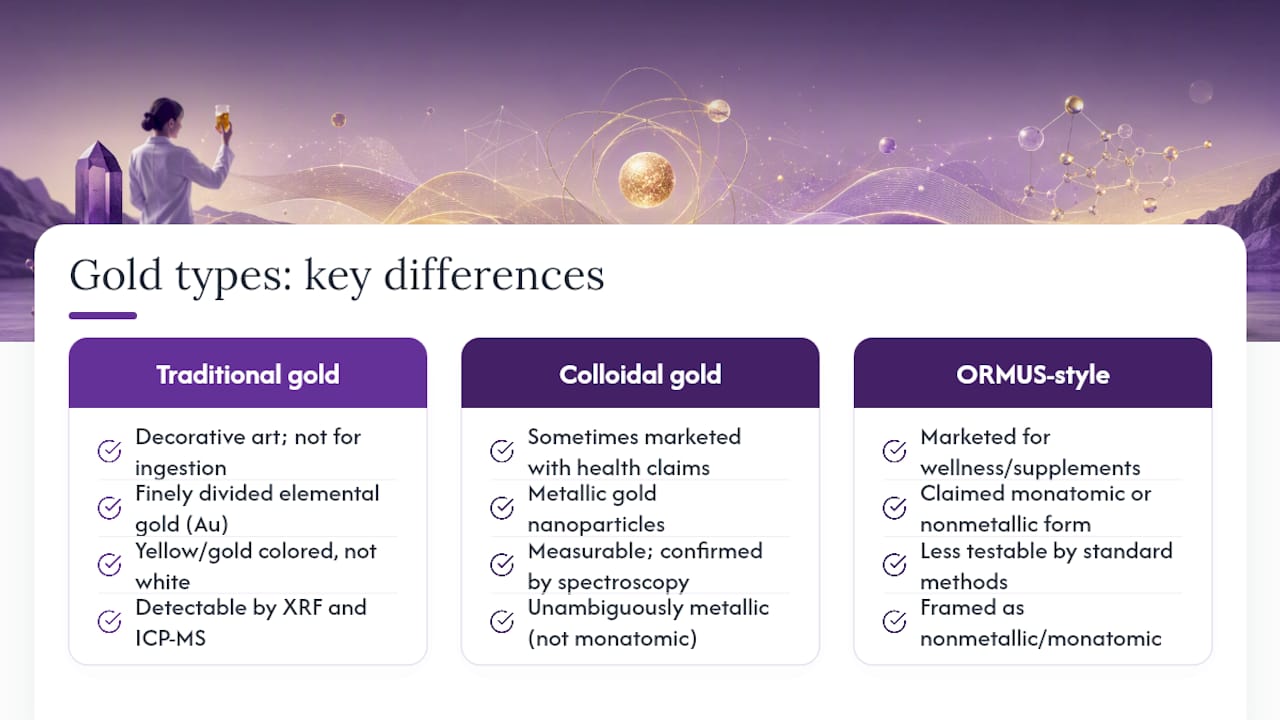
Both kindei and shell gold are metallic gold. They are yellow or gold-colored, not white. They are detectable by standard analytical methods including X-ray fluorescence (XRF) and ICP-MS. Their chemistry is straightforward: they are finely divided elemental gold (Au), and their properties are those of metallic gold at small particle sizes.
Colloidal gold sits between these craft materials and ORMUS claims in terms of testability. It is physically real, measurable, and its nanoparticle nature is confirmed by spectroscopy. What it shares with ORMUS products is a lack of clinical trial evidence for the health claims sometimes attached to it. What it does not share is the “monatomic” or “nonmetallic” framing, because colloidal gold is unambiguously metallic gold in nanoparticle form.
Kejiwa’s perspective on white powder gold and responsible guidance
The conversation around white powder gold sits at a genuinely interesting intersection: ancient alchemical tradition, modern mineral chemistry, and a wellness community hungry for tools that support energetic and spiritual practice. At Kejiwa, we hold that intersection with care.
What we sell is Ormus minerals, small-batch preparations made with intentional craftsmanship and sourced ingredients. We do not claim our products cure or treat any disease. We do not present anecdotal community reports as clinical proof. What we do believe, based on the experiences of practitioners who use our products in meditation, ceremony, and daily wellness practice, is that Ormus minerals can support a felt sense of energetic coherence, mental clarity, and nervous system settling. Those are experiential claims, not pharmaceutical ones, and we think that distinction is worth holding clearly.
We also think the chemistry conversation matters. Knowing that “monatomic gold” is not a chemically validated state does not mean the products in this category have no value. It means you should buy from vendors who are honest about what their products contain, how they are made, and what the evidence does and does not support. Batch testing, third-party COAs, and transparent sourcing are the floor, not a bonus feature.
For practitioners doing deep energetic work, the question is not whether ORMUS has passed a double-blind clinical trial. It is whether you are working with a product made honestly, tested responsibly, and offered by a company that respects your intelligence enough to tell you the truth about what it knows and what it does not.
Kejiwa’s Ormus minerals: small-batch, tested, and transparently made
Kejiwa’s Ormus mineral collection is crafted in small batches using carefully sourced ingredients and intentional production methods. Every batch is produced with attention to purity, and Kejiwa provides documentation for customers who want to understand what is in their product.
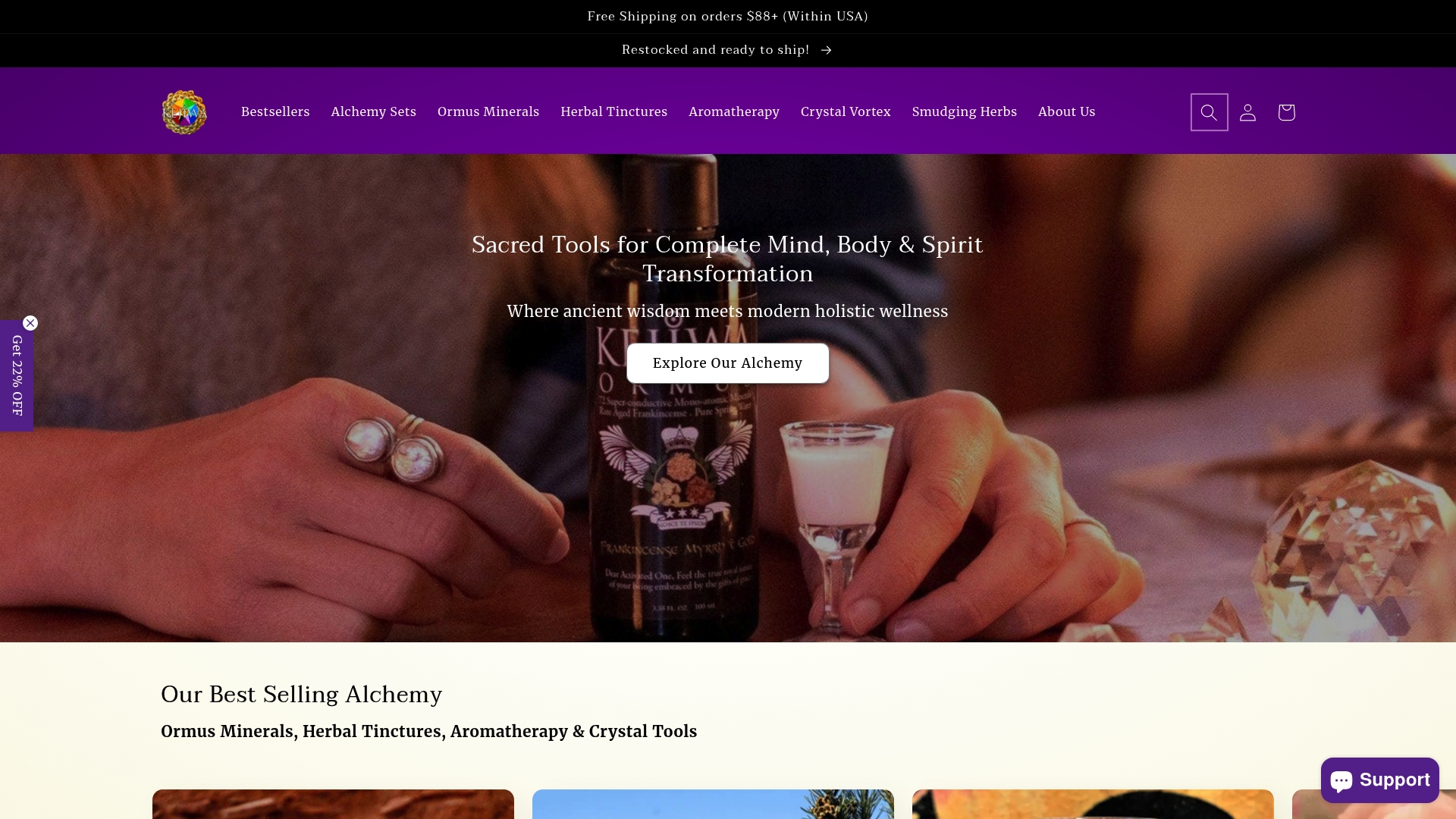
Kejiwa makes COA documentation available to customers and encourages anyone with questions about testing to reach out directly. The brand’s approach to claims is deliberately modest: Kejiwa documents reported physical and experiential benefits from its community while being clear that these are not clinical health claims. If you are a practitioner looking for an Ormus product made by people who take both the craft and the chemistry seriously, view the full Ormus collection and request product documentation before you order.
Sources
The sources below back the scientific, historical, and brand-specific claims in this article. Where a source is community or marketing material, that context is noted.
- Monatomic brain-boosting powder is fool’s gold | AAP
- Gold powder - CAMEO
- Brush gilding with gold powder | Giusto Manetti Battiloro
- All about kindei — Shizendo
- White Powder Gold: The Missing Key To Spiritual Mastery
This article is general information, not a substitute for advice from a qualified doctor. Consult a qualified healthcare professional about your own circumstances before acting on anything here.