


Crystals are defined in alchemy as active agents of transformation, not passive decorations. The role of crystals in alchemy spans both physical and metaphysical dimensions: they embody elemental forces, enable purification through crystallization, and serve as tools for shifting consciousness. This tradition reaches back to 206 BCE in China’s Western Han dynasty, where quartz and talc appeared in early alchemical preparations. Paracelsus later formalized the importance of crystals in alchemy through his tria prima framework, linking the crystalline Salt principle to physical restoration and mineral medicine. What you hold in your hand when you pick up a crystal is not folklore. It is a condensed record of elemental intelligence.
What is the role of crystals in alchemy?
Crystals function as elemental anchors in the alchemical system. They represent the intersection of matter and spirit, the point where invisible forces take physical form. Every major alchemical tradition, from Chinese Taoist alchemy to European Hermeticism, assigned specific minerals a role in the transmutation of both substances and the self.
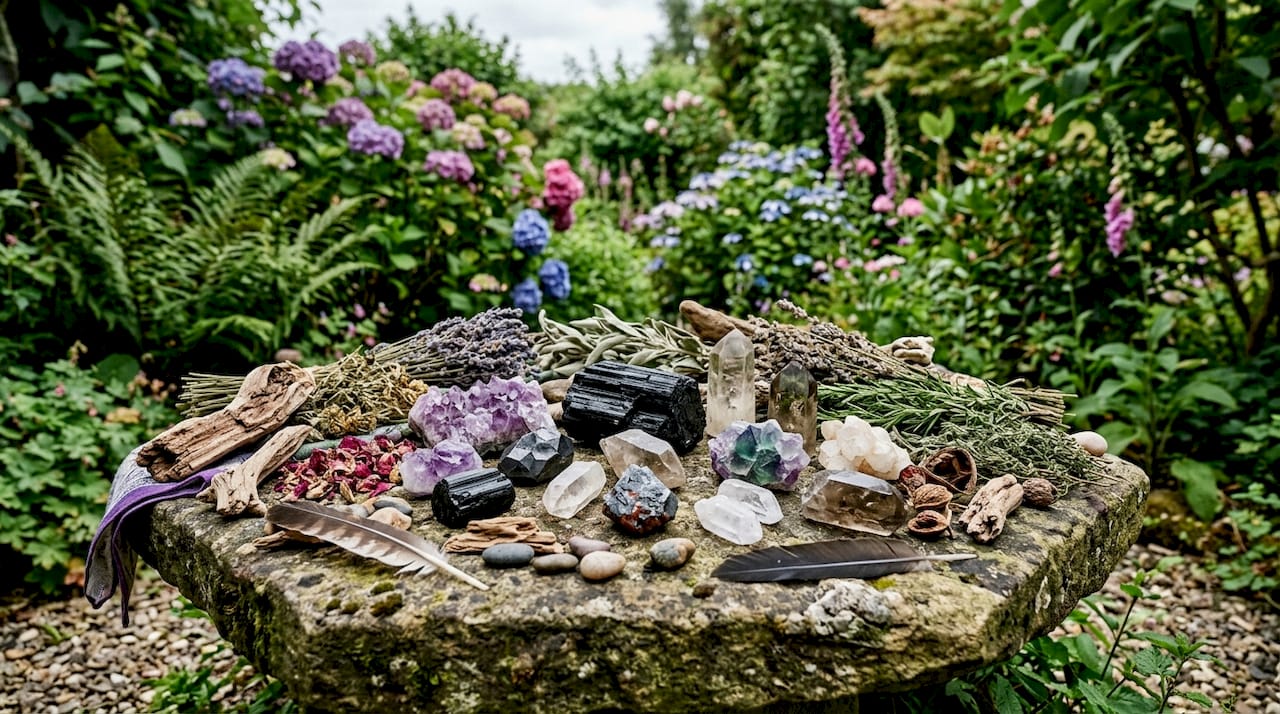
The recognized industry term for crystal-based alchemical practice is mineral alchemy, a branch of the broader Great Work. Mineral alchemy treats crystalline substances as carriers of formative power. Alchemy was the first experimental mineral science, aimed at restoring matter and the human body to their original wholeness. That framing matters because it removes crystals from the realm of superstition and places them inside a coherent, if ancient, scientific philosophy.
The alchemical properties of crystals fall into three broad categories: elemental correspondence, purification capacity, and energetic amplification. Each category has both a physical and a spiritual dimension. Understanding all three gives you a far richer picture than any single tradition offers alone.
How were crystals used in ancient and medieval alchemy?
Early mineral use across cultures
Quartz and talc were geomaterials used in alchemical and medicinal preparations as far back as 206 BCE. That date places crystal use in alchemy well before the European medieval period, which is where most Western readers assume the story begins. Chinese Taoist alchemists understood that specific mineral structures held stabilizing and transformative properties, and they incorporated them into elixirs and ritual preparations accordingly.
Medieval European alchemy expanded this mineral vocabulary considerably. Practitioners worked with:
- Cinnabar (mercury sulfide): roasted to yield liquid mercury, demonstrating real chemical transformation
- Orpiment and realgar (arsenic sulfides): used to fix mercury and enable solidification
- Stibnite (antimony sulfide): prized for its needle-like crystal structure and purifying properties
- Emeralds and rubies: cited in alchemical philosophy as symbols of the perfected Stone, representing the completion of the Great Work
Cinnabar yields mercury when roasted, and orpiment fixes mercury chemically. These were not metaphors. They were repeatable chemical processes that alchemists observed and recorded. The symbolic language of crystal symbols in alchemical texts grew directly from these observed mineral behaviors.
Crystallization as a purification method
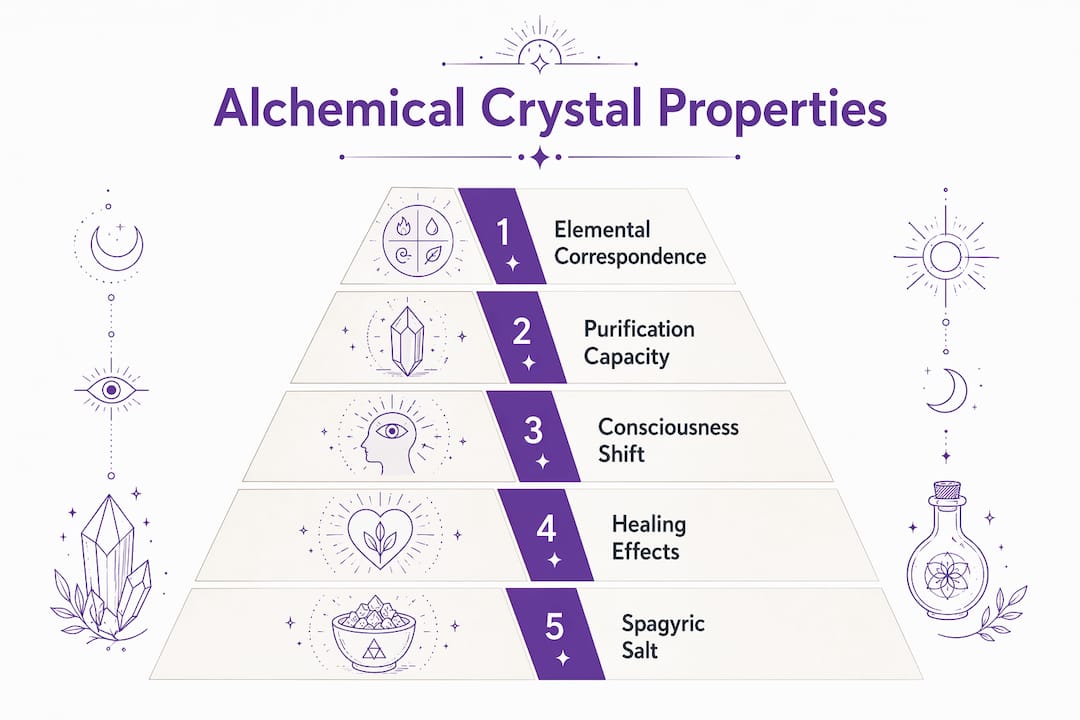
The spagyric tradition, codified by Paracelsus in the 16th century, treated crystallization as a formal purification stage. Spagyric method involves separation, purification by crystallization, and recombination to potentize medicines. The crystallized residue was not waste. It was the concentrated essence of the original substance, ready to be reunited with its purified volatile components.
Pro Tip: When studying alchemical texts, pay attention to the word “calcination.” This refers to the burning of a substance to ash, which is then dissolved and recrystallized. The crystal that forms after calcination is what Paracelsus called the Salt, the fixed body of the medicine.
What are the alchemical properties of crystals?
The five-element framework and crystal correspondence
Five-element systems in alchemy link crystals to elemental states of consciousness and physical principles required for transformation. Each element corresponds to a specific quality of awareness and a class of crystals that embody it.
| Element | Quality | Example Crystal |
|---|---|---|
| Earth | Stability, grounding | Black Tourmaline |
| Water | Flow, emotional depth | Moonstone |
| Fire | Will, transformation | Carnelian |
| Air | Thought, clarity | Clear Quartz |
| Quintessence | Pure awareness | Selenite |
This table is not decorative. Each correspondence tells you which crystal to work with when a specific elemental quality is deficient or excessive in your practice or your body.
Paracelsus’s tria prima and the crystalline Salt
Paracelsus organized all matter into three principles: Salt, Sulfur, and Mercury. Salt represents the fixed, physical body of a substance. The crystalline principle in Paracelsian tradition is the fixed physical body, vital to the preparation of alchemical remedies through crystallization. Sulfur carries the soul or energetic signature. Mercury carries the spirit or volatile essence.
When you crystallize a substance in spagyric practice, you are isolating its Salt. That Salt holds the mineral memory of the original plant or stone. Recombining it with the purified Sulfur and Mercury creates a medicine that works on all three levels simultaneously: body, energy, and spirit. This is why healing crystals in alchemy are understood as more than mineral supplements. They carry a complete energetic architecture.
Pro Tip: Black Tourmaline corresponds to the Earth element and is traditionally used in grounding practices. Selenite, associated with Quintessence, is used to clear and elevate energetic states. Working with both in sequence mirrors the alchemical movement from nigredo (darkening, grounding) toward albedo (purification, clarity).
Crystals serve as tools to shift states of consciousness within the five-element framework. That function is not incidental. It is the core of their spiritual role in alchemy.
How do crystals facilitate the alchemical Great Work?
The Great Work, or Magnum Opus, describes the full alchemical process of transformation from raw, unrefined matter to perfected, luminous essence. Crystals participate at every stage. The four primary stages are nigredo, albedo, citrinitas, and rubedo, with quintessence integration as the culminating state.
-
Nigredo (blackening): The initial dissolution of fixed patterns. Dense, grounding crystals like Black Tourmaline and Obsidian support this stage by anchoring awareness during the breakdown of old structures.
-
Albedo (whitening): Purification and clarification. Crystallization purifies substances to reveal their essence, and crystals like Selenite and Clear Quartz mirror this process energetically, clearing residue and amplifying clarity.
-
Citrinitas (yellowing): The dawning of solar awareness and will. Fire-element crystals like Citrine and Carnelian correspond to this stage, supporting the emergence of directed intention.
-
Rubedo (reddening): Integration and embodiment of the perfected self. Rubies and garnets appear in alchemical texts at this stage, symbolizing the fully realized, embodied spirit.
-
Quintessence integration: The fifth element, pure awareness beyond the four. Selenite and high-vibration crystals like Danburite are associated with this final state of unified consciousness.
In spagyric medicine, crystallization is a key purification stage that separates and enhances medicinal principles. The physical process of crystallization in the laboratory mirrors the inner process of the Great Work. You dissolve what is impure, allow the essential structure to form, and recombine it into something more potent than the original. This is alchemy and crystal energy working in parallel, on matter and on the self simultaneously.
Healing crystals in alchemy also restore mineral balance. Paracelsian spagyrics treats Salt as the fixed principle key to restoring mineral balance and health. When the body lacks specific mineral coherence, crystalline medicines reintroduce the formative pattern that the body has lost. This is not metaphor. It is the original logic of mineral medicine, predating modern supplementation by centuries.
You can explore the full range of spagyric preparation methods to understand how crystallization fits within the broader spectrum of plant and mineral alchemy.
Modern applications of crystal alchemy in wellness
The ancient knowledge of crystal use in alchemy has not disappeared. It has been refined, recontextualized, and applied in contemporary wellness and spiritual practice. Several threads connect the old tradition to what practitioners work with today.
- Ormus minerals: Ormus and monoatomic gold formulations use crystalline structures to support consciousness expansion and energetic coherence. This is a direct continuation of the Paracelsian Salt principle applied to mineral supplementation.
- Spagyric tinctures: Modern spagyric herbalists still use the separation, crystallization, and recombination method to prepare plant medicines. The magic of spagyric tinctures lies in this triple extraction, which produces a medicine that works on body, energy, and spirit simultaneously.
- Crystal meditation: Working with specific crystals during meditation activates elemental states of awareness. Earth crystals ground scattered energy. Air crystals sharpen focus. Quintessence crystals open receptivity to higher states.
- Energy balancing rituals: Placing crystals on or around the body during healing sessions draws on the five-element correspondence system. This practice maps directly onto the alchemical understanding of elemental imbalance as the root of illness.
- Wellness formulations: Some contemporary wellness practitioners incorporate crystals alongside CBD and botanical compounds to support nervous system regulation and energetic balance, reflecting the alchemical principle that multiple agents work better in concert than in isolation.
The scientific understanding of crystalline structures supports this tradition. Crystals maintain highly ordered molecular lattices, which means they interact with electromagnetic fields in consistent, measurable ways. That consistency is exactly what alchemists valued: a substance whose formative pattern is stable enough to impart structure to less organized matter.
Key Takeaways
Crystals in alchemy are active agents of elemental transformation, not symbols. Their role spans physical purification through crystallization and spiritual development through elemental correspondence.
| Point | Details |
|---|---|
| Crystals as Salt principle | In Paracelsian spagyrics, the crystallized Salt is the fixed body of any medicine, essential for potency. |
| Historical mineral science | Quartz and talc appeared in alchemical preparations as early as 206 BCE, proving crystal use predates medieval Europe. |
| Five-element correspondence | Each element maps to specific crystals: Black Tourmaline for Earth, Selenite for Quintessence, Clear Quartz for Air. |
| Great Work stages | Crystals support every stage from nigredo to rubedo, grounding dissolution and amplifying purification. |
| Modern continuity | Ormus minerals and spagyric tinctures apply ancient crystallization knowledge to contemporary healing and consciousness work. |
Why I think crystals deserve more rigor, not just reverence
People often treat crystals as either pure magic or pure nonsense. Both positions miss the point entirely. What I have found, working with mineral alchemy and spagyric preparations over years of practice, is that crystals are most powerful when you approach them with the same precision an alchemist brought to the laboratory.
The mistake most practitioners make is skipping the elemental correspondence work. They pick a crystal because it is beautiful or because someone told them it “raises vibration.” That is like taking a medicine without knowing what it treats. The five-element framework gives you a map. Black Tourmaline is not generically good. It is specifically grounding, specifically Earth, specifically useful when you are dissolving old patterns in the nigredo stage and need an anchor.
The other misconception I encounter constantly is that crystallization is only a metaphor in alchemy. It is not. The physical act of dissolving a mineral salt and allowing it to recrystallize is a real purification process. The crystal that forms carries a more coherent structure than what you started with. That coherence is the medicine. When you understand that, the spiritual and physical dimensions of crystal work stop feeling separate.
My honest recommendation: study the tria prima before you buy another crystal. Know whether you are working with Salt, Sulfur, or Mercury qualities. Then choose your crystal accordingly. That single shift will change how you work with them entirely.
— Kejiwa
Kejiwastore’s mineral alchemy collection
Kejiwastore crafts small-batch products that carry the full logic of alchemical crystallization into your daily practice. Every formulation begins with the same principles Paracelsus described: separation, purification, and recombination.
The Ormus minerals collection applies crystalline mineral science to support energetic coherence, meditation depth, and nervous system restoration. These are not generic supplements. They are prepared using methods that honor the Salt principle, the fixed crystalline essence that carries formative power. Kejiwastore also offers spagyric herbal tinctures made through the full three-stage alchemical process, giving you plant medicine that works on body, energy, and spirit at once.
FAQ
What is the role of crystals in alchemy?
Crystals serve as elemental agents of transformation in alchemy, embodying the Salt principle in Paracelsian spagyrics and corresponding to the five elements in broader alchemical systems. They facilitate both physical purification through crystallization and spiritual development through elemental correspondence.
How were crystals used in ancient alchemy?
Quartz and talc appeared in alchemical preparations during China’s Western Han dynasty as early as 206 BCE, while medieval European alchemists used cinnabar, orpiment, and stibnite for mineral transformation and purification.
What are the alchemical properties of crystals?
Alchemical properties of crystals fall into three categories: elemental correspondence (each crystal maps to Earth, Water, Fire, Air, or Quintessence), purification capacity (crystallization isolates the fixed Salt essence), and energetic amplification (crystals stabilize and intensify specific states of consciousness).
How does crystallization work in spagyric medicine?
Spagyric medicine separates a substance into its three Paracelsian principles, purifies each through processes including crystallization, and then recombines them into a potentized medicine that acts on body, energy, and spirit simultaneously.
What crystals correspond to the stages of the Great Work?
Black Tourmaline and Obsidian support nigredo (dissolution), Selenite and Clear Quartz support albedo (purification), Citrine supports citrinitas (will), and Rubies or Garnets correspond to rubedo (integration). Selenite and high-vibration stones like Danburite are associated with quintessence integration.