


Alchemy in spirituality is defined as the symbolic and experiential process of transmuting your inner “lead,” meaning unconscious patterns, emotional wounds, and ego defenses, into spiritual “gold,” which is integrated wholeness and self-realization. This is not metaphor for its own sake. Spiritual alchemy is an ancient philosophical framework that uses the stages of physical transformation as a precise map for inner change. The role of alchemy in spirituality spans more than 2,000 years of practice, from Hellenistic Egypt through Jungian psychology, and its core insight remains unchanged: the raw material of your suffering is the very substance your growth requires. Three primary stages, nigredo (blackening), albedo (whitening), and rubedo (reddening), mark the arc from dissolution to integration.
What is the sacred alchemy tradition and how does it work?
Sacred alchemy tradition originates in Hellenistic Egypt, where Greek philosophy merged with Egyptian metallurgical knowledge and Hermetic mysticism around the first few centuries CE. The resulting worldview held that matter and spirit were not separate. They were two expressions of one underlying reality.
The foundational Hermetic principle “as above, so below” captures this perfectly. Whatever happens in the cosmos mirrors what happens within the human psyche, and vice versa. Alchemical symbols were intentionally cryptic, designed to compel direct experience rather than passive reading. You could not simply memorize alchemy. You had to live it.
The sacred tradition rests on several interlocking ideas:
- Prima materia: The raw, unrefined starting material. In spiritual terms, this is your unexamined emotional life, your wounds, your reactive patterns.
- The Philosopher’s Stone: Not a literal rock, but a symbol of perfected consciousness. It represents the fully integrated self, the psyche refined through repeated cycles of breakdown and renewal.
- Solve et coagula: “Dissolve and coagulate.” Break down what is rigid, then allow something truer to solidify in its place.
- The four elements: Earth, water, fire, and air map onto states of being. Earth is the body and material reality. Water is emotion and the unconscious. Fire is will and transformation. Air is intellect and perception.
Alchemy’s continuity over 2,000 years links practical laboratory work with spiritual symbolism, culminating in Carl Jung’s model of psychological individuation. Jung recognized that alchemical texts were describing the psyche’s own drive toward wholeness. That recognition gave modern practitioners a rigorous psychological language for what mystics had always known.
How do alchemical stages guide spiritual growth?
The alchemical stages are the most practical gift the tradition offers. They give you a map for experiences that would otherwise feel like pure chaos.

The simplified three-stage model, nigredo, albedo, and rubedo, describes the broad arc of transformation. The more detailed seven-stage model breaks this arc into granular phases: calcination, dissolution, separation, conjunction, fermentation, distillation, and coagulation. Both models describe the same territory at different resolutions.
| Stage | Physical Process | Spiritual Meaning |
|---|---|---|
| Calcination | Burning to ash | Confronting ego rigidity and pride |
| Dissolution | Dissolving in water | Releasing fixed beliefs and emotional armor |
| Separation | Filtering the solution | Discerning what is authentic from what is conditioned |
| Conjunction | Combining purified elements | Integrating opposites within the self |
| Fermentation | Decay followed by new life | Death of the old identity, emergence of deeper purpose |
| Distillation | Repeated purification | Refining insight through sustained practice |
| Coagulation | Solidifying the essence | Embodying the integrated self in daily life |
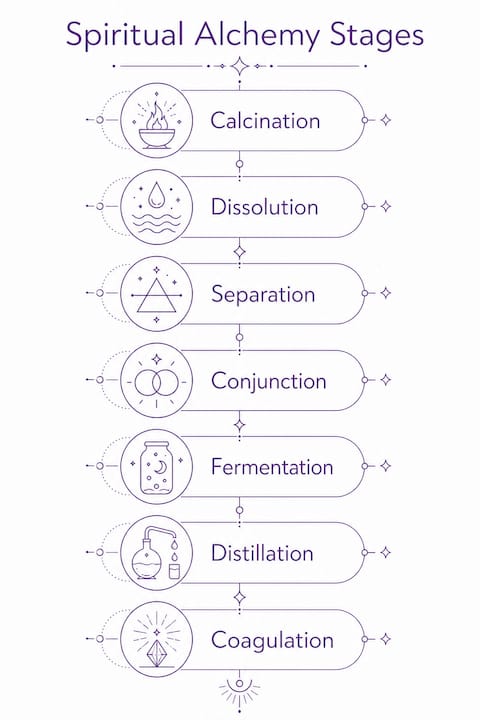
Each stage carries a color code. Nigredo is black, the color of decomposition and shadow. Albedo is white, the color of clarity after purification. Rubedo is red, the color of vitality and full embodiment. These are not decorative. They signal where you are in the process.
The psychological reading of each stage is equally precise. Calcination is the burning away of ego defenses, often triggered by crisis or loss. Dissolution is the grief and disorientation that follows. Separation is the slow work of discernment: which beliefs are actually yours, and which were handed to you? Conjunction is the surprising moment when apparent opposites, strength and vulnerability, logic and intuition, begin to coexist without conflict.
Pro Tip: When you feel like you are falling apart, check which stage you are in before trying to fix it. Dissolution is supposed to feel like drowning. Rushing past it skips the purification.
The alchemical stages are cyclical, not linear. You will revisit calcination many times across a lifetime as new layers of ego reveal themselves. This is not failure. It is the process working exactly as designed.
What makes alchemy different from ordinary self-improvement?
Alchemy differs from conventional self-improvement in one fundamental way: it does not treat you as a problem to be fixed. It treats you as raw material to be refined through surrender, not willpower.
Standard self-help is goal-oriented. You identify a weakness, apply a technique, and measure progress. Alchemy inverts this. The prima materia, your anger, your grief, your fear, is not an obstacle. It is the substance the transformation requires. Jungian psychology frames this as a collaboration between the conscious ego and the collective unconscious, not a project managed by willpower alone.
This distinction matters enormously for how you approach dark periods. In self-improvement, a depressive episode is a setback. In alchemy, it is nigredo, the necessary blackening that precedes purification. Holding space for that darkness without rushing it is the actual work.
Spiritual alchemy is an act of surrender. The alchemist does not force the gold to appear. They create the conditions, tend the fire, and trust the process. The transformation happens through you, not by you.
Two common pitfalls undermine this work:
- Spiritual bypass: Using spiritual frameworks to avoid genuine emotional processing. You talk about “transmuting” anger without ever actually feeling it. The stage gets named but not lived.
- Ego inflation: Identifying with being “the alchemist” rather than humbly doing the shadow work. This beginner pitfall turns a practice of humility into a new identity costume.
The antidote to both is simple, though not easy. Stay close to your actual experience. The Philosopher’s Stone symbolizes dynamic balance and ongoing transformation, not a static achievement you reach and then possess.
How can you apply spiritual alchemy in everyday life?
Spiritual alchemy is a practice of embodiment, refining both body and ego as vessels for consciousness rather than escaping them. The work happens in ordinary life, not only in meditation retreats or esoteric study.
Here is how to bring alchemical principles into your daily practice:
- Name your prima materia. Each morning, identify the emotional state you are carrying. Frustration, numbness, restlessness. Do not judge it. Treat it as the raw material for the day’s inner work.
- Observe before reacting. The separation stage requires discernment. When a strong emotion arises, pause long enough to ask: is this a conditioned response, or is it pointing to something true?
- Use ritual to mark transitions. Lighting incense, working with a botanical aromatherapy mist, or sitting in intentional silence signals to your nervous system that you are entering a different mode of attention. Ritual is not superstition. It is a technology for shifting states.
- Journal the stages. Track which alchemical phase feels most active in your life right now. This builds the self-awareness that makes the process conscious rather than reactive.
- Honor the slow periods. Fermentation looks like stagnation from the outside. If you feel stuck, consider that something is composting beneath the surface. Patience is not passivity here. It is active trust.
Pro Tip: Spagyric tinctures are themselves products of alchemical process, separating and recombining plant essences. Using them as part of a daily ritual connects the outer practice to the inner one in a tangible, embodied way.
True alchemical work often appears mundane. It lives in how you respond to a difficult conversation, how you sit with grief instead of numbing it, and how you return to presence after losing it. The laboratory is your daily life.
Key Takeaways
Spiritual alchemy is the most complete map available for inner transformation because it accounts for darkness, cyclical return, and embodied integration, not just peak experiences or linear progress.
| Point | Details |
|---|---|
| Alchemy is a transformation map | It uses symbolic stages to describe how psychological “lead” becomes integrated wholeness. |
| Stages are cyclical, not linear | You revisit calcination, dissolution, and other stages repeatedly as new ego layers surface. |
| Surrender drives the process | Alchemy requires holding uncomfortable states without rushing, not fixing them with willpower. |
| Embodiment is the goal | The work refines body and ego as vessels for consciousness, grounded in everyday life. |
| Bypass and inflation are real risks | Naming stages without living them, or identifying as “the alchemist,” stalls genuine growth. |
What I’ve learned from years of working with alchemical principles
The hardest thing to accept about this path is that the timing is not yours to control. You can create conditions. You can tend the fire. But the actual transformation moves at its own pace, and forcing it produces a convincing imitation of growth rather than the real thing.
I have watched people arrive at the nigredo stage and immediately reach for a solution, a new practice, a new teacher, a new framework. That impulse is understandable. Sitting in the blackening is genuinely uncomfortable. But the discomfort is the process. The moment you rush past it, you carry the unprocessed material forward, and it surfaces again, usually louder.
The symbolic richness of alchemy is one of its great gifts. When you know you are in fermentation, the decay feels purposeful rather than catastrophic. That reframe does not make it painless. It makes it bearable, and bearable is enough to keep going.
Transformation is not a destination you reach. It is the quality of attention you bring to each cycle. The gold is not waiting at the end. It is what you become in the process of returning, again and again, to the work.
— Kejiwa
How Kejiwastore supports your alchemical practice
Alchemical principles do not live only in texts and symbols. They live in the materials you work with and the rituals you build around them.
Kejiwastore crafts small-batch products that embody the alchemical process from the ground up. The Ormus minerals collection works with monatomic elements traditionally associated with heightened consciousness and energetic refinement. The spagyric herbal tinctures are made using a genuine alchemical extraction process: separating, purifying, and recombining plant essences to preserve the full spectrum of the plant’s intelligence. Botanical aromatics support the ritual dimension of daily practice, helping you mark the transitions that make inner work conscious. Every product is handcrafted with organic and wild-harvested ingredients, made for practitioners who take their inner work seriously.
FAQ
What is the role of alchemy in spirituality?
Alchemy in spirituality is the symbolic and practical process of transforming unconscious ego patterns into integrated wholeness, using stages like nigredo, albedo, and rubedo as a map for inner change. It treats emotional suffering as raw material for growth rather than a problem to eliminate.
What are the seven stages of spiritual alchemy?
The seven stages are calcination, dissolution, separation, conjunction, fermentation, distillation, and coagulation. Each stage represents a phase of psychological and spiritual refinement, from burning away ego rigidity to embodying an integrated self.
How does alchemy relate to meditation?
Meditation supports alchemical work by creating the conditions for sustained inner observation, which is the core skill required at every stage. It helps you hold uncomfortable states, like nigredo, without immediately reacting or escaping.
What is the Philosopher’s Stone in spiritual terms?
The Philosopher’s Stone symbolizes perfected consciousness and dynamic, ongoing transformation, not a fixed achievement. It represents the fully integrated self that emerges through repeated cycles of dissolution and renewal.
How is spiritual alchemy different from self-help?
Self-help is goal-oriented and driven by willpower. Spiritual alchemy is surrender-based, treating dark periods as necessary stages rather than setbacks, and requiring collaboration between the conscious ego and the deeper unconscious rather than top-down control.