


The fastest way to screen a crystal is to combine four quick checks: how it feels against your skin (cool and dense), what you see under a loupe (natural inclusions, not round air bubbles), whether it scratches glass, and whether the color looks zoned or suspiciously uniform. No single test is definitive, but practical home checks like temperature, weight, loupe inspection, and color zoning catch the majority of glass, resin, and dyed fakes before you spend a dollar.
Run through this quick checklist first:
- Cool to the touch: Real minerals stay noticeably cooler than room temperature for several seconds; plastic and resin warm up almost immediately.
- Heavier than expected: Genuine stones feel dense for their size. Resin and plastic feel light and hollow.
- No round air bubbles: Glass fakes almost always contain small spherical bubbles visible under magnification. Natural crystals show irregular mineral inclusions or growth lines instead.
- Natural inclusions or veining: Look for wispy clouds, rutile needles, or color zoning. Perfect, flawless clarity in an inexpensive stone is a red flag.
- Scratches glass: Most genuine crystals (quartz family and above) scratch a glass surface cleanly. Soft glass imitations often cannot.
- Color is zoned, not uniform: Real amethyst and citrine show gradients. Uniform, saturated color throughout a piece often signals dyeing or heat treatment.
- Seller discloses origin and treatments: Honest sellers name the locality and disclose any heat treatment or stabilization upfront.
If two or more of these checks raise doubts, run the detailed home tests below. If the piece is expensive or rare, professional lab testing is worth the cost.
Key Takeaways
Genuine crystals feel cool and dense, show natural inclusions under a loupe, and come from sellers who disclose origin and treatments without hesitation.
| Point | Details |
|---|---|
| Start with temperature and weight | Real minerals stay cool against skin and feel dense; plastic and resin warm up and feel light. |
| Use a loupe for air bubbles | Round spherical bubbles under magnification almost always indicate glass; natural crystals show irregular inclusions. |
| Know which stones get faked most | Citrine, turquoise, moldavite, and amber face the highest rates of imitation and undisclosed treatment. |
| Get lab testing for high-value pieces | GIA and AGS labs confirm species, detect treatments, and provide certificates worth having for insurance or resale. |
| Kejiwastore discloses treatments and origin | Every crystal listing includes locality, treatment status, and photos of the actual piece, with returns supported. |
Table of Contents
- How Do You Tell Real vs Fake Crystals at Home?
- Which Crystals Are Most Commonly Faked?
- When Should You Pay for Professional Gem Testing?
- What Should You Ask a Seller Before Buying?
- What Tools Make Home Testing More Reliable?
- What Can Science Actually Confirm About Crystals?
- Kejiwa’s Take on Authenticity and Sourcing
- Kejiwastore’s Curated Crystal Collections
- Sources
How Do You Tell Real vs Fake Crystals at Home?
These tests move from least invasive to most. Start at the top and only go further if you still need clarity.
1. Temperature test
Purpose: Distinguishes mineral from plastic or resin.
Hold the stone against the inside of your wrist for five seconds. A genuine mineral stays cool; plastic and resin reach skin temperature almost instantly. Temperature and heft checks are reliable first-line screens because genuine minerals conduct heat away from your skin far more efficiently than polymer imitations.
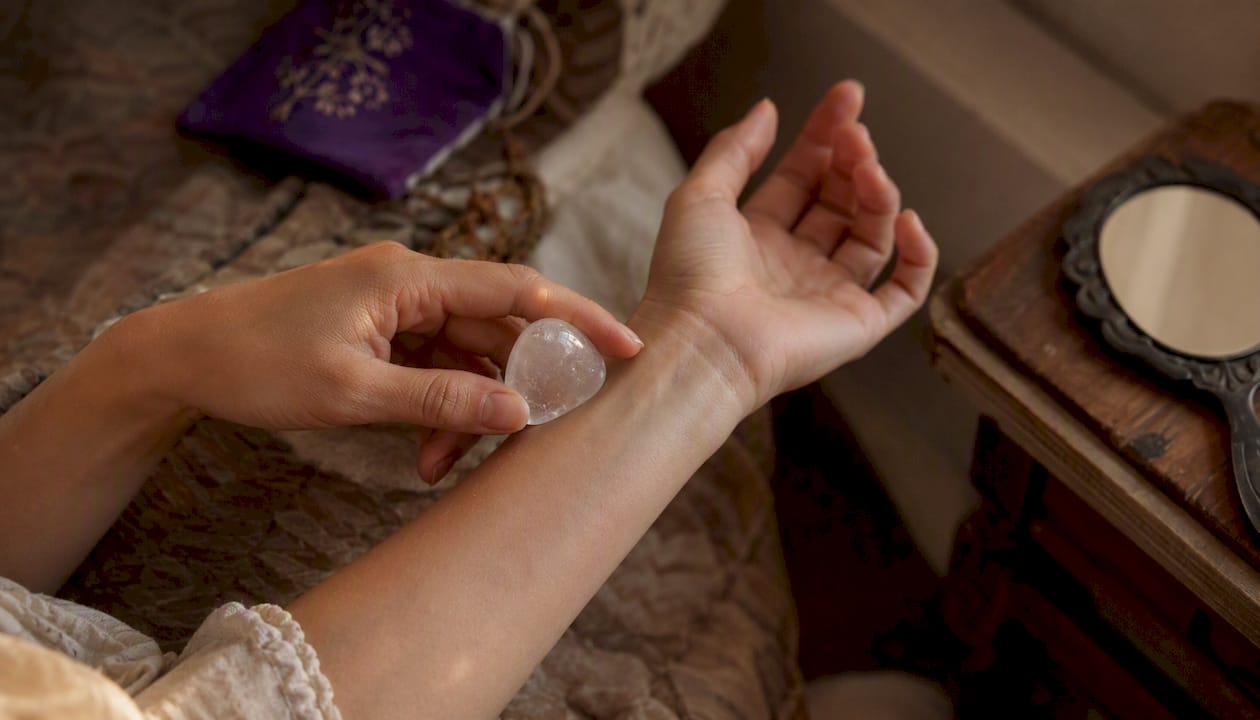
Limitation: Glass also feels cool initially, so this test alone does not rule out glass fakes.
2. Weight and heft test
Purpose: Detects low-density imitations (plastic, resin, hollow glass).
Pick up the stone and compare it to a similar-sized piece of known material. Genuine quartz, for example, has a specific gravity around 2.65, meaning it feels noticeably heavier than a same-sized piece of plastic. If you have a pocket scale accurate to 0.1 g, you can approximate specific gravity by weighing the stone dry, then suspended in a cup of water (using a thread). The ratio of dry weight to the difference between dry and submerged weight gives you a rough specific gravity figure to compare against published mineral data.
Limitation: This works best when you have a reference piece or published values to compare against.
3. Loupe and magnification inspection
Purpose: Reveals internal structure, inclusions, and manufacturing artifacts.
Rotate the stone slowly and look for:
- Round, spherical bubbles: A near-certain sign of glass.
- Swirl patterns: Molten glass cools in visible flow lines; natural crystals do not.
- Mineral inclusions: Wispy clouds, rutile needles, phantoms, or fractures are natural growth signatures.
- Dye concentration in cracks: Dyed stones often show deeper color pooling along surface fractures.
4. Air-bubble check (glass detection)
Purpose: Specifically targets glass imitations.
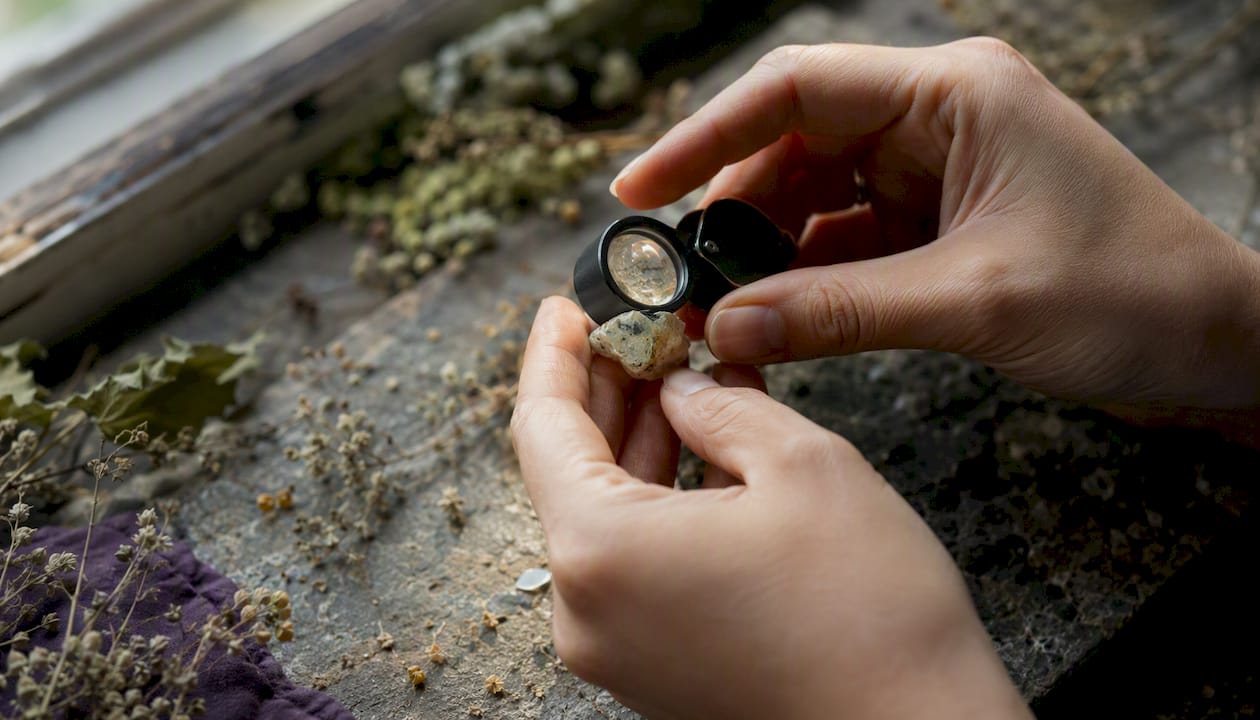
Glass imitations frequently contain rounded air bubbles and swirl patterns that are invisible to the naked eye but obvious under a 10x loupe. Natural crystals grow slowly and show mineral inclusions and growth patterns instead. This check takes under a minute and costs nothing beyond the loupe.
5. UV flashlight test
Purpose: Detects certain treatments and identifies some species.
In a darkened room, shine a 365 nm UV flashlight (shortwave UV gives stronger reactions than 395 nm) on the stone. Genuine calcite often fluoresces strongly. Many dyed stones show uneven or absent fluorescence. Synthetic or glass opal may fluoresce differently from natural opal. Keep notes on what you see; reactions vary by species, so cross-reference with a mineralogy database for your specific stone.
Limitation: Fluorescence is species-dependent. Absence of fluorescence does not mean a stone is fake.
6. Scratch and hardness test
Purpose: Confirms approximate Mohs hardness.
Quartz (hardness 7) scratches glass (hardness around 5.5) cleanly. Try scratching an inconspicuous spot on the stone against a glass surface. If the stone scratches the glass and leaves no powder residue on the stone itself, hardness is consistent with quartz or harder. If the stone crumbles or leaves a white powder trail, it may be softer material like calcite, howlite, or chalk.
Do this only on an inconspicuous area. Scratching a display face permanently damages the piece.
7. Magnet test
Purpose: Detects iron-bearing minerals and some treatments.
Hold a small neodymium magnet near the stone. Genuine hematite and magnetite show clear magnetic attraction. Hematite “fakes” made from reconstituted powder and resin often show weaker or inconsistent attraction. This test is species-specific and not useful for most quartz-family stones.
8. Tapping and sound test
Purpose: Distinguishes hollow glass or resin from solid mineral.
Gently tap two pieces together or tap the stone against a hard surface. Solid mineral produces a clear, glass-like ring. Hollow glass or thin-walled resin produces a duller, flatter sound. This is a rough directional check, not a definitive one.
Pro Tip: No single test closes the case on its own. Run at least three tests and look for consistent results across all of them. A stone that passes temperature, loupe, and hardness checks is far more likely to be genuine than one that only passes one.
Which Crystals Are Most Commonly Faked?
Some stones attract far more imitation than others, usually because they are popular, expensive, or visually striking. Knowing which ones to scrutinize saves you time.
- Citrine: Most commercial “citrine” is heat-treated amethyst, identifiable by its unnaturally bright, uniform orange color concentrated at the tips of clusters. Natural citrine is rarer, usually pale yellow to honey-gold, and shows color throughout the crystal rather than only at the points.
- Turquoise: Frequently imitated with dyed howlite or magnesite. Dyed howlite has a similar matrix pattern but the color sits on the surface; look for dye bleeding into surface cracks under a loupe.
- Malachite: Reconstituted malachite (ground powder mixed with resin) shows overly regular, almost printed-looking banding. Natural malachite has organic, flowing concentric rings that vary in width.
- Moldavite: One of the most faked stones on the market. Genuine moldavite has a distinctive sculptured, lechatelierite-rich surface texture and a specific gravity around 2.3–2.4. Glass fakes feel lighter and show smoother, more uniform surfaces.
- Lapis lazuli: Often imitated with dyed jasper or sodalite. Check for pyrite flecks (natural lapis usually has them) and test with acetone on a cotton swab; dye will transfer, natural color will not.
- Amber: Copal resin is sold as amber. The needle test (briefly touching a hot needle to an inconspicuous spot) releases a piney, resinous scent from real amber and a sharp, acrid plastic smell from copal or synthetic resin.
- Opal: Glass and synthetic opal show structural and visual markers that differ from natural opal, including a more regular “lizard skin” play-of-color pattern in synthetics and visible foil backing in doublets and triplets.
- Rose and clear quartz: Glass imitations are common. The loupe check for air bubbles and the temperature test together catch most of them.
| Stone | Typical Fake or Treatment | Quick Visual Check |
|---|---|---|
| Citrine | Heat-treated amethyst | Bright orange only at cluster tips; white base |
| Turquoise | Dyed howlite or magnesite | Dye pooling in surface cracks under loupe |
| Malachite | Reconstituted resin composite | Overly regular, printed-looking banding |
| Moldavite | Green glass | Smooth surface, lighter weight than genuine |
| Lapis lazuli | Dyed jasper or sodalite | No pyrite flecks; dye transfers on acetone swab |
| Amber | Copal resin or plastic | Acrid smell from hot needle; floats in saturated saltwater |
| Opal | Glass doublet or synthetic | Regular “lizard skin” pattern; visible layering at edge |
| Clear quartz | Glass | Round air bubbles under loupe; warms quickly |
When Should You Pay for Professional Gem Testing?
Home tests are directional. They catch most common fakes, but they cannot confirm rare species, detect subtle treatments, or produce documentation for insurance or resale. Professional testing makes sense in four situations:
- You are spending more than a few hundred dollars on a single piece.
- The stone is claimed to be a rare species (moldavite, alexandrite, paraiba tourmaline).
- You need a certificate for insurance, estate valuation, or legal purposes.
- Home tests give contradictory results and you cannot resolve the uncertainty.
What labs actually test:
- Refractive index (RI): Measured with a refractometer; each mineral species has a characteristic RI range that distinguishes it from imitations.
- Specific gravity: Measured precisely in a lab using hydrostatic weighing; more accurate than the home approximation.
- Spectroscopy (FTIR, Raman, UV-Vis): Identifies chemical composition and detects treatments like irradiation, filling, or coating that are invisible to the eye.
- Inclusion analysis under microscopy: Reveals growth patterns, fluid inclusions, and healing fractures that confirm natural origin.
- Elemental analysis (LA-ICP-MS): Used for origin determination in high-value stones; traces trace elements back to specific geographic deposits.
Reputable gemological laboratories in the United States include the Gemological Institute of America (GIA) and the American Gem Society (AGS) Laboratories. Independent gem labs certified by recognized gemological bodies are also reliable. Turnaround typically runs one to four weeks for standard reports. Costs vary by stone type and report complexity, so contact the lab directly for current fee schedules.
Before you submit a piece for testing, prepare:
- Clear photos in natural light from multiple angles
- Weight in grams (measured on a pocket scale)
- Any existing documentation or purchase receipts
- A description of where and when you acquired the piece
The mineral trade is largely unregulated, which means lab certification carries real weight when you are buying or selling at higher price points. A certificate from a recognized lab is one of the few objective trust anchors in an otherwise informal market.
What Should You Ask a Seller Before Buying?
Provenance matters on two levels: ethical and practical. Ethically, knowing where a stone was mined tells you whether it came from a conflict-affected region or was extracted under unsafe labor conditions. Practically, locality information helps you cross-reference the stone’s expected appearance against documented specimens from that deposit.
Buyers who ask straightforward questions about origin, treatment, and return policy significantly reduce their risk of purchasing a misrepresented stone. Honest sellers answer these questions readily. Evasive answers are themselves a signal.
Questions to ask any seller, online or in person:
- What is the country and locality of origin?
- Has this stone been heat-treated, dyed, stabilized, or coated?
- What is the return policy if I have the piece independently tested?
- Can you provide photos under natural light and from multiple angles?
- What are the weight and measurements of this specific piece?
- Is a certificate of authenticity or lab report available?
Trust signals in a listing:
- Specific locality named (e.g., “amethyst from Vera Cruz, Mexico” rather than “Brazilian amethyst”)
- Multiple high-resolution photos including close-ups of inclusions or matrix
- Clear, no-questions-asked return window
- Transparent pricing with no artificial urgency
Red flags:
- Vague origin (“from South America” or “natural crystal”)
- Perfect uniformity in color and surface texture across every piece in a lot
- Pressure to close the sale quickly
- No return policy or a policy that excludes “natural variation” disputes
Pro Tip: When buying online, ask the seller to send an additional photo of the stone held next to a ruler and a coin for scale. This one request filters out many sellers who are working from stock photos rather than the actual piece you would receive.
Combining intuition with objective quality checks, including clarity, color, finish, and verifiable origin information, leads to better long-term collecting decisions than relying on either alone.
What Tools Make Home Testing More Reliable?
A small kit of inexpensive tools meaningfully improves your ability to screen crystals at home. You do not need all of them at once. Buy in the order listed below for the biggest accuracy gains per dollar spent.
Start here (highest impact):
- 10x jeweler’s loupe ($10–$30): The single most useful tool. Look for a triplet-corrected lens with built-in LED lighting. Cheap single-element loupes distort at the edges and make bubble identification harder.
- Pocket scale accurate to 0.1 g ($15–$25): Needed for the specific-gravity approximation and for verifying seller-stated weights. Avoid scales that only read to 1 g; the precision matters.
- 365 nm UV flashlight ($15–$40): Shortwave UV (365 nm) produces stronger, more diagnostic fluorescence reactions than the cheaper 395 nm models. Check the output specification before buying.
Add next (moderate impact):
- Small neodymium magnet ($5–$10): Useful for hematite, magnetite, and iron-bearing minerals. A rare-earth magnet is far stronger than a refrigerator magnet and gives clearer results.
- Set of Mohs hardness picks ($20–$50): Calibrated mineral picks let you test hardness without guessing. More reliable than improvised tools like a knife blade or fingernail.
- Small container of water: Needed for the specific-gravity approximation alongside the pocket scale. No purchase required.
Optional (specialized use):
- Inexpensive refractometer ($50–$150): Useful if you regularly buy faceted stones or transparent minerals. Requires a flat polished surface to read accurately and a learning curve to interpret results. Not necessary for most casual collectors.
Avoid UV flashlights marketed only by LED count rather than wavelength. A flashlight with 100 LEDs at 395 nm is less useful for crystal testing than a single-LED 365 nm model with adequate output.
What Can Science Actually Confirm About Crystals?
Mineralogical and gemological tests are objective and well-validated. Refractive index, specific gravity, spectroscopy, and microscopic inclusion analysis can confirm a mineral’s species, detect treatments, and establish whether a stone is natural, synthetic, or imitation. These are the same techniques used by GIA-trained gemologists and university geology departments. Home versions of these tests (temperature, loupe, hardness, specific gravity approximation) are directional rather than definitive, but they are grounded in the same physical properties.
What mineralogical testing cannot do is validate metaphysical or health claims. Scientific reviews find almost no credible evidence that crystals provide measurable healing effects beyond placebo, though many people report meaningful subjective benefits. Crystals should not replace medical care. The authenticity of a stone as a mineral specimen and the validity of healing claims are entirely separate questions, answered by different kinds of evidence.
This distinction matters practically: you can verify that a stone is genuine amethyst using mineralogical methods. Whether that amethyst does anything specific for your energy field is a different conversation, one that sits outside the scope of a loupe and a pocket scale.
Pro Tip: Document your home test results with photos. A loupe photo showing inclusions, a scale reading, and a UV reaction shot create a useful record for resale, insurance, or future comparison if you acquire more pieces from the same locality.
Kejiwa’s Take on Authenticity and Sourcing
At Kejiwa, we source crystals the same way we approach every ingredient in our botanical alchemy work: with transparency about what the material is, where it came from, and how it was prepared. If a stone has been heat-treated or stabilized, we say so. If we know the locality, it appears in the listing. Our crystal and orgonite collections include specimen photos taken under natural light, and we stand behind every piece with a clear return policy.
We also want to be honest about something the broader crystal market sometimes glosses over: treated stones are not inherently inferior. Heat-treated citrine is still quartz. Stabilized turquoise is still turquoise. The ethical issue is undisclosed treatment, not treatment itself.
If you want to go deeper on how crystals fit into intentional practice, our crystals and alchemy guide covers provenance, energetic use, and what to look for in a well-sourced specimen. And if you are building a collection alongside other wellness tools, our crystals and orgonite wisdom blog shows how we think about pairing minerals with other practices.
Kejiwastore’s Curated Crystal Collections
Kejiwastore’s crystal collections are curated with the same sourcing standards described throughout this guide: locality disclosed, treatments noted, and clear photos of the actual piece you receive. Each listing includes weight and measurements so you can run your own checks before the stone arrives. For higher-value pieces, supporting documentation is available on request.
If you have been wondering how to choose a crystal you can trust, browsing the Crystal Vortex collection is a straightforward next step. Every piece there has been selected with provenance and visual quality in mind, and returns are handled without friction if a piece does not meet your expectations.
Sources
The following sources informed this guide and offer reliable further reading on mineral identification, buyer protection, and gemological testing:
- Crystals
- How To Spot Fake Crystals - Gemstone Rush Guide
- Guide to healing crystals — Healthline
- Mineralexpert
- Geology