


Botanical smoke cleansing is the intentional burning of dried plant material to clear, reset, and energetically refresh a person, object, or space. Unlike aromatherapy, which works primarily through scent, smoke cleansing is a purposeful ritual act: the smoke is a vehicle for your stated intention. The quickest effective method takes only a short time. Open a window, light a bundle of Salvia officinalis (garden sage) or a sprig of rosemary, let it smolder, and move the smoke deliberately into corners while repeating a short intention aloud — something as simple as “I release what no longer serves this space.” Extinguish the bundle in a fireproof dish and let the room air out.
A few non-negotiables before you begin: always work in a ventilated space, keep a damp cloth or small bowl of water within reach, use a heat-safe vessel under any smoldering material, and keep birds and pets with respiratory sensitivity out of the room. Salvia apiana (white sage) is the herb most people picture, but it carries significant cultural weight and is at risk from overharvesting. Garden sage and rosemary are equally effective and far more accessible.
Table of Contents
- What supplies do you actually need for smoke cleansing?
- How do you perform a full smoke-cleansing ritual, step by step?
- Which herbs work best, and what does each one do?
- How do you make your own bundles and resin blends at home?
- What is the difference between smudging and smoke cleansing?
- Safety, health, and ethical sourcing: a practical checklist
- When should you cleanse, and how often?
- Practitioner tips and common mistakes that undermine your cleanse
- Key Takeaways
- Why sourcing and intention matter more than the herb you choose
- Ready-made botanical supplies from Kejiwastore
- Useful sources and further reading
What supplies do you actually need for smoke cleansing?
You do not need an elaborate altar setup. A few well-chosen items are enough to perform a safe, effective herbal smoke cleansing from day one.
The core kit:
- Heat-safe vessel: An abalone shell, ceramic bowl, or cast-iron dish to catch ash and hold smoldering material. Never use plastic or thin glass.
- Matches or a lighter: Long-reach matches reduce the risk of burning your fingers when relighting bundles.
- Charcoal discs: Required for burning loose resins like frankincense or copal. Handle with metal tongs — they get extremely hot.
- Fan, feather, or your hand: For directing smoke into corners and along walls.
- Bowl of water or damp cloth: Your immediate fire-safety backup.
Herb formats range from bundled sticks (the most beginner-friendly) to loose dried herbs on a charcoal disc, to palo santo sticks, to raw resins. Each burns differently. Bundles smolder slowly and are easy to extinguish; resins produce dense, aromatic smoke and need charcoal to stay lit.
If you or someone in your home has respiratory sensitivity, asthma, or a smoke alarm that triggers easily, smokeless alternatives work beautifully. Botanical aromatherapy mists or sound (singing bowls, bells) carry the same intentional energy without combustion.
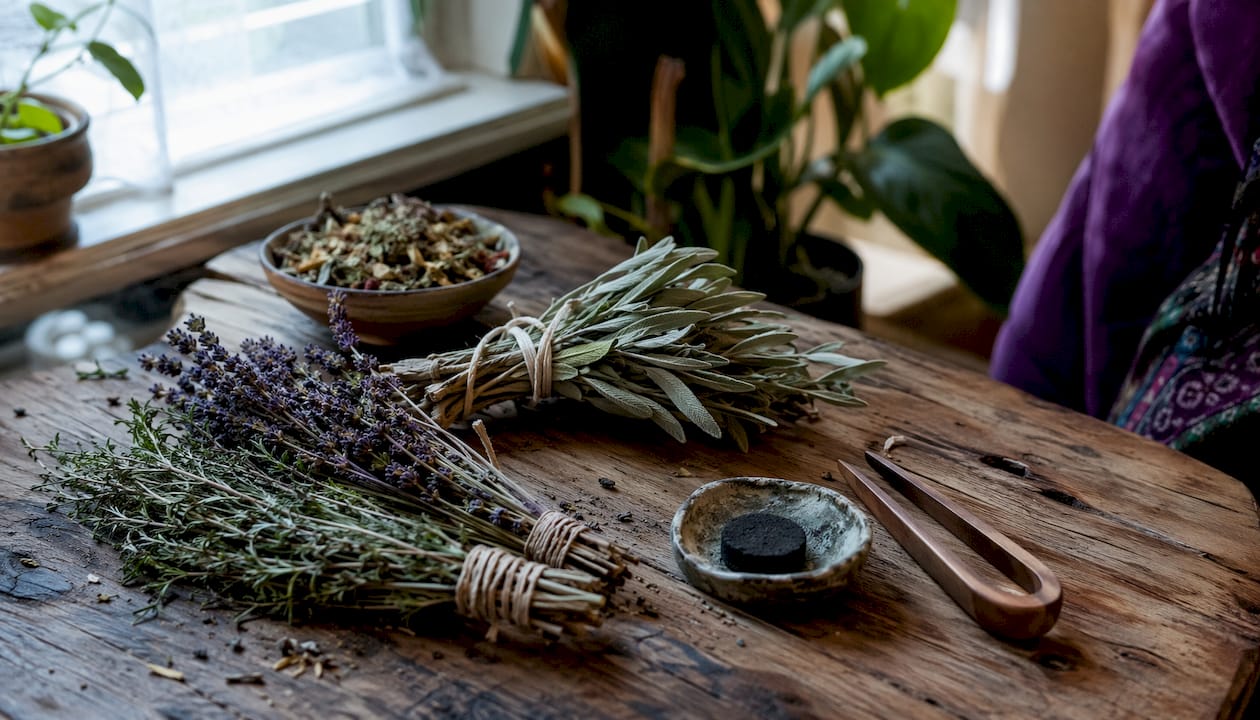
On sourcing: bioregional botanicals — garden rosemary, lavender, or garden sage you grew yourself — create a more meaningful practice and sidestep the ethical concerns tied to commercially wild-harvested bundles. Mountain Rose Herbs is one well-regarded US supplier that publishes sourcing transparency for dried botanicals.
Pro Tip: Harvest rosemary or garden sage from your yard in the morning, tie stems in small bundles with natural cotton twine, and hang them upside down in a dry, dark spot for two to three weeks. You’ll have a season’s worth of cleansing material for almost nothing.
How do you perform a full smoke-cleansing ritual, step by step?
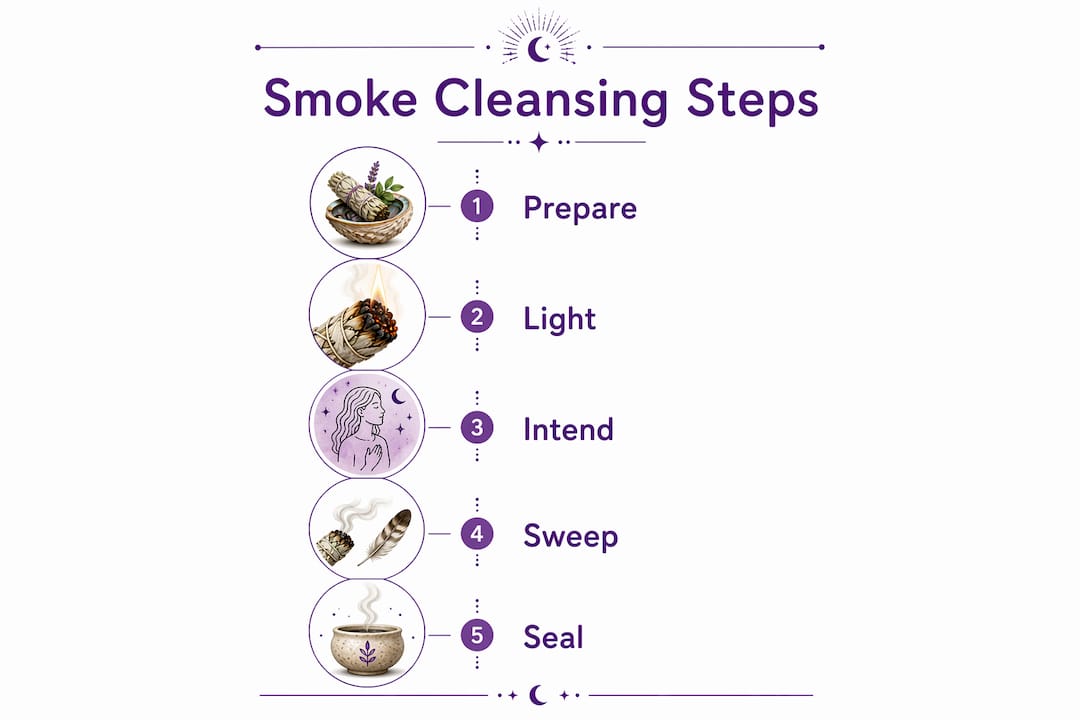
A structured ritual sequence works even without elaborate timing or tools. Follow these steps and you’ll finish with a space that feels genuinely different.
- Prepare the space. Open at least one window in every room you plan to cleanse. Remove pets and cover fish tanks. Place your heat-safe vessel on a stable, non-flammable surface.
- Ground and center yourself. Take three slow breaths. Feel your feet on the floor. State your intention aloud — one clear sentence: “I cleanse this space of stagnant energy and welcome in clarity and peace.”
- Cleanse yourself first. Light your herb bundle or charcoal disc and let it catch. Pass the smoke slowly over your own body, starting at your feet and moving upward to your head, then drawing it toward your heart. Skipping this step often leaves you carrying the energy you were trying to clear from the room.
- Move through the space clockwise. Starting at the main entrance, walk clockwise through each room. Linger in corners for five to ten seconds — corners trap stagnant energy. Pay attention to thresholds, closets, and the space behind doors.
- Speak your intention as you move. You do not need a script. Repeating your one-sentence intention, or simply saying “this space is clear,” is enough.
- Extinguish safely. Press the bundle firmly into your fireproof dish. Do not blow on it — that can scatter embers. Wait until you see no glow before leaving the room.
- Air the space. Leave windows open for at least fifteen minutes. The smoke carries the released energy out with it.
Safety checklist:
- Never leave smoldering material unattended, even for a moment.
- Keep the damp cloth within arm’s reach throughout.
- If a smoke detector triggers, extinguish immediately, ventilate, and wait before resuming.
- Ash from bundles can stay hot for several minutes. Let it cool fully before disposal.
Which herbs work best, and what does each one do?
Every botanical in this guide has a distinct energetic quality, scent profile, and sourcing consideration. Latin names matter here because common names overlap across regions.
- White sage (Salvia apiana): The most recognized cleansing herb in North American practice, with a sharp, camphor-like smoke. Culturally significant to many Indigenous peoples of the Southwest. Use it only if sourced from Indigenous-owned suppliers, and consider garden sage as your everyday alternative.
- Garden sage (Salvia officinalis): Earthy, slightly peppery, and widely available. Equally effective for clearing and far more sustainable. Grows readily in most US climates.
- Rosemary (Rosmarinus officinalis / Salvia rosmarinus): Bright, resinous, and protective. Historically used across Mediterranean and European folk traditions for purification and memory. One of the best all-purpose cleansing herbs you can grow at home.
- Mugwort (Artemisia vulgaris): Smoky, slightly bitter, and deeply associated with dreamwork and psychic clarity. Used in Slavic and European folk traditions. Avoid during pregnancy.
- Lavender (Lavandula spp.): Soft, floral, and calming. Excellent for calling in peace after a clearing, or for cleansing a bedroom or meditation space.
- Cedar (Cedrus spp. and local cedar species): Warm, woody, and grounding. Used across many North American and Himalayan traditions for protection and blessing.
- Juniper (Juniperus spp.): Sharp and resinous. Burned in Balkan and Northern European traditions to banish illness and protect thresholds. Abundant and ethically sourced from most regions.
- Bay laurel (Laurus nobilis): Spicy and slightly medicinal. Associated with victory, clarity, and prophetic work. Kitchen bay leaves burn well when fully dried.
- Palo santo (Bursera graveolens): Sweet, citrusy, and uplifting. Used to raise vibration after a clearing. Source carefully — look for suppliers who harvest only naturally fallen wood.
- Frankincense (Boswellia sacra): Rich, resinous, and sacred across North African and Arabian traditions. Raises frequency and supports meditation. Burned on charcoal.
- Copal (Protium spp.): Light, bright, and deeply purifying. Central to Mesoamerican ceremony. Pairs well with frankincense for a layered cleanse-and-uplift effect.
- Dragon’s blood resin (Daemonorops draco): Intensely protective and amplifying. A small amount goes a long way; it intensifies the clearing effect of other herbs and resins.
- Rose petals: Gentle, heart-centered, and uplifting. Burn dried petals to call in love, compassion, or gratitude after a heavy clearing.
| Herb / Resin | Best for | Sourcing sensitivity | Indoor smokiness |
|---|---|---|---|
| Garden sage | Clearing, everyday use | Low | Moderate |
| Rosemary | Purification, protection | Low | Light |
| Lavender | Calming, calling in peace | Low | Light |
| Mugwort | Release, dreamwork | Low | Moderate |
| White sage | Deep clearing | High | Moderate |
| Palo santo | Uplifting, blessing | Medium | Light |
| Frankincense | Raising vibration, meditation | Low | Heavy |
| Copal | Purification, blessing | Low | Heavy |
| Dragon’s blood | Protection, amplifying | Low | Heavy |
| Cedar / Juniper | Grounding, protection | Low | Moderate |
How do you make your own bundles and resin blends at home?
Making your own supplies closes the loop between intention and practice. When you grow, harvest, and bundle your own herbs, the relationship with the plant becomes part of the ritual itself.
Drying basics:
- Harvest in the morning after dew has dried, ideally just before the plant flowers (when volatile oil content peaks).
- Shake off any insects and remove damaged leaves.
- Tie stems loosely at the base with natural cotton twine and hang upside down in a dry, dark, well-ventilated space.
- Herbs are ready to bundle when stems snap cleanly rather than bend.
Bundle-making:
- Gather stems into a tight bunch, 4–8 inches long, with the thicker stems at the center for even burning.
- Starting at the base, wrap cotton twine upward in a spiral to the tip, then back down, finishing with a knot at the base.
- Cure the finished bundle for an additional one to two weeks before burning — this prevents uneven smoldering and excessive smoke.
- Store in a cool, dry place away from direct sunlight. A paper bag works better than plastic, which traps moisture.
Three starter blends:
- Everyday cleanse: Rosemary + garden sage, bundled together or burned loose on a charcoal disc. Clean, bright, and grounding.
- Love and uplift: Dried rose petals + a small piece of frankincense resin on a charcoal disc. The rose softens the space; the frankincense lifts the frequency.
- Heavy-duty clearing: Copal + dragon’s blood resin + a pinch of frankincense, all on a charcoal disc. Use this after conflict, illness, or moving into a new space. Open every window before you begin.
Pro Tip: When using charcoal discs, light the disc with tongs over your fireproof dish and wait until the entire surface glows gray before adding resin. Adding resin too early produces acrid smoke rather than the clean, aromatic burn you want.
What is the difference between smudging and smoke cleansing?
The distinction matters, and using the right language is part of practicing with integrity.
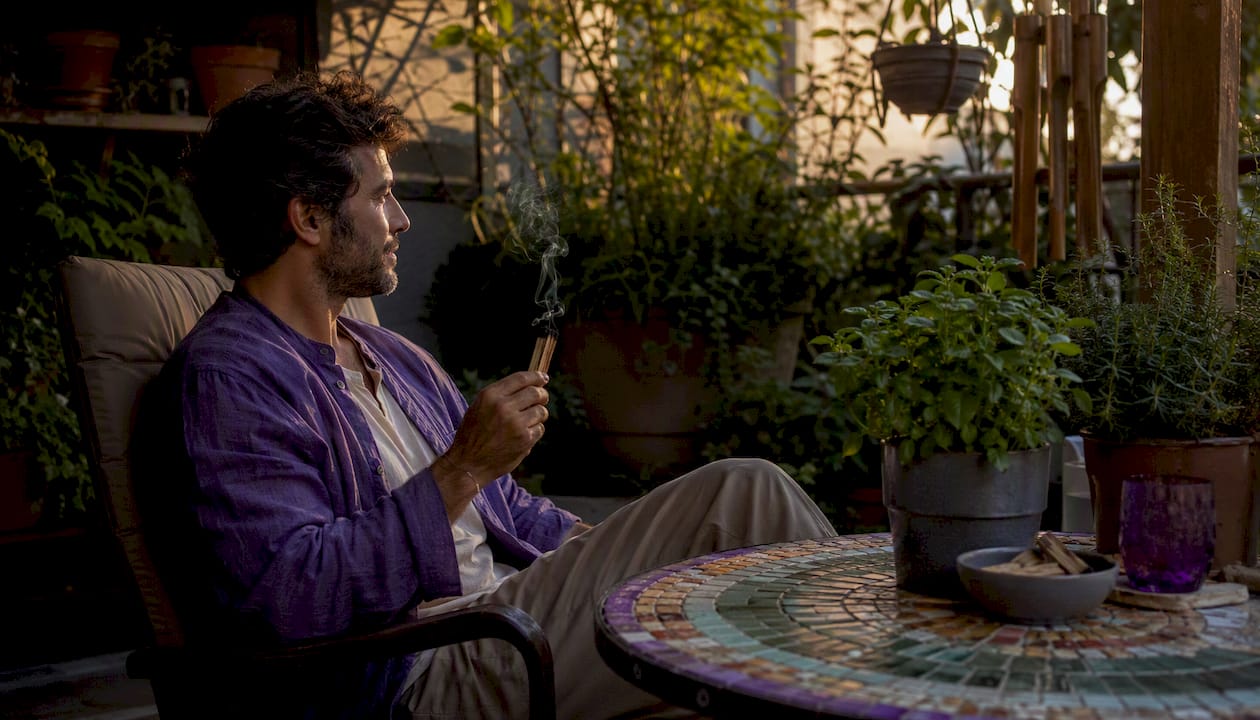
Smudging is a specific ceremonial practice belonging to many Indigenous peoples of North America. It involves particular sacred plants (white sage, cedar, sweetgrass, and others), specific protocols, and a spiritual context that is inseparable from those traditions. It is not a generic term for burning herbs.
Smoke cleansing is the broader, cross-cultural practice of using herbal smoke for purification, protection, or prayer. It belongs to virtually every human culture in some form: Celtic saining with juniper, Hindu havan ceremonies with havan samagri, Australian Aboriginal smoking ceremonies, Himalayan juniper offerings, and frankincense in North African and Arabian temples. Traditional smoke work used local plants — juniper in the Balkans, mugwort in Slavic rites — chosen by purpose and availability, not by trend.
If your ancestry connects you to European, Mediterranean, or Asian traditions, you have a rich lineage of smoke practices to draw from without borrowing from Indigenous protocols. If you feel called to use white sage specifically, source it from Indigenous-owned suppliers and use it with full awareness of its cultural weight.
White sage (Salvia apiana) is also on the United Plant Savers at-risk list due to commercial overharvesting. Favoring garden-grown or locally abundant plants is both an ethical and ecological choice.
Safety, health, and ethical sourcing: a practical checklist
Fire safety:
- Always use a fireproof dish or vessel — ceramic, cast iron, or abalone shell.
- Handle charcoal discs with metal tongs only; they reach temperatures that cause instant burns.
- Never leave smoldering material unattended, even briefly.
- Extinguish bundles by pressing firmly into the dish; do not blow on them.
- Let ash cool completely before disposing of it.
Health and ventilation:
- Open windows in every room before you begin.
- If you have asthma, COPD, or significant respiratory sensitivity, use aromatherapy mists or sound instead of smoke.
- Birds are especially vulnerable to smoke and airborne particles — remove them from the home entirely before any burning.
- Cats and dogs with respiratory conditions should also be kept out of the room.
- If a smoke detector triggers, stop immediately, ventilate fully, and check your building’s rules before resuming.
Ethical sourcing:
- Prioritize garden-grown or locally abundant botanicals over commercially wild-harvested ones.
- If purchasing white sage or palo santo, verify the supplier’s harvesting practices and prefer Indigenous-owned or certified-sustainable sources.
- Avoid bundles with no sourcing information on the label or website.
Building and lease considerations: Some apartment leases prohibit open flames or burning materials. Check your lease before your first session, and temporarily disable smoke detectors only if you can reactivate them immediately afterward. Never disable a detector and leave the space.
When should you cleanse, and how often?
There is no mandated frequency. Most practitioners cleanse as needed rather than on a fixed schedule, and that approach is both practical and energetically sound.
Common triggers for a cleanse:
- After an argument or emotionally charged conversation in the space
- Following illness in the household
- Moving into a new home or office
- After hosting a large gathering
- When a room simply feels heavy or stagnant without an obvious cause
Maintenance rhythms vary widely. Some practitioners do a quick weekly pass through their main living area — five minutes with a rosemary bundle — and reserve a full room-by-room cleanse for monthly or seasonal moments. Solstices and equinoxes are natural reset points that many practitioners mark with a deeper ritual.
A practical weekly routine might look like this: light a small rosemary bundle on Sunday evening, set a single intention for the week ahead, and move through your main living space in under ten minutes. A post-conflict deep cleanse, by contrast, might involve all three rooms, a heavy-duty resin blend, and a full hour of deliberate attention to every corner and threshold.
Practitioner tips and common mistakes that undermine your cleanse
The most common beginner mistake is skipping a stated intention. Without it, the ritual becomes aromatherapy — pleasant, but not an energetic reset. State your intention aloud before you light anything.
Other mistakes worth avoiding:
- Ignoring corners and dead zones. Energy stagnates in the physical geometry of a room. Behind doors, inside closets, and in ceiling corners are the spots most practitioners miss — and the spots where stagnant energy returns fastest.
- Over-relying on commercial bundles. Many mass-market bundles burn unevenly, contain filler herbs, or have no sourcing transparency. Growing your own or buying from a vetted supplier gives you a more reliable, ethical product.
- Excessive smoke indoors. More smoke does not mean a deeper cleanse. A steady, thin smolder is more effective and far safer than a thick cloud.
- Skipping the self-cleanse. Passing smoke over your own body before moving through the space is not optional — it is the step that keeps you from carrying the energy you are trying to clear.
Refinements that make results last:
After clearing with sage or mugwort, finish with a sealing step. Palo santo, copal, or a short spoken blessing signals that the clearing is complete and invites in what you want to call forward. This two-part structure (clear, then seal) is what separates a lasting energetic shift from a temporary one.
Pro Tip: Target the space behind every door in the room — most practitioners walk past these spots entirely. Spend an extra five seconds directing smoke into that hidden corner, and you’ll notice the room holds its clarity noticeably longer.
Key Takeaways
Botanical smoke cleansing works when you combine a clearly stated intention, proper ventilation, and deliberate smoke direction into corners and dead zones — with ethically sourced, garden-grown botanicals whenever possible.
| Point | Details |
|---|---|
| Intention is the active ingredient | State your purpose aloud before lighting anything; silent intention alone does not create an energetic reset. |
| Ventilation is non-negotiable | Open windows in every room before you begin and keep them open for at least fifteen minutes after. |
| Prioritize local and garden-grown herbs | Rosemary, garden sage, and lavender are effective, sustainable, and free from the sourcing concerns tied to white sage. |
| Target corners and dead zones | Behind doors, inside closets, and ceiling corners hold stagnant energy; linger there for five to ten seconds each. |
| Kejiwastore’s curated supplies | Kejiwastore offers ethically sourced smudging herbs and botanical aromatherapy mists for practitioners who want ready-made, vetted options. |
Why sourcing and intention matter more than the herb you choose
The conversation in smoke-cleansing circles tends to fixate on which herb is most powerful. That framing misses the point. The herb is a vehicle. What actually determines whether a cleanse lands is the clarity of your intention and the quality of your attention as you move through the space.
White sage became the default in mainstream wellness culture largely because it was marketed aggressively, not because it is inherently superior to rosemary, garden sage, or juniper. Those plants have centuries of documented use in European and Mediterranean folk traditions, they grow abundantly in most US climates, and they carry no ethical baggage. A rosemary bundle you grew yourself, harvested with care and dried properly, will outperform a shrink-wrapped commercial bundle every time — not because of the plant’s chemistry, but because of the relationship you built with it.
The ethics question is also not just about cultural respect, though that matters enormously. It is about energetic coherence. If you are using a plant harvested without permission from overstressed wild populations, that history is part of what you are bringing into your space. Sustainable sourcing is not a footnote to the practice. It is the practice.
Ready-made botanical supplies from Kejiwastore
If you want to skip the sourcing research and start cleansing today, Kejiwastore’s curated collection has you covered.
Kejiwastore offers handcrafted smudging herbs and botanical bundles sourced with the same ethical standards this guide recommends, alongside a full range of botanical aromatherapy mists for practitioners who need a smokeless option. Every product is small-batch, intentionally crafted, and made with organic or wild-harvested ingredients. Whether you are building your first cleansing kit or restocking a well-worn practice, browse the Kejiwastore collection and find what resonates with your ritual.
Useful sources and further reading
These are the primary sources behind this guide, organized by what each one offers:
- Mountain Rose Herbs: Smoke Cleansing Around the World — Cross-cultural history, terminology guidance (smudging vs. smoke cleansing), and sourcing ethics. Start here for cultural context.
- Insights by Omkar: Smoke Cleansing Ritual — Detailed step-by-step ritual instructions, materials list, timing, and aftercare. Best for beginners building their first full ritual.
- Aromatic Medicine School: Aromatic Herbs for Smoke Cleansing — Herbalist perspective on bioregional botanicals, garden-grown alternatives, and sustainable practice.
- Lhasa Remedy: How to Cleanse Your Space with Incense — Cross-cultural incense traditions including Himalayan and Tibetan practices; useful for finding your own ancestral smoke tradition.
- HerLux Rituals: Sacred Smoke Cleansing — Practitioner-focused guide emphasizing intention-setting and the distinction between ritual and aromatherapy.
- Esoteric Universe: Clearing Herbs Guide — Detailed profiles of resins and herbs including frankincense, copal, and dragon’s blood; useful for building layered blends.
- United Plant Savers: Species at Risk List — The authoritative US reference for at-risk plant species, including white sage. Check here before purchasing any wild-harvested botanical.